


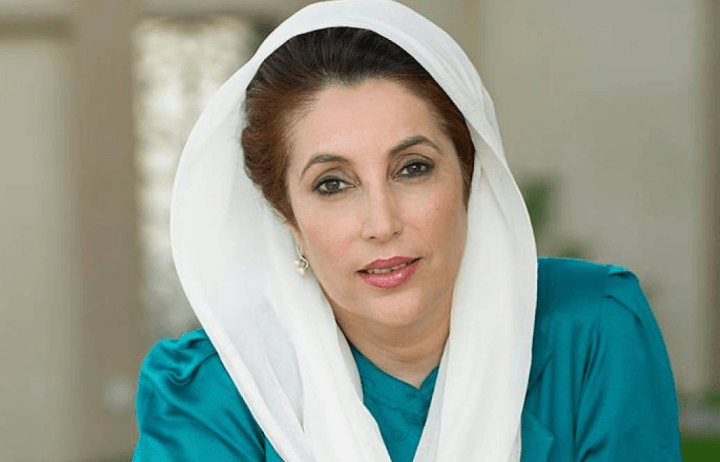
ISLAMABAD: More than 18 years after her assassination, Benazir Bhutto's influence continues to resonate well beyond Pakistan's borders.
In his first encyclical, Pope Leo XIV placed Pakistan's former prime minister alongside some of history's most revered champions of human dignity and social progress, offering a rare international acknowledgment of her democratic legacy and the sacrifices she made in public life.
As the only Muslim figure cited in the passage, Bhutto's inclusion underscores the enduring global relevance of her advocacy for democracy, pluralism, and resistance to political extremism.
Bhutto appears by name in Magnifica Humanitas, the papal document released in May, where Pope Leo XIV highlights individuals whose lives and contributions, according to the Vatican's official text, “contributed to making history more humane.”
In Paragraph 124 of the 245-paragraph encyclical, she is mentioned alongside globally recognized figures, including Martin Luther King Jr., Nelson Mandela, Mother Teresa and Marie Curie, individuals whose achievements transcended national borders and left a lasting mark on humanity.
The recognition is particularly notable because Bhutto is the sole representative of the Muslim world in that section of the document.
Every other figure cited is associated with the Christian tradition or Western intellectual history.
Among the 57 member states of the Organization of Islamic Cooperation, no other leader or public figure is mentioned.
The encyclical itself is addressed not only to the world's 1.3 billion Catholics but, as Pope Leo writes, to “all people of goodwill,” giving the document significance well beyond the Catholic Church.
Pakistan's first female prime minister
Bhutto's place in the text reflects a legacy that continues to command international attention decades after she first entered office.
In 1988, she became Pakistan's first female prime minister and the first woman elected to lead a Muslim-majority nation, breaking political barriers across the Islamic world and emerging as one of the most prominent democratic leaders of her generation.
She served as prime minister twice, from 1988 to 1990 and again from 1993 to 1996.
After years in exile, she returned to Pakistan in 2007 to contest elections and revive the democratic process, but was assassinated in Rawalpindi on December 27 that year while campaigning for a third term.
Significantly, the Vatican does not invoke Bhutto's religious identity. Instead, the encyclical recognizes her public service and commitment to democratic principles.
According to The Pillar's reader's guide to the document, she is included among figures who “changed history by their defense of human dignity.”
The company she keeps in the text underscores the weight of that recognition.
The list includes canonized Catholic saints, Nobel Prize winners, pioneering educators, environmental advocates and civil rights leaders whose contributions reshaped societies across continents.
Bhutto is the only Muslim and the only political leader from Asia named in that section.
Within that broader moral appeal, Bhutto's inclusion serves as a powerful reminder of the values the Pope seeks to elevate: courage in public service, commitment to democratic ideals and the defense of human dignity in the face of violence and extremism.
For Pakistan, the acknowledgment amounts to a rare tribute from one of the world's most influential religious institutions.
Bhutto's legacy places her among a select group of historical figures whose lives continue to be seen as examples of humanity's capacity to advance justice, freedom and human progress.
AI and implications for humanity
The encyclical, subtitled "On the Safeguarding of the Human Person in the Time of Artificial Intelligence," was signed on May 15 and formally presented by Pope Leo XIV at the Vatican's Synod Hall.
It represents the Catholic Church's first comprehensive doctrinal statement on artificial intelligence and its implications for humanity.
Its central argument is that technological progress must remain anchored in ethical responsibility.
The document calls for artificial intelligence to be regulated, made transparent and prevented from exercising autonomous lethal decision-making, insisting that human dignity must remain at the center of emerging technologies.