



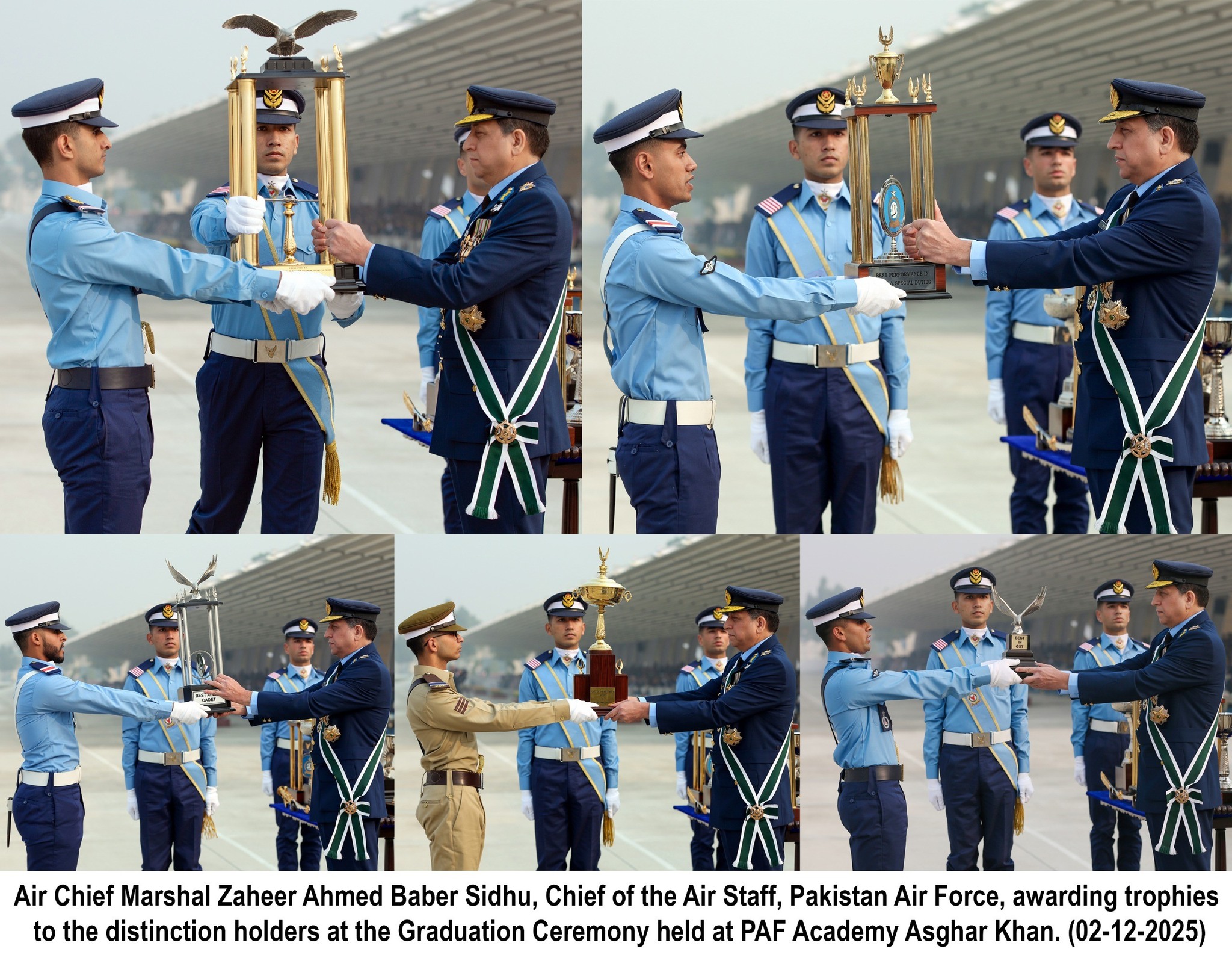
ISLAMABAD: Pakistan Air Chief Marshal Zaheer Ahmed Baber Sidhu used the passing out parade at PAF Academy Risalpur on Tuesday to praise graduating cadets while declaring that the Pakistan Air Force (PAF) had demonstrated clear superiority over India during the May conflict.
Congratulating the newly commissioned officers, he commended the “graduating cadets, distinction holders, [and] winners of swords of honor,” and extended special appreciation to the Royal Saudi Air Force cadets.
Their presence, he said, reflected the “strong friendship and cooperation between our two great nations and their armed forces.”
Addressing the parade, Sidhu told the cadets they were entering “one of the most distinguished, respected and professional air forces of the world,” and now carried “the hopes of the entire nation” as defenders of Pakistan’s airspace.
He highlighted what he described as a major transformation in PAF training, built around “future-focused technological interface with equal emphasis on character, leadership, intellectual prowess, mental resilience, and physical robustness.”
This, he said, had prepared graduates for the “evolving battle space shaped by emerging technologies.”
Turning to regional tensions, the Air Chief said Pakistan was “living in challenging times,” and warned adversaries of seeking to “undermine the sovereignty of this beloved country.” Referring to the confrontation with India in May, he said that “the people of Pakistan and its armed forces defeated the enemy with far greater numerical might.”
Sidhu said the PAF conducted “full-spectrum multi-domain operations” involving space, cyber, electronic warfare, long-range vectors, unmanned aerial systems, and loitering munitions.
He asserted that during the intense aerial engagements of May 6-7, the PAF “shot down the enemy’s most modern and capable aircraft,” including Rafale, Su-30MKI, Mirage 2000, MiG-29 jets and unmanned systems, calling it “one of the most intense and longest BVR-versus-BVR battles of modern aerial history.”
He said Pakistan also responded to further Indian actions on May 10 with a “paralyzing punch,” striking “bases and ground assets deep into enemy territory,” but added that operations remained “calibrated and balanced with a single aim to ensure peace with honor.”
Linking battlefield performance to years of internal reforms, the air chief said the PAF had pursued an aggressive modernization and indigenization drive, including advanced combat systems and what he described as a “homegrown kill chain” enabled by unmanned platforms, electronic warfare and space-linked assets.
He praised the National Aerospace Science and Technology Park as a “strategic setup of national significance.”
Sidhu praised PAF personnel for their conduct, saying, “No doubt you fought aggressively in synergy with the sister services and the entire nation is proud of your courage and bravery.”

He contrasted Pakistan’s claims with those from India, saying PAF statements were “based on evidence and undeniable hard fact.”
Reiterating Pakistan’s broader stance, he said the country “wishes to maintain friendly relations with all, especially with our neighbors,” but warned that if national sovereignty was challenged, “our adversary will find Pakistan armed forces even harder and better prepared.”
He concluded by asserting that Pakistan had “successfully emerged as a net regional stabilizer” and that strengthened ties with global powers reflected “credible military progress” and the country’s strategic maturity.