


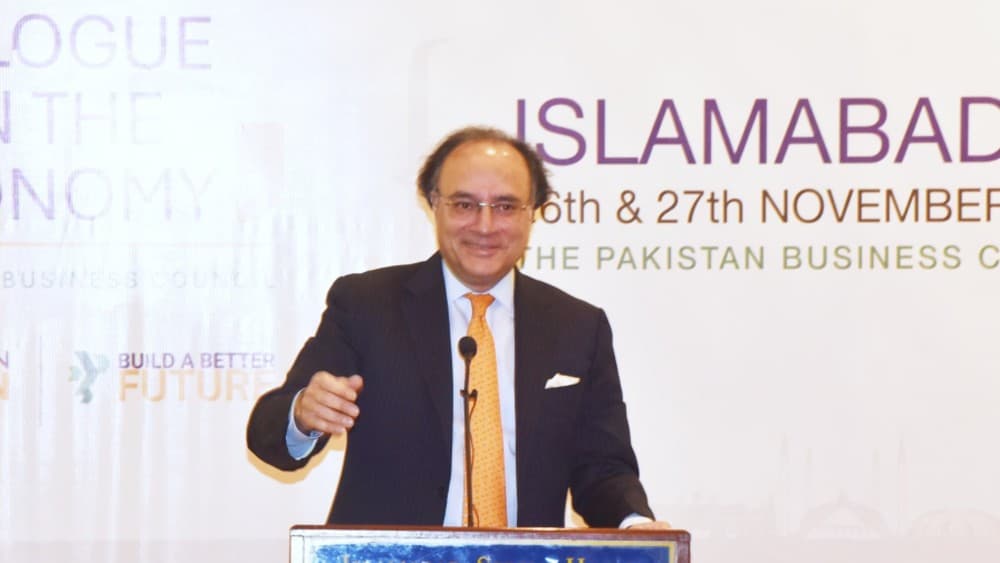
ISLAMABAD: After years of twin deficits, Pakistan has achieved fiscal and current account surpluses and is now pivoting toward export-led growth and structural reforms to secure long-term economic stability and investment opportunities.
This was stated in an article by Pakistan’s Finance Minister Muhammad Aurangzeb, published by USA Today on Dec. 22.
From deficits to surpluses
“The country’s long battle with twin deficits — fiscal shortfalls and external imbalances — appears to have taken a decisive turn,” Aurangzeb writes, adding, “For the first time in years, Pakistan has recorded a primary surplus on the fiscal side alongside a current account surplus.”
He credited remittance inflows for providing “much of the strength behind this improvement.”
Highlighting the country’s achievements on the economic front, Aurangzeb states, “inflation, once running at a crippling 38%, has fallen into the single digits, while foreign reserves have climbed to cover two and a half months of imports, surpassing $14.5 billion.”
“The rupee has also shown rare stability, reinforcing investor confidence that Pakistan has moved beyond its latest crisis cycle.”
Moving beyond consumption
About the country’s macroeconomic position, the Pakistani finance minister underlined that “the economy expanded by 2.7% in the last fiscal year, which, although positive, remains well below what is needed to generate employment for a rapidly growing population.”
Historically, Pakistan’s growth spurts have been fueled by consumption and debt, only to collapse into renewed balance-of-payments problems.
This time, Aurangzeb insists, the strategy is different.
Export-led growth
The government is steering toward export-led growth, supported by a new budget that introduces structural reforms in taxation, energy, and state-owned enterprises.
Tariff reform, in particular, is designed to end decades of protectionism and force industries to become globally competitive.
As the minister noted, “If they are competitive, then we move towards export-led growth.”
This shift also reflects a recognition that global demand is changing, and Pakistan must carve out its share in international markets.
Information technology services, textiles, and agricultural exports are areas where the government sees potential to scale up and capture greater value.
The finance minister writes that, “Pakistan’s IT exports surpassed four billion US dollars last year, and officials believe this figure could double within five years if regulatory clarity and infrastructure investments continue.”
“The finance ministry has also been working to simplify tax regimes for exporters, aiming to reduce the bureaucratic bottlenecks that have often discouraged competitiveness,” he writes.
Aurangzeb underlines that “By redirecting focus from short-lived consumption to long-term productivity, Islamabad is trying to rewrite the country’s economic playbook.”
Resilience for long term
“Beyond fiscal stability, Pakistan’s reform agenda is broad and ambitious,” the finance minister writes, adding, “Privatization of state-owned companies, tariff liberalization, and new regulatory structures in the energy sector are intended to reduce inefficiencies that have long drained the exchequer.”
Aurangzeb stressed that these moves are about more than short-term savings.
The finance minister further states, “They form the foundation of what the World Bank has described as Pakistan’s potential 'East Asia moment,' recalling how liberalization spurred the economic rise of Southeast Asia.”
“Islamabad has already signed a landmark ten-year Country Partnership Framework with the World Bank, the first of its kind, which prioritizes climate resilience and population management alongside economic reform,” he adds.
Existential priorities
“Population growth and climate change,” Aurangzeb underscores, are “existential challenges that must be addressed urgently.”
“Child stunting, learning poverty, and especially the exclusion of girls from education risk constraining the country’s productive capacity for generations.”
“We have to address that.”
On climate, the minister writes, “Pakistan is leveraging technical assistance and financing from multilateral institutions to build resilience against increasingly severe floods and droughts.”
Risks on the horizon
Aurangzeb states, “Global commodity price shocks, particularly in oil, could undo some of the progress on inflation and the current account.”
“Political instability remains a perennial concern, with reforms often stalling amid shifting alliances.”
The finance minister maintains, “The burden of external debt also looms large, making Pakistan dependent on continued discipline and international support.”
Opportunities for investors
About opportunities for investors, Aurangzeb writes that “agriculture remains a priority”, adding, “minerals and mining sector is another area drawing attention.”
“The Tethyan Copper Belt in Balochistan, home to one of the country’s first copper projects, is being framed as a supply-side answer to global shortages.”
Aurnagzeb states, “The government is also focusing on the new economy — data centers, artificial intelligence, and other digital services.”
Regulatory frameworks are being updated to ensure Pakistan is not left behind in emerging sectors.
“Technology change is a real game changer for Pakistan,” writes Aurangzeb, encouraging US investors to take a closer look.
Message to the world
In his message to the world, Aurangzeb writes: “Come and visit us. It can be trade or investment. But most of all, it’s a beautiful country.”
“By marrying structural reform with an invitation to partnership, Pakistan is presenting itself not as a perennial risk story but as an emerging opportunity in South Asia.”
“Investors willing to look beyond past turbulence may find in today’s Pakistan a market at the cusp of transformation,” he concludes.