


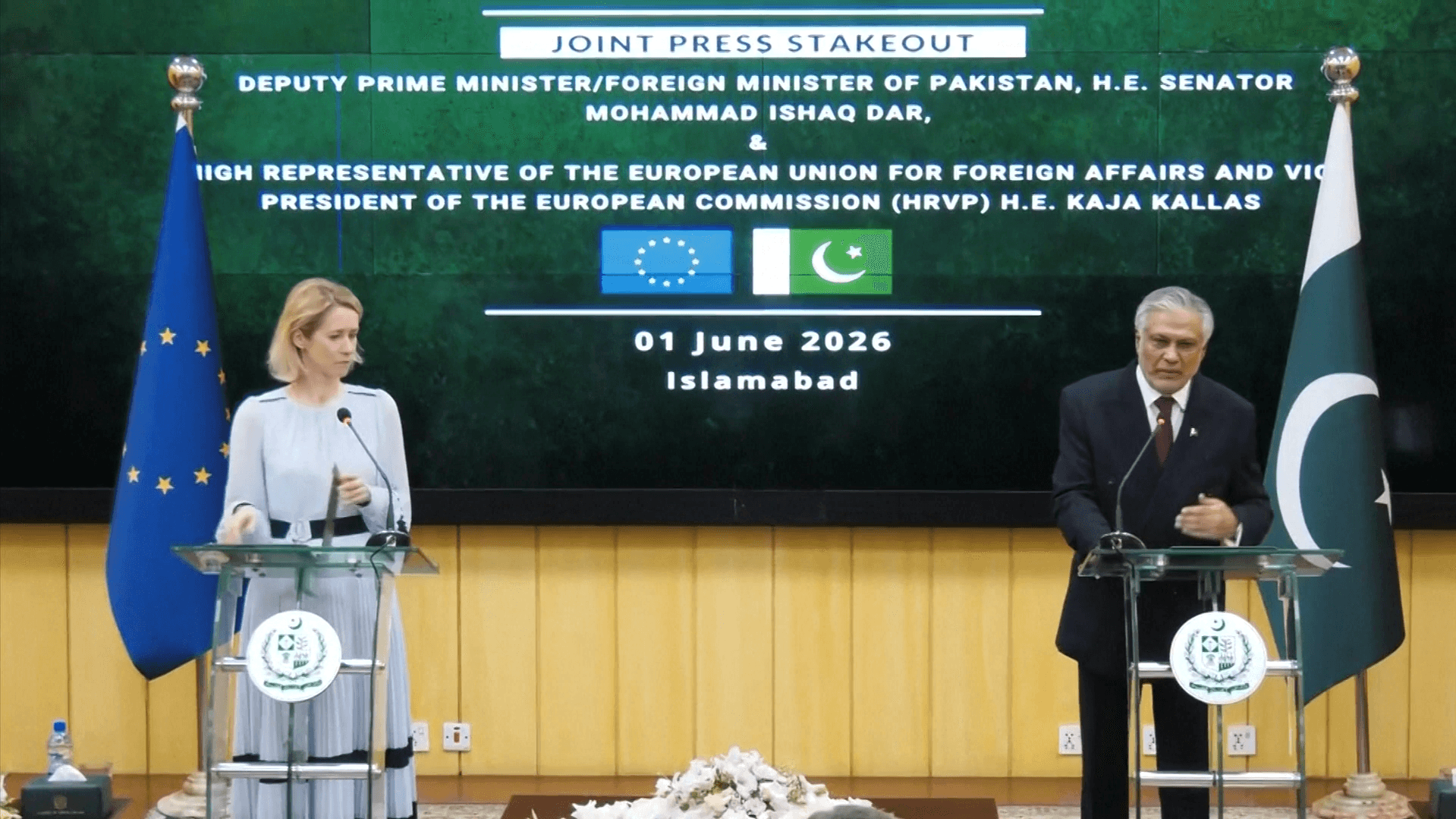
ISLAMABAD: European Union's High Representative of the European Union for Foreign Affairs and Security Policy, Kaja Kallas, credited Pakistan on Monday with preventing a return to full-scale war in the Middle East, saying Islamabad's mediation had been decisive in keeping a fragile peace intact.
"Your diplomatic efforts have helped to prevent a return to full-blown war on several occasions, and these efforts are much recognized and appreciated across Europe," Kallas said at a press conference following the 8th round of the Pakistan-EU Strategic Dialogue in Islamabad.
Kallas said Pakistani mediation had produced a tenuous diplomatic opening to extend the ceasefire and reopen the Strait of Hormuz, but warned that any temporary arrangement between Washington and Tehran would need to be followed by substantive negotiations over Iran's nuclear stockpile.
She said that the EU was prepared to play a direct role in any eventual settlement, through maritime operations, economic leverage, nuclear expertise and its existing relationships across the Gulf and with Tehran.
The joint communiqué issued after the talks formally commended Pakistan for hosting the Islamabad Talks between the two sides and called for a negotiated resolution of all outstanding issues, including unimpeded passage through the Strait of Hormuz.
Islamabad, in turn, acknowledged EU backing for its mediation role.
The dialogue was co-chaired by Kallas and Pakistan’s Deputy Prime Minister and Foreign Minister Ishaq Dar at the Ministry of Foreign Affairs. According to the country’s Foreign Office, Kallas also met separately with Prime Minister Shehbaz Sharif and Chief of Defense Forces Field Marshal Syed Asim Munir.
On the Pakistan-Afghanistan front, Kallas said weeks of fighting had produced grave humanitarian consequences and risked deepening instability and radicalization in the region. She also acknowledged Pakistan's right to self-defense under international law.
Trade formed a substantial part of the discussions. Kallas said the EU is Pakistan's largest export market, ahead of China and the United States combined. She stated that Pakistan is also the world's top beneficiary of EU trade preferences under the GSP+ scheme.
The EU foreign policy chief said continued access to the EU market is contingent on measurable progress on labor rights, human rights, environmental standards and governance. According to the joint communiqué, Pakistan expressed interest in joining the EU's new GSP+ regulation, and both sides agreed to work toward meeting the relevant conditions.
The communiqué also cited the first EU-Pakistan Business Forum, held in Islamabad on April 28-29, as evidence of growing economic engagement. The forum launched the EU-Pakistan Business Network, and both sides agreed to convene it periodically.
Kallas noted that Pakistan leads the EU's global Erasmus Mundus scholarship rankings for the fifth straight year.
On migration, both sides agreed to continue implementing the Pakistan-EU Talent Partnership Roadmap and to coordinate efforts to combat migrant smuggling and human trafficking. The communiqué committed both parties to the framework of the UN Global Compact for Safe, Orderly and Regular Migration.
The communiqué backed the UN Charter's core principles of sovereignty, territorial integrity, non-interference and the non-use of force. It also welcomed UN Security Council resolution 2788, passed unanimously in July 2025 under Pakistan's presidency of the Council.
Both sides also pledged to support the UN80 initiative to keep the organization effective and fiscally efficient.
On Gaza, both sides called for full adherence to ceasefire commitments, unobstructed humanitarian access and a permanent end to hostilities. They expressed concern over conditions in the occupied West Bank, called for an end to illegal settlement activity, and backed a two-state solution consistent with international law.
On Lebanon, both sides backed its sovereignty and stability and called for coordinated international efforts toward a lasting resolution.
Pakistan briefed the EU on Jammu and Kashmir. The EU briefed Pakistan on Russia's war in Ukraine. The two sides backed peaceful resolution through dialogue, according to the communiqué.
They also discussed counterterrorism cooperation under the 2019 Strategic Engagement Plan. The communiqué expressed serious concern over terrorist entities operating in Afghanistan and called on Afghan de facto authorities to take effective, verifiable action against all such groups. Both sides noted the deteriorating rights situation in Afghanistan, particularly restrictions on women's access to education and public life.
The EU and Pakistan agreed to hold the 9th round of the Strategic Dialogue in Brussels.