


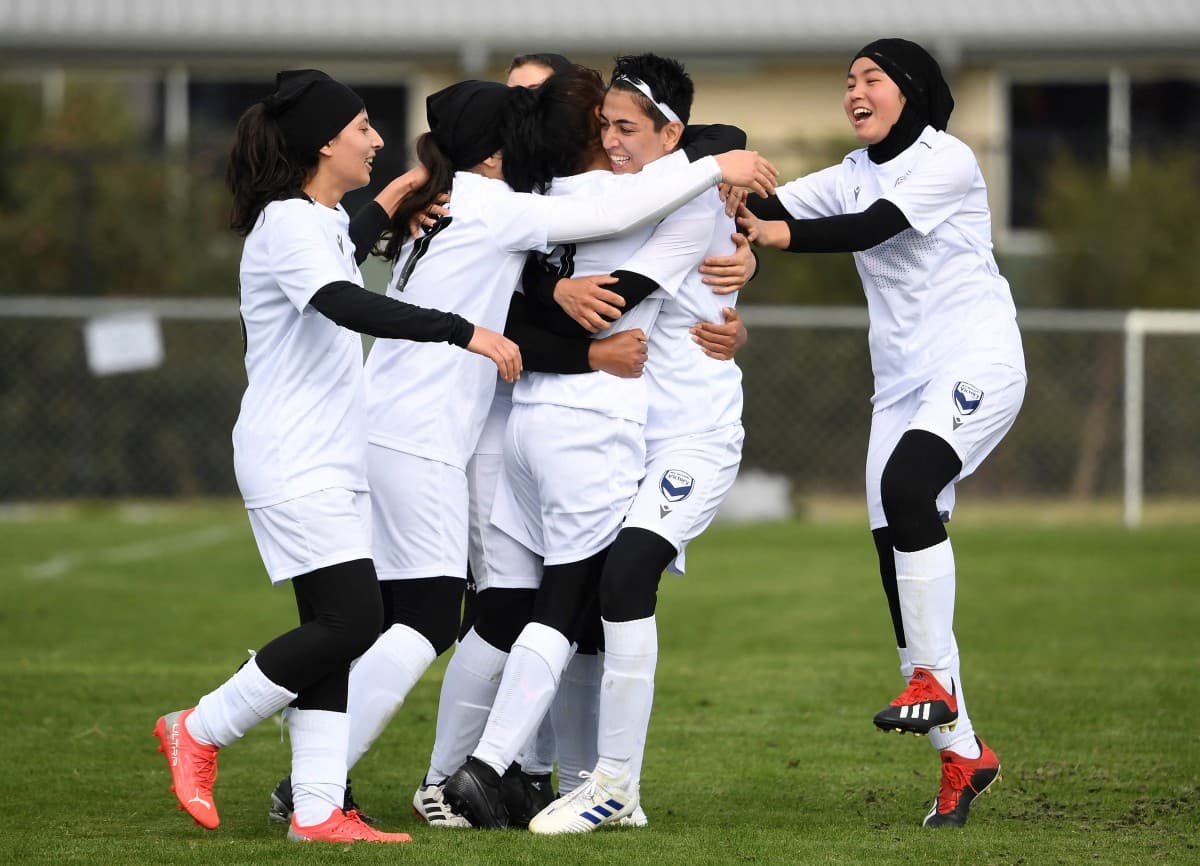
ISLAMABAD: Afghan women footballers are set to return to international competition after FIFA approved a regulatory change allowing teams to be recognized under exceptional circumstances.
The decision, taken at a FIFA Council meeting in Vancouver this week, comes after years in which Afghan women were unable to compete internationally following the Taliban’s return to power in 2021 and the subsequent ban on women’s sports in Afghanistan. The national team has not played a competitive international match since December 2018.
Under the amended governance rules, FIFA may now approve the registration of a national or representative team even if it is not formally recognized by its member association, in this case, the Afghanistan Football Federation. The change is intended to prevent players from being excluded from international football due to “situations beyond their control,” according to FIFA.
The ruling effectively clears the way for Afghan women players, many of whom have fled the country to represent Afghanistan in officially sanctioned matches with full recognition.
“We are proud of the beautiful journey initiated by Afghan Women United,” FIFA President Gianni Infantino said, referring to a refugee-based squad supported by FIFA. “We aim to enable them, as well as other member associations that may not be able to register a national team, to make the next step.”
The Afghan Women United program was launched as a one-year pilot in 2025 after sustained lobbying from displaced Afghan players. The team has already competed in the FIFA United Women’s Series, recording its first victory against Libya in November.
More than 80 Afghan women footballers are currently based in countries including Australia, the United States, several European nations and parts of the Middle East. Many were among the 25 players who held contracts with the national setup before the Taliban takeover.
FIFA said regional selection camps are underway in England and Australia ahead of a training camp in New Zealand scheduled for June. The team is expected to return to action later this year.
However, Afghanistan will not be eligible to qualify for the 2027 Women’s World Cup under the current arrangement. The team could, however, compete in qualification pathways for the 2028 Olympic Games.
Popal, who has long advocated for Afghan women’s football from exile, said the development represents both opportunity and responsibility.
“Our team has always been known as an activist team,” she told Reuters. “But this opportunity, with the right support from FIFA, will be the time for us to also show some skills and develop youth talent in the diaspora.”
She acknowledged the limitations facing women still inside Afghanistan, where opportunities to play remain severely restricted.
“I know it’s going to be tough because Afghan women inside Afghanistan will struggle to be part of that,” she said. “But if we can still be the voice for them and send messages of hope, then we will continue to use our platform.”
The move marks one of FIFA’s most significant interventions in recent years on behalf of displaced athletes, and is expected to set a precedent for how the governing body handles teams affected by political upheaval and restrictions on women’s sports.