


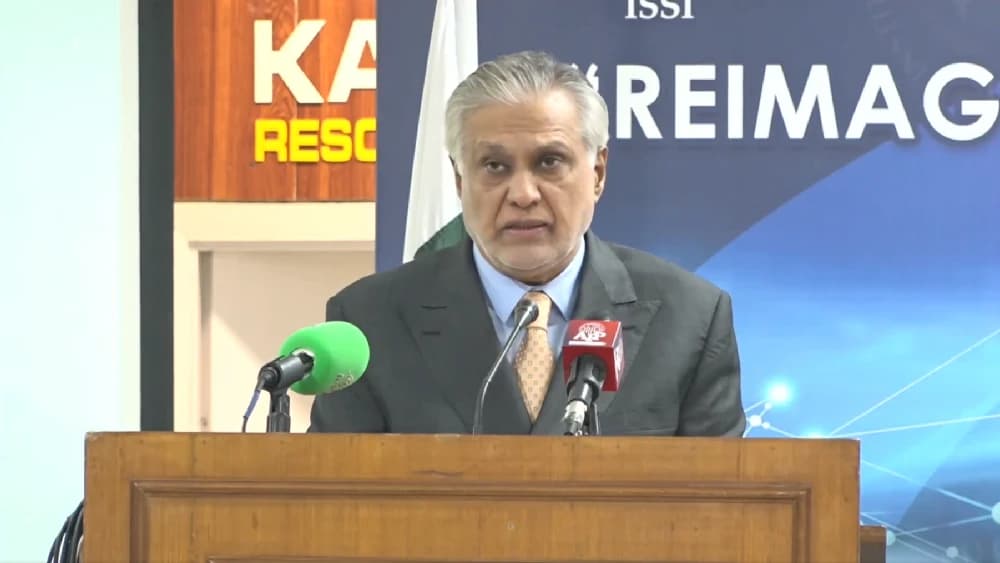
ISLAMABAD: Deputy Prime Minister and Foreign Minister Ishaq Dar said on Wednesday that the region’s development challenges, including poverty, inequality and low intra-regional trade, necessitate a revival of regional platforms such as SAARC.
"Stronger regional cooperation is needed to address mounting security and climate challenges", addressing the Islamabad Conclave 2025, organized by the Institute of Strategic Studies Islamabad (ISSI).
South Asia must move towards dialogue and collective action to ensure long-term stability.
Dar said Pakistan believed regional peace was achievable only through engagement, confidence-building measures and a commitment to resolving disputes through peaceful means.
Dar said global tensions, from Europe to the Middle East, had heightened uncertainty and placed multilateral institutions under stress. He said unilateral actions by some states had weakened global consensus. “Multilateralism is under assault,” he cautioned, urging countries to restore trust in diplomacy and international norms.
Recalling the brief but serious military confrontation between Pakistan and India earlier this year, Dar said the incident underscored the urgency of reducing regional risks. He said the episode carried “the potential to escalate far beyond its duration,” and highlighted the need for crisis-management mechanisms and sustained communication.
The foreign minister said South Asia’s security environment remained sensitive due to the presence of three nuclear-armed neighbors, continued arms buildup and the introduction of advanced weapons systems. Long-standing disputes, particularly the Jammu and Kashmir issue, continued to pose challenges to peace, he added.
Dar said Pakistan remained committed to a cooperative regional framework that rejected bloc politics and zero-sum approaches. He said Pakistan’s upcoming term as a non-permanent member of the UN Security Council would be used to advance dialogue, conflict prevention and equitable development.
The foreign minister also highlighted the growing impact of climate change, noting that rising temperatures, floods, droughts and glacial melt were directly affecting South Asia’s food and water security. He called for deeper regional investment in renewable energy, climate adaptation and disaster preparedness.
“Pakistan envisions a South Asia where connectivity replaces confrontation, and cooperation drives prosperity,” he said, adding that Pakistan stood ready to work with all regional partners to build a stable and secure future for the people of South Asia.