


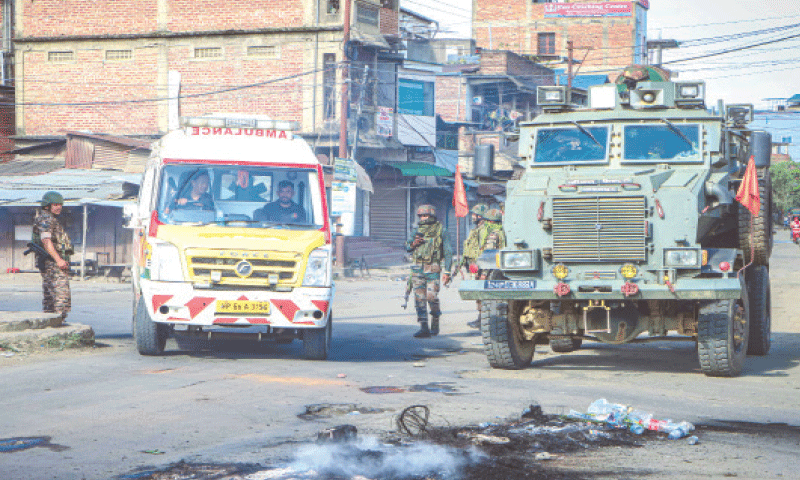
ISLAMABAD: Indian security forces say they arrested two men linked to a separatist group and seized weapons Tuesday in Manipur, a state bordering Myanmar, locked in ethnic civil conflict for nearly three years, drawing repeated warnings from the United Nations of humanitarian collapse.
Indian authorities claim that both men are members of the People's Liberation Army of Manipur, a group advocating for Manipur's independence from India that New Delhi has designated a terrorist organization, according to The Hindu.
Police say they recovered a double-barrel gun, a country-made pistol, 181 rounds of ammunition, two hand grenades, and a detonator in Imphal West district, Manipur Police said in a statement reported by local Indian media.
The arrests come as Manipur's hill-dwelling Kuki-Zo people — predominantly Christian tribal communities — continue to bear the highest cost of a conflict India has struggled to contain or explain to the outside world.
Violence erupted in May 2023 after a court directed authorities to consider granting the majority Meitei — a valley-dwelling Hindu community with outsized political influence — expanded indigenous land protections. Kuki-Zo groups feared this would expose their constitutionally protected ancestral hill territories to encroachment, according to UN Special Rapporteurs.
The International Work Group for Indigenous Affairs has noted that many indigenous groups already view Manipur's 1949 merger into the Indian Union as forced, a grievance that has fueled secessionist movements for decades.
What followed the 2023 violence was a virtual partition of the state, with peace-building researchers describing the physical separation of communities as the most complete in the region's modern history.
The humanitarian toll has been severe. Tens of thousands remain in displacement camps with no clear path home, according to the Internal Displacement Monitoring Centre. By late 2024, approximately 80% of schools across the state were severely affected by curfews and ethnic segregation, impacting over 300,000 students, according to UNICEF.
Research published in 2025 found that roughly 1,200 teaching staff had been displaced and that academic records had been destroyed, making educational continuity nearly impossible in conflict zones. Internet shutdowns, among the longest in India's history, blocked digital learning entirely, disproportionately affecting tribal children, the same research noted.
Healthcare has collapsed along ethnic lines. The Safeguarding Health in Conflict Coalition and researchers from The Lancet documented at least eight major attacks on health facilities in 2024 alone, including grenades delivered to hospitals and arson at medical centers.
Because major specialist hospitals are concentrated in the Meitei-dominated valley, Kuki-Zo residents in the hills have been completely cut off from critical care. Preventable deaths have risen among patients unable to cross hostile territory for emergency surgery or dialysis, the Coalition documented.
Blockades have caused critical shortages of life-saving medicines, routine immunizations, and maternal health supplies across hill districts, the same findings showed.
The UN has warned that rhetoric around identifying "outsiders" — pushed by local groups seeking a National Register of Citizens — risks fueling further ethnic cleansing. Amnesty International has accused Manipur's authorities of partisan policing that allowed militias on both sides to arm themselves with weapons looted from state armories.
Human Rights Watch and the UN High Commissioner for Human Rights have repeatedly cited India's Armed Forces Special Powers Act, which grants security forces broad immunity, as a structural driver of impunity that has deepened mistrust in state institutions over decades.
Separately, Manipur's newly appointed chief minister wrote to India's civil aviation minister this week requesting subsidized flights on the Imphal-Guwahati route. He said that air connectivity for Manipur's people was "not just a convenience but an essential requirement," according to Press Trust of India, India's national wire service. It is a telling measure of how isolated the state remains from the rest of the country.