


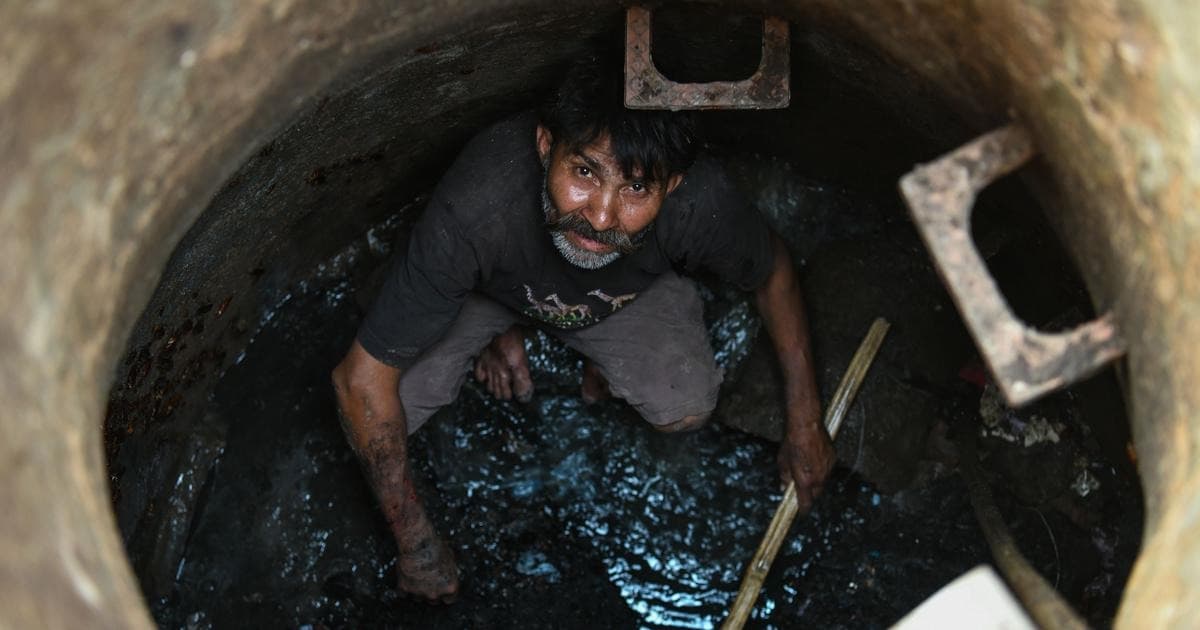
ISLAMABAD: The Union government in India has told Lok Sabha (Parliament) that 622 sanitation workers have died while cleaning sewers and septic tanks across India since 2017, even as it maintained that sanitation work is an “occupation-based” activity rather than caste-driven, Indian media reported on Friday.
In a written reply to the Lok Sabha on March 17, Minister of State for Social Justice and Empowerment Ramdas Athawale presented state-wise data on fatalities linked to hazardous sanitation work. The response came to a question raised by Samajwadi Party MP Iqra Choudhary.
According to the data, compensation has been fully disbursed to 539 affected families, while 25 families received only half payments. However, 52 families have not received any compensation at all, and six cases were closed without resolution. In Uttar Pradesh alone, 13 families received no compensation and three cases were closed.
The highest number of deaths was recorded in Uttar Pradesh (86), followed by Maharashtra (82), Tamil Nadu (77), Haryana (76), Gujarat (73), and Delhi (62). The government did not specify the amount of compensation paid in each case.
Athawale also stated that a “fresh survey” conducted under the Prohibition of Employment as Manual Scavengers and Their Rehabilitation Act, 2013 found no manual scavengers in any district of the country. This claim contrasts with earlier surveys in 2013 and 2018, which identified 58,098 manual scavengers nationwide, including 32,473 in Uttar Pradesh.
Activist groups have challenged the government’s position. In 2025, the Dalit Adivasi Shakti Adhikar Manch (DASAM) called for immediate FIR registrations and independent judicial inquiries into such deaths. The organization reported 116 deaths linked to manual scavenging in 2024 and 158 in 2025.
The issue has also drawn judicial scrutiny. In January last year, the Supreme Court of India ordered a ban on manual scavenging in six metropolitan cities, criticizing the Union government for ambiguity in its efforts to eradicate the practice.
Despite official claims of progress, complaints from workers persist. The government acknowledged receiving 842 complaints from across states and union territories, including 130 from Uttar Pradesh, citing issues such as unpaid wages, lack of safety equipment, and caste-based discrimination.
Under the National Action for Mechanized Sanitation Ecosystem (NAMASTE), aimed at improving safety and dignity for sanitation workers, 89,248 sewer and septic tank workers and 234,425 waste pickers have been validated as of March 12. This includes 12,424 sanitation workers and 35,641 waste pickers in Uttar Pradesh.
The government said earlier rehabilitation programs for manual scavengers have now been integrated into the NAMASTE scheme, which it claims will enhance worker safety and ensure full rehabilitation.
However, the continued deaths, compensation gaps, and worker complaints highlight ongoing concerns about the implementation of these measures and the persistence of hazardous sanitation practices in the country, the report said.