


NAROWAL: Every morning, Amrit Singh walks to the edge of the Kartarpur Corridor, gazing across the fence where the white domes of Dera Baba Nanak glimmer faintly in the distance. On quiet days, when the wind stills, he says he can almost hear the temple bells from across the border.
“It used to be full of voices,” Singh said softly, standing near the empty pathway that once brought pilgrims from India to Gurdwara Darbar Sahib.
“You’d hear hymns, laughter, greetings in Punjabi, people meeting after years. Now, it’s just silence.”
A lifelong resident of Narowal, Singh has lived most of his forty years within sight of the corridor. When it opened in November 2019, it felt to him like a “miracle,” a promise that faith could rise above politics.
“The corridor gave us hope,” he told Pakistan TV Digital. “It showed that people can come together, even if governments disagree. But now it’s just another locked gate between people who should be able to meet in peace.”
Corridor of peace
Once celebrated as a historic gesture of goodwill between Pakistan and India, the Kartarpur Corridor allowed Sikh pilgrims from India visa-free access to Gurdwara Darbar Sahib, the final resting place of Guru Nanak Dev Ji, the founder of Sikhism.
That promise dimmed after May 10, when a brief four-day military flare-up between the two nuclear-armed neighbors led to tit-for-tat restrictions. In the aftermath, New Delhi suspended the corridor, citing “security concerns,” and halted cross-border pilgrim movement. Pakistan, however, did not follow suit, keeping its side of the corridor open as what officials called “a gesture of faith and peace.”
“The corridor was meant to transcend politics. Today, politics has fenced it in,” said a senior official of the Pakistan Sikh Gurdwara Parbandhak Committee (PSGPC), which manages the site.
In September, the PSGPC organized a symbolic reception at Wagah to welcome Indian pilgrims, but none arrived. “We prepared the langar, we sang the shabads, we prayed,” the official said. “But no one came.”
Pakistan’s door remains open
Punjab Minority Affairs Minister Sardar Ramesh Singh Arora said Pakistan continues to keep its side of the corridor operational as a “symbol of welcome.”
“The Kartarpur Corridor was built after decades of requests from Sikh devotees,” Arora said in an interview with Pakistan TV Digital. “Since May, India has kept its side closed. In June, it also barred Sikhs from visiting Lahore for the death anniversary of Guru Arjan Dev Ji.”
To honor those who could not cross, the Evacuee Trust Property Board (ETPB) and the Ministry of Religious Affairs held a symbolic ceremony at Wagah for Indian Sikhs.
Despite the closure, Pakistan’s hospitality has continued. During the Baisakhi festival in April, Pakistan issued 6,800 visas to Sikh devotees; 5,700 pilgrims visited and praised Pakistan’s arrangements.
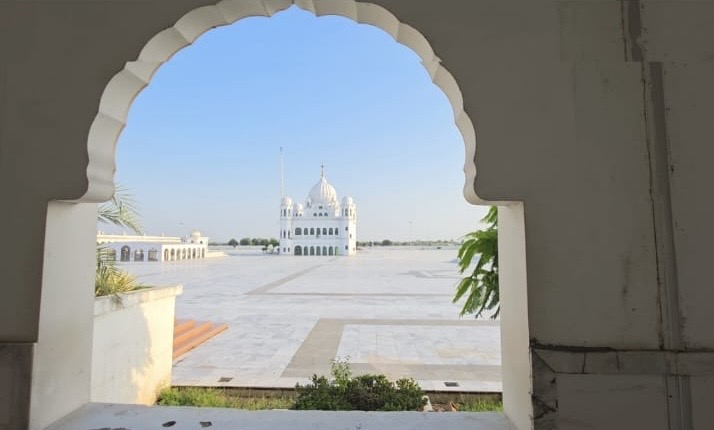
The Kartarpur Corridor gates remain open on Pakistan’s side in Narowal, Punjab, while the Indian border stays closed, October 2025. India has suspended the corridor since May 2025.
“Pakistan is the second home for Sikhs,” Arora said. “Even if the corridor on the other side remains closed, our doors are open. Kartarpur is not just a crossing point, it is a place of faith, and faith should never be fenced in by politics.”
Waiting for gates to reopen
For residents like Singh, who live close to the corridor, the silence feels deeply personal.
“When the corridor was open, our town came alive,” he said. “Pilgrims would stop at our shops, they’d share tea, stories, blessings. It wasn’t just good for business — it brought warmth, connection, and peace.”
But since India’s suspension of the corridor in May, that life has faded. The small tea stalls and guesthouses near the complex now sit mostly empty.
“We thought Guru Nanak’s message would keep this corridor open forever,” Singh said. “But faith alone cannot unlock a border.”
With Guru Nanak’s birth anniversary approaching next month, Pakistani authorities have made full preparations to receive Sikh pilgrims. However, visa delays and limited permits on the Indian side have dampened expectations.
Indian Sikh leaders and lawmakers from Punjab have publicly urged New Delhi to reopen the route, calling its continued closure a denial of religious rights and an unnecessary strain on border communities.
Faith beyond fences
Though the corridor agreement between Pakistan and India has been renewed until 2029, the suspension underscores how politics continues to overshadow faith.
“While some choose to spread propaganda, we choose to extend hospitality,” Arora said. “Our message is clear: the corridor of peace remains open from Pakistan’s side. Let faith speak louder than hate.”
As the sun sets over Narowal, the golden light washes over the white marble of Gurdwara Darbar Sahib. The Pakistani gate stands open. Silent, steady, and waiting.
Amrit Singh looks across the empty road once more. “Guru Nanak taught us that humanity comes before borders,” he said. “We’re still waiting, and we’ll keep waiting.”