

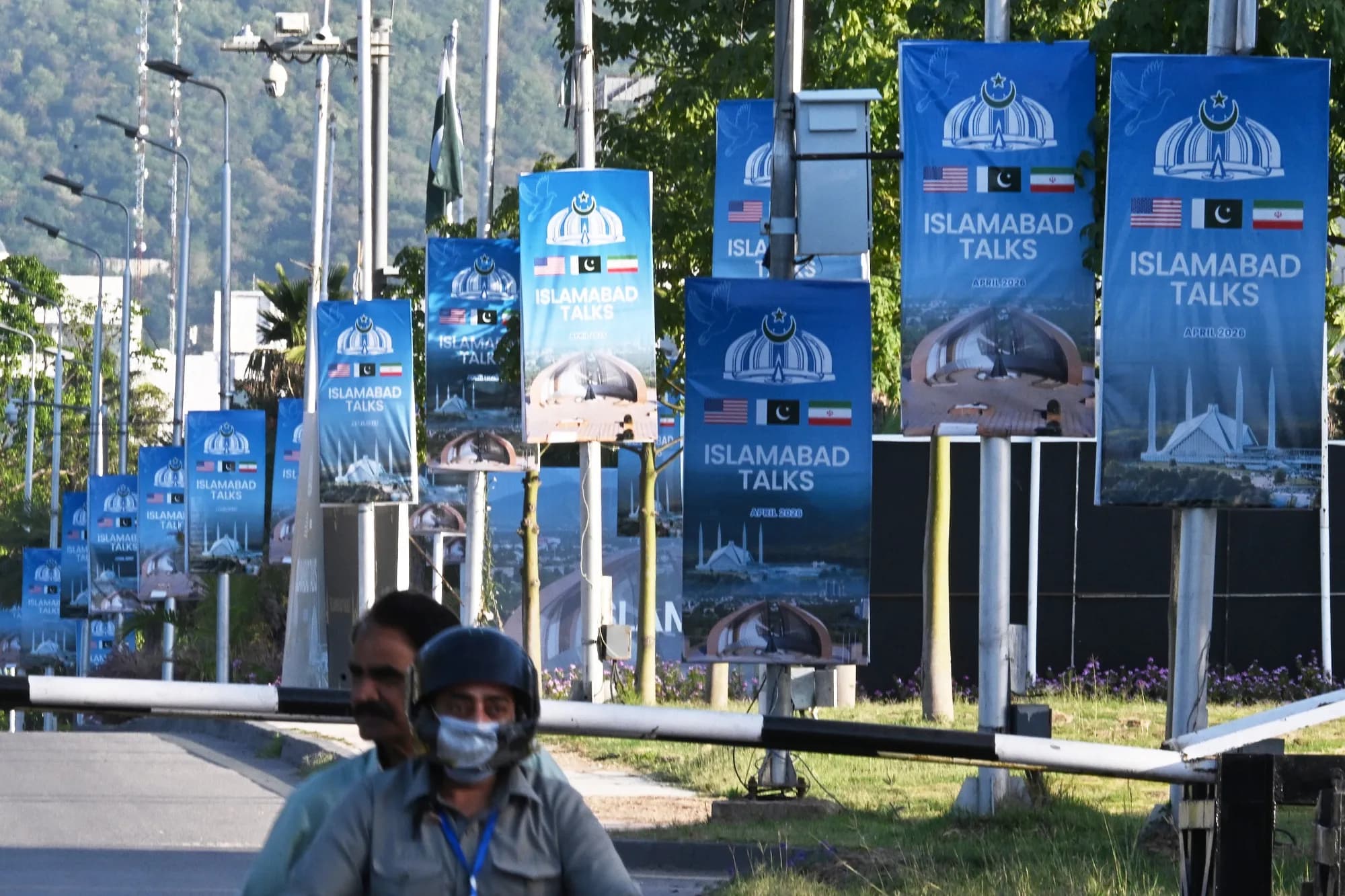
ISLAMABAD: The news cycle out of the Middle East runs on a reliable rhythm: an Iranian threat, an American countermove, oil prices spike, markets shudder. Since the United States and Israel launched strikes on Iran on February 28, that cycle has repeated often enough to feel permanent. It is not.
Beneath the escalatory optics – Iran's navy announcing the Strait of Hormuz "completely closed," the US blockade forcing two dozen ships to turn back, ballistic missiles exchanged across four Gulf states – a parallel track has been running without interruption.
Talks between Washington and Tehran have not stopped. The question shaping the next phase of this conflict is not whether a deal will be sought, but whether either government can sell one to its own people.
The economics of quitting
Iran's economy entered 2026 fractured. According to the International Monetary Fund's 2026 DataMapper projections, Iran's nominal GDP stands at $300.29 billion with per capita income of $3,410, masking severe conditions: the IMF projects a 6.1% real GDP contraction for 2026 with consumer price inflation at 68.9%. The World Bank reports a 2.7% GDP contraction in the 2025/2026 fiscal year and projects another 2.8% contraction for 2026, while the UN Development Programme notes that reimposed snapback sanctions on Iran's nuclear program have pushed larger segments of the population below upper-middle-income poverty thresholds.
A government presiding over 68.9% inflation, a contracting economy, and a population priced out of basic goods does not have indefinite latitude to sustain a full military confrontation with the world's largest economy.
The talks Trump says didn't stop
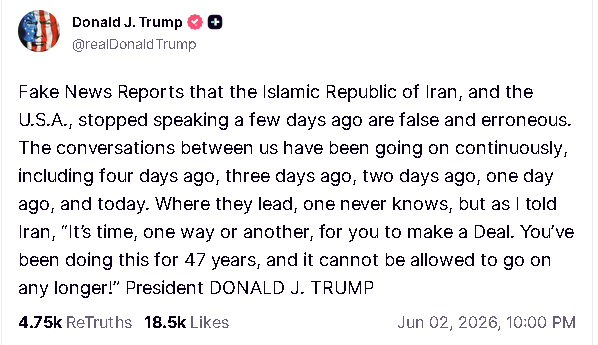
On June 2, 2026, President Donald Trump posted on Truth Social: "Fake News Reports that the Islamic Republic of Iran, and the USA, stopped speaking a few days ago are false and erroneous. The conversations between us have been going on continuously." As reported by Reuters on May 29, Trump stated he would make a "final determination" on a proposal to extend the early-April ceasefire by 60 days, allowing negotiators to forge a permanent end to the war.
A senior Iranian source told Reuters a potential agreement was "close" but not yet approved, and crucially, the deal under discussion does not include nuclear-related conditions contrary to Trump's public demands. That framing (fabricated victory) is essential context. Both governments communicate to two audiences simultaneously: a negotiating counterpart and a domestic constituency that must be managed.
US Secretary of State Marco Rubio told a Senate foreign relations committee hearing that Tehran had agreed to discuss nuclear program aspects previously refused, and confirmed that Iran's new supreme leader, Mojtaba Khamenei, is alive and "increasingly engaging," as reported by The Guardian. His testimony opened diplomatic doors even as Iranian state media announced the opposite.
What Iran's hardline statements actually signal
Iran's public posture has been deliberately combative. The joint statement issued by Iran's Armed Forces declared that "the American and Zionist enemies will have no option but surrender," as reported by Tasnim News Agency. This insulates the negotiating team from charges of capitulation, making any eventual deal easier to present as a position of strength.
Iran's opening and closing of the Strait of Hormuz has followed the same logic. As reported by Forbes on April 18, Iran's navy broadcast that the strait was "completely closed again" and blamed US government failure to fulfill negotiating commitments.
Trump acknowledged "very good conversations" were continuing. Ship traffic has stayed far below prewar levels, a trickle instead of 100+ vessels daily.
BBC's analysis captured the tension precisely: Iran "wants the war to stop as quickly as possible, not at any price." The phrase "not at any price" is the constraint; "as quickly as possible" is the incentive.
US domestic pressure
According to Pew Research, 61% of Americans disapprove how the conflict was handled. YouGov/Economist polling found 58% of Americans oppose the war, with 70% across party lines saying the US should make a deal quickly.
Global oil prices surged and crude oil futures leaping more than 7% on reports of escalation places additional pressure on the Trump administration to secure resolution ahead of congressional elections in November.
Structure of a possible deal
Negotiations have centered on a 60-day ceasefire extension, gradual removal of the US blockade on Iranian ports, and release of $12 billion in Iran's frozen assets, according to Reuters.
Kazakhstan has signaled willingness to receive Tehran's enriched uranium stockpile as part of any deal, per IAEA Director General Rafael Grossi. Iran's conditions include full sanctions relief, US force withdrawal from the region, and ending Israel's offensive in Lebanon.
The gap between news and reality
Military escalation and diplomatic progress are not mutually exclusive, they occur simultaneously, with each side using kinetic activity as leverage. When Iran fires on a tanker, oil prices move and coverage shifts to crisis framing, but the diplomatic channel does not stop.
The war has killed thousands and pushed global energy prices to emergency levels, producing a US public majority across partisan lines demanding it end. The parties need an exit.
The question is which version each government can defend to its own people. That answer is being decided in rooms that generate no news coverage.
One thing is clear: the talks are continuing.