


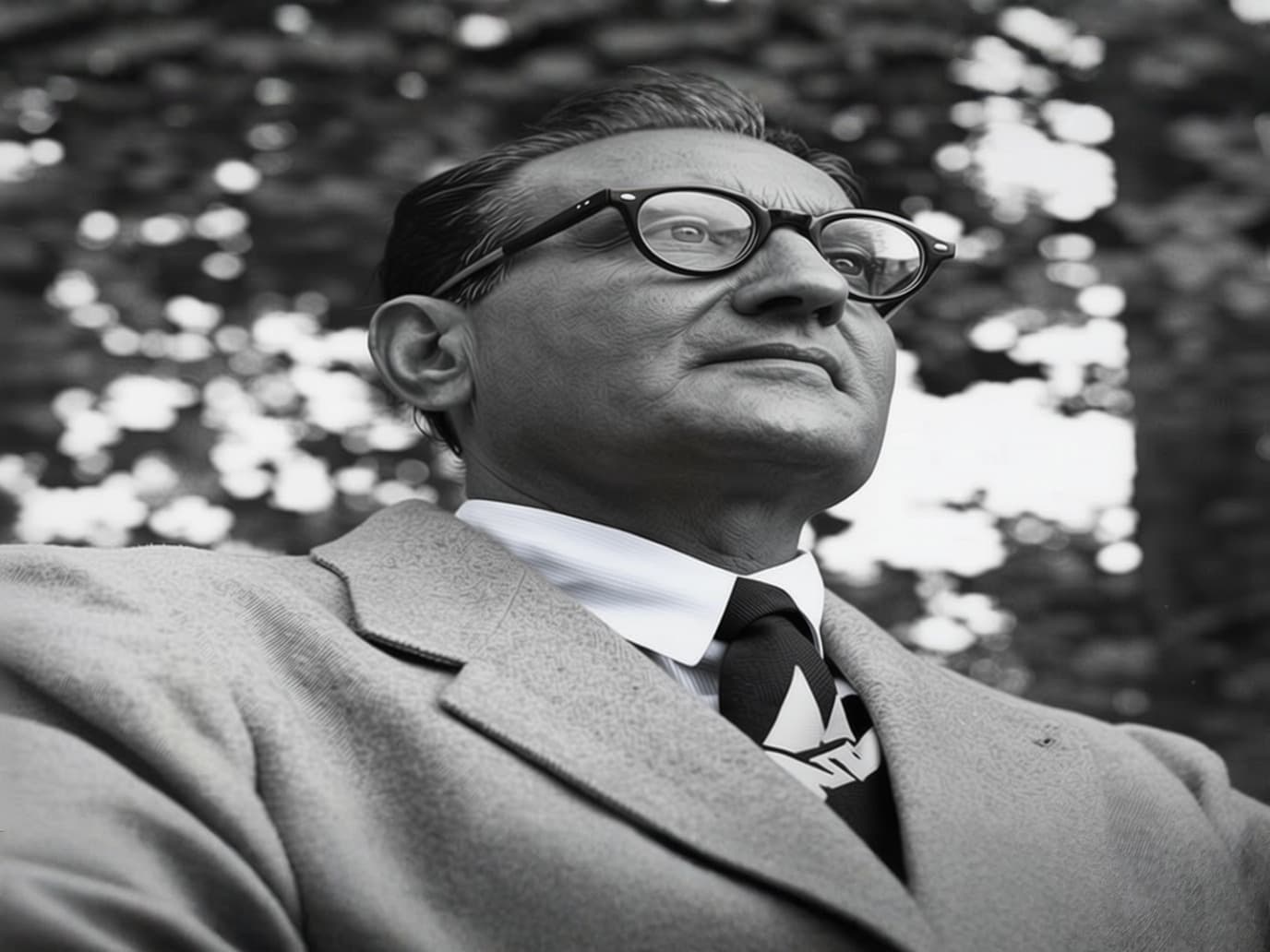
ISLAMABAD: When Pakistanis remember Syed Abid Ali Abid on Tuesday's 55th anniversary of his death, they recall a figure who rejected the idea that literature exists to comfort.
Abid spent decades arguing that verse without social purpose, no matter how melodious, abandons poetry's true work.
"Chand sitaron se kya puchhun kab din mere phirte hain," he wrote in one of his most quoted couplets (commonly translated as "Why should I ask the moon and stars when my fortunes will turn?") That question captures Abid's refusal to accept passive resignation, whether in life or in literature.
Born Sept. 17, 1906, in Dera Ismail Khan, Abid died in Lahore on Jan. 20, 1971, aged 64.
Multiple platforms, single message
Abid's career spanned education, broadcasting and film. After completing a master's degree in Persian, he led Dyal Singh College in Lahore as principal, working to strengthen Urdu scholarship there.
Radio Pakistan Lahore recruited him in the late 1940s as one of its first drama and feature writers. He spent the following decade creating content for the station during Pakistan's formative years.
Pakistani cinema also drew on his skills. "Heer Ranjha," the first Punjabi talking film, used both his narrative structure and dialogue.
Across these platforms, Abid pushed the same argument: creative work must engage the world it emerges from.
Criticism as cultural project
His books in Urdu and Persian laid out systematic approaches to evaluating literature. "Usool-e-Intiqad-e-Adabiyat" (Principles of Literary Criticism) and "Asloob" (Style) established frameworks connecting artistic choices to larger cultural questions.
"Al-Bayan" and "Al-Badi" went deeper into technical analysis. In "Al-Badi," Abid examined how poets use alliteration and parallelism to create effects, the same tools he employed writing his own verse.
His book "Sheir-e-Iqbal" analyzed Muhammad Iqbal's poetry.
Throughout these works, Abid returned to a core conviction: writing that aims only at beauty while ignoring social and cultural responsibilities falls short.
Writing what he preached
Abid published three poetry collections: "Main Kabhi Ghazal Na Kehta" (I Would Never Have Written a Ghazal), "Shama" and "Yad-e-Baiza."
His dual role as critic and poet created an unusual dynamic: he set the standards, then had to meet them publicly. This put his own verse under scrutiny using the very analytical tools he'd developed for judging others.
Abid's fluency in Urdu and Persian wasn't just artistic enrichment. It gave him practical advantages: he could draw on twice the literary history, deploy images that worked across linguistic traditions, and reach audiences in multiple languages. His study of English literature added a third reference point.
The poetry collections show this range in action. Individual poems layer references that readers familiar with Persian classical verse would recognize alongside structures more common in Urdu ghazals.
Examining hardship and hope
Several verses probe suffering's nature. One asks:
"Ye kya tilism hai duniya pe bar guzri hai
Wo zindagi jo sar-e-rahguzar guzri hai"
"What magic is this that weighs upon the world?
The life that was spent wandering upon the paths."
Another looks at how commitment can sour:
"Unhin ko arz-e-wafa ka tha ishtiyaq bahut
Unhin ko arz-e-wafa na-gawar guzri hai"
Rendered as: "Those who once had a great longing for the plea of faithfulness; it is they who found the plea of faithfulness most unpleasant."
But his work doesn't stop at lamentation. Morning light appears as transformation's possibility:
"Aai sahar qarib to maine parhi ghazal
Jalne lage sitaron ke bujhte hue kanval"
Commonly interpreted as: "As the dawn drew near, I recited a ghazal; the fading lotus-stars began to glow again."
He also wrote: "Aam ho faiz-e-baharan to maza aa jae," translated as "If the bounty of spring were common, how pleasant it would be."
A contradiction worth noting
Abid's most famous couplet rejects asking celestial bodies for guidance about fortune. Yet his poetry repeatedly returns to moon and star imagery: chand and sitara appear throughout his verse.
This creates an interesting tension: the poet who warns against looking to the heavens for answers keeps looking there himself for metaphors. The imagery serves his purposes even as his message questions its authority.
Similarly, Abid advocated strongly for realism in poetry as defense against cultural stagnation. Yet his own verse incorporates mystical elements and spiritual imagery — not strictly realistic approaches.
These contradictions don't necessarily weaken his work. They may instead show a writer grappling honestly with competing impulses: the pull toward transcendent imagery versus the commitment to grounded social engagement.
Lasting questions
Pakistani scholars continue engaging with Abid's central challenge: whether literature can maintain artistic integrity while serving social purposes, or whether these goals inevitably conflict.
His career suggests he saw no contradiction. The same person who dissected poetic technique in "Al-Badi" deployed those techniques in his own compositions. The principal who built Urdu programs at Dyal Singh College also wrote dialogue for Pakistan's first Punjabi talkie.
Tuesday's commemorations mark not just a death but an ongoing argument about what writers owe their readers, their culture and themselves.
Pakistan honors scholar who insisted poetry must challenge, not just console
When Pakistanis remember Syed Abid Ali Abid on Tuesday's 55th anniversary of his death, they recall a figure who rejected the idea that literature exists to comfort.
Topics in this story