


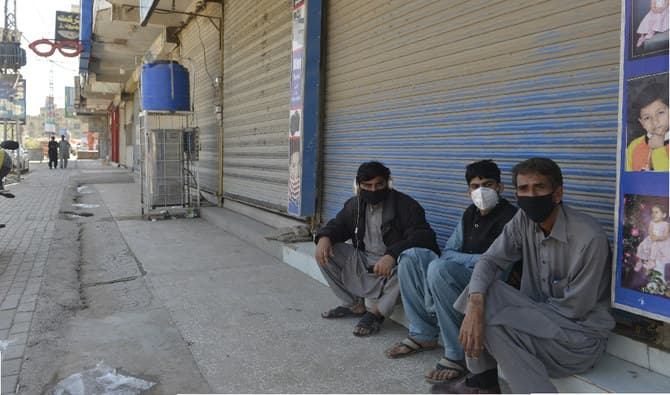
ISLAMABAD: Pakistan announced on Monday that it would close bazaars, markets, and shopping malls at 8 p.m. as part of austerity measures amid the escalating Israel-US war on Iran, which has impacted global supplies.
According to a statement from the Prime Minister's Office (PMO), Prime Minister Shehbaz Sharif chaired a meeting to review petroleum products, energy conservation, and the implementation of austerity measures. As part of this initiative, the government announced the closure of markets and shopping malls in Punjab, Khyber Pakhtunkhwa, Balochistan, the Islamabad Capital Territory, Gilgit-Baltistan, and Azad Jammu & Kashmir.
The statement added that the decision has been made in consultation with provincial governments.
“In divisional headquarters of Khyber Pakhtunkhwa, bazaars, markets, and shopping malls will be allowed to remain open until 9 p.m.,” it added.
The government said that shops selling daily-use items, departmental stores, and all types of malls will also close at 8 p.m.
Bakeries, restaurants, tandoors, and other food outlets will be closed by 10 p.m., the statement added.
Marriage halls, marquees, and other commercial venues where weddings are held will remain closed after 10 p.m., as per the statement.
Wedding events on private property and in homes will also be prohibited after 10 p.m., as per the statement.
It added that medical stores and pharmacies will be exempt from these restrictions.
The government announced that these decisions will take effect from April 7.
It further added that in the cities of Gilgit and Muzaffarabad, intercity public transport will be free for one month, with all expenses borne by the federal government.
Sufficient petrol supplies
In an official statement, the Cabinet Committee to Monitor Petrol Prices met under the chairmanship of Finance Minister Senator Muhammad Aurangzeb to assess petroleum supply, stock positions, and market conditions.
Officials told the meeting that overall supply remains stable. Diesel stocks cover about 25 days, petrol supplies are sufficient to meet current demand, and crude oil stocks stand at around 12 days, supported by incoming cargoes and scheduled imports, according to the Petroleum Division.
Import arrangements for the coming weeks are on track through commercial purchases and government-to-government deals, while refineries are operating at optimal levels to maintain output, the division said. The committee noted that a reliable energy supply remains critical for agriculture, fertilizer production, transport, and industry, as well as for maintaining price stability.
The committee called for vigilance to prevent hoarding, speculative activity, and disruptions in availability following recent price changes, the ministry stated. It stressed close monitoring of demand patterns, including local variations, and action against unauthorized storage and market irregularities within the regulatory framework.
Members also reviewed the gas supply, including the stock positions of SNGPL and SSGC, and discussed the allocation between domestic consumers and the power sector, according to the Petroleum Division. They called for a data-driven approach to manage seasonal demand and increasing reliance on liquefied petroleum gas.
The committee emphasized the use of a digital dashboard launched by the Oil and Gas Regulatory Authority (OGRA) to track real-time data on stocks, sales, and supply conditions from depots to retail outlets. The system is intended to improve visibility of inventory and demand fluctuations and enable timely identification of supply gaps, the ministry said.
However, data reporting from retail outlets remains below expectations despite a nationwide network of more than 12,000 petrol pumps, according to the Finance Ministry. The committee called for full operationalization of the system.
The finance minister directed stakeholders to ensure timely and accurate data sharing to support decision-making. OGRA was instructed to enforce compliance with reporting requirements, accelerate digitization across the supply chain, and coordinate with oil marketing companies. Pakistan State Oil will expand reporting coverage across its retail network, the ministry said.
Joint teams from the Petroleum Division, OGRA, the Federal Investigation Agency, and Pakistan State Oil will be deployed to selected PSO petrol pumps in Islamabad to improve data entry, transparency, and operational compliance. The committee said such mechanisms should be institutionalized to strengthen oversight and accountability.
Aurangzeb said maintaining market stability requires coordination, monitoring, and enforcement, and stressed the need to ensure uninterrupted fuel availability, improve transparency, and protect consumers.
The meeting was attended by senior federal ministers and officials from relevant ministries, divisions, and regulatory authorities.