


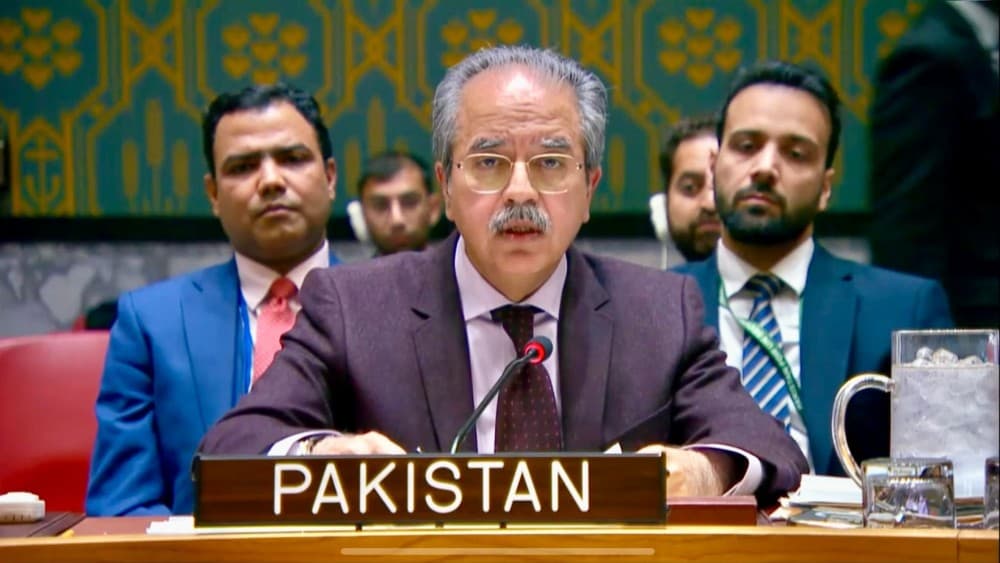
ISLAMABAD: Pakistan’s Permanent Representative to the United Nations, Asim Iftikhar Ahmad, on Thursday accused India of engaging in “water terrorism” and urged the international community to ensure adherence to the Indus Waters Treaty during a Security Council briefing on “Energy, Critical Minerals, and Security.”
Addressing water resources, Ahmad said: “This applies equally to water, the most critical of natural resources.” He added that “shared water resources are indispensable for sustaining life, and for sustainable development and prosperity.”
“We reject the weaponization of water to choke this lifeline for lower riparians, also threatening regional peace, security and stability,” he said.
India's 'water terrorism'
Referring to India, Ahmad said: “Pakistan itself is confronted with water terrorism by India that has resorted to unilateral and unlawful action of putting in abeyance of the Indus Waters Treaty in violation of international law and the provisions of that Treaty.”
He added, “International community must impress upon India to return to full compliance with the Indus Waters Treaty, which remains valid and in-force as per the August 2025 award of the Court of Arbitration.”
Speaking at the session, Ahmad said: “Access to affordable, reliable and sustainable energy is essential for development, stability and prosperity.”
He added that the global shift toward renewable energy, electric mobility, battery storage, advanced manufacturing, digital infrastructure and grid modernization has “sharply increased the demand for critical minerals.”
“This upsurge has generated new geopolitical and geo-economic pressures,” he said, warning that “if not managed responsibly, competition over natural resources can affect supply chains, aggravate tensions, undermine sovereignty, and contribute to instability.”
Highlighting risks in conflict-affected regions, Ahmad said: “Experience shows that where mineral wealth intersects with weak governance, entrenched poverty and external interference, the risks of instability increase.”
He noted that “illicit extraction, trafficking networks and opaque financial flows have fuelled armed conflict and violence, weakened state institutions and deprived populations of legitimate revenues.”
He said, “The scramble for natural resources and its linkage to conflict and instability is therefore not new.”
Ahmad added that Pakistan believes “natural resources must serve as instruments of economic development and shared prosperity, and not coercion or conflict.”
.jpg&w=3840&q=75)