


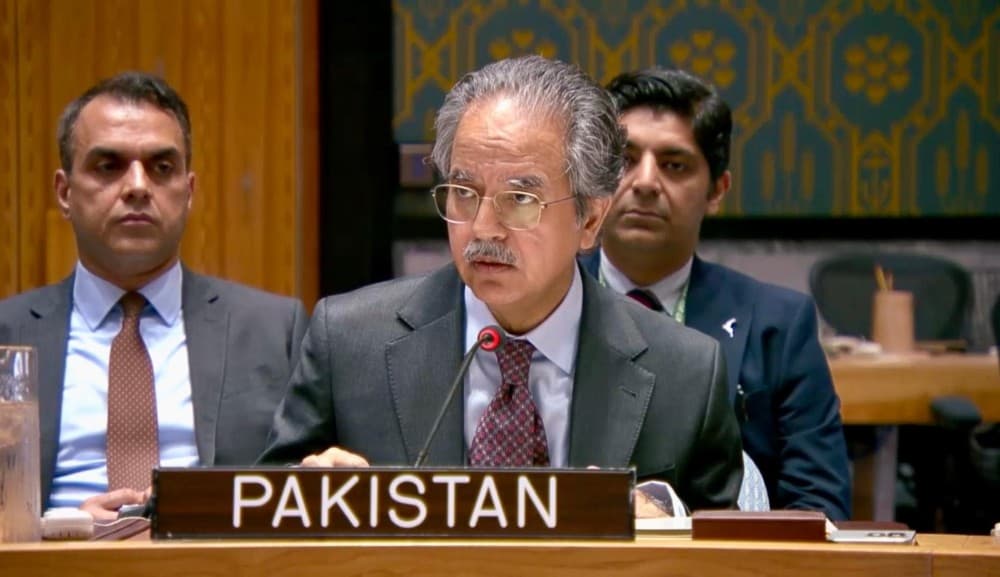
ISLAMABAD: Pakistan has urged the Afghan Interim Government to take “verifiable and non-reversible” action against terrorist groups operating from Afghan territory, warning that continued inaction threatens regional peace and security, said a statement from Pakistan's Permanent Mission to the UN, posted on X on Tuesday.
The statement said that Pakistan’s Permanent Representative to the United Nations, Ambassador Asim Iftikhar Ahmad, made the remarks during his address to a meeting of the UN Security Council on Afghanistan.
The envoy, according to the statement, said that Islamabad had supported Afghanistan through humanitarian assistance, trade facilitation, diplomatic engagement and regional cooperation efforts since the Taliban returned to power nearly five years ago.
The statement quoted Ahmad as saying that Pakistan had expected the Taliban administration to transform into a responsible governing authority, fulfil its international commitments and ensure that Afghan soil was not used for terrorism against other countries.
Terrorism from Afghanistan
"The ambassador stated that terrorist organisations, including the Tehreek-e-Taliban Pakistan (TTP), the Balochistan Liberation Army (BLA), its Majeed Brigade, ISIL-K and the East Turkestan Islamic Movement (ETIM), continue to operate with impunity from Afghanistan," the statement said.
The mission statement quoted Ahmad as saying that Pakistan suffered more than 5,300 terrorist incidents in 2025 and lost over 1,200 lives in attacks linked to militants based in Afghanistan.
"He cited a vehicle-borne improvised explosive device attack on a police post in Khyber Pakhtunkhwa on May 9, in which 15 police personnel were killed, claiming investigations showed the attack had been planned from Afghanistan."
"The envoy said Pakistan remained open to dialogue and appreciated mediation efforts by Qatar, Türkiye, Saudi Arabia and China. However, he expressed concern over what he described as the Taliban’s refusal to publicly condemn groups such as the TTP and BLA," added the statement.
According to the statement, Ahmad also criticized what he called shortcomings in international reporting on Afghanistan, saying greater attention should be paid to terrorism, illicit financing networks and the proliferation of weapons inside the country.
"He further voiced concern over the humanitarian and human rights situation in Afghanistan, particularly restrictions on women and girls, while reiterating Pakistan’s long-standing support for Afghan refugees."
Concluding his remarks, the statement said, the ambassador said Pakistan sought a peaceful, stable and prosperous Afghanistan but stressed that meaningful progress depended on decisive Taliban action against terrorist groups operating from Afghan territory.
Right of reply
Later, another statement said that in a right of reply during the Security Council session, Ambassador Iftikhar rejected criticism of Pakistan's counterterrorism operations, stating that recent strikes were directed solely against terrorist infrastructure operating from Afghan territory.
He said the targets included drone facilities, ammunition depots and logistical sites allegedly used to support attacks against Pakistan, adding that no civilian facilities were targeted.
"He also accused India of using development and humanitarian engagement in Afghanistan as a cover to pursue policies aimed at destabilising Pakistan. He alleged that militant groups such as the TTP and BLA were receiving external support and criticised New Delhi for failing to condemn attacks carried out against Pakistani civilians and security personnel."
Responding to remarks made during the debate, Ahmad said the international community's core expectations from the Taliban remained unchanged, including inclusive governance, protection of human rights and ensuring that Afghan soil is not used for terrorism against other countries, the statement concluded.