


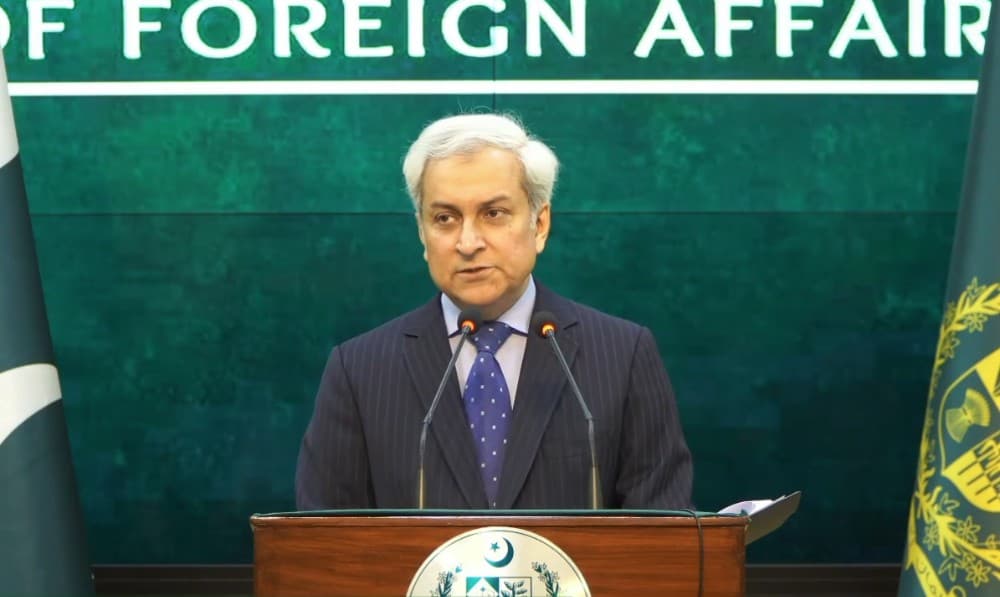
ISLAMABAD: Pakistan on Thursday strongly condemned India’s proposed Chenab-Beas Link Project, terming it a serious violation of the Indus Waters Treaty and international law.
Foreign Office spokesperson Tahir Andrabi, responding to media queries following the weekly briefing, said Pakistan had taken note of reports and official tender documents issued by the Indian government regarding the project.
According to reports, India plans to begin construction of the Chenab-Beas Link Tunnel on August 1 to divert approximately 1.9 million acre-feet of water annually from the Chenab River to the Beas basin.
Andrabi said the proposed inter-basin diversion of water from the Chenab, one of the western rivers allocated to Pakistan under the waters agreement, constituted a grave breach of the treaty and of international legal frameworks governing transboundary water resources.
The foreign office spokesperson also expressed concern over India’s reported plans to carry out silt flushing operations at the Salal Dam in Indian Illegally Occupied Jammu and Kashmir.
He said such measures could provide water control capabilities not permitted under the Indus Waters Treaty or the 1978 Salal Agreement.
He noted that India had neither formally informed Islamabad about these projects nor sought consultations. Andrabi warned that attempts to “weaponize water” could endanger Pakistan’s water, food, and economic security, while posing risks to regional peace and stability.
Andarabi reiterated that Pakistan reserves all options to safeguard its rights under the treaty and urged the international community to press India to fully implement the IWT.
Pakistan rejects Rubio-Iran intelligence claim
The spokesperson also rejected reports claiming that Deputy Prime Minister and Foreign Minister Ishaq Dar shared information regarding Iran’s nuclear program during a recent meeting with US Secretary of State Marco Rubio.
Tahir Andrabi said no such information was exchanged during Dar’s meeting with Rubio in Washington on May 29.
The clarification came after former CIA analyst Larry Johnson alleged that Dar had conveyed messages about Iran’s nuclear intentions to US officials.
However, Rubio also dismissed the claims during a congressional hearing, stating he was unaware of any such message and would have known if it had been delivered.
‘Internationally recognized dispute’
Responding to a question about the Swiss ambassador’s remarks during her visit to the Indian Illegally Occupied Jammu and Kashmir (IIOJK), the spokesman stated that “Jammu and Kashmir is an internationally recognized dispute,” according to the statement.
Ambassador Maya Tissafi last week visited Indian-occupied territory of Jammu and Kashmir,
“Productive meetings in Srinagar with Lieutenant Governor Manoj Sinha and Chief Minister Omar Abdullah on the scope for (Switzerland-India) collaboration in Kashmir — from sustainable tourism and vocational training to food processing and agriculture,” Tissafi said in a post on X, reported Indian media.
Andrabi stated that the visit of any international personality “does not alter” the status of Jammu and Kashmir as an internationally recognized dispute, the resolution of which is to be achieved through an independent and impartial plebiscite.
“In this regard, Pakistan remains in touch with the international community and with respective governments to discuss this issue. We brief them on the grave human rights violations in Indian Illegally Occupied Jammu and Kashmir, as well as its broader implications for the peace and stability of the region and beyond. In the same manner, we remain engaged with the Swiss government on this matter,” Andrabi said according to the statement.
‘Human rights violations in India’
The spokesman, while responding to a question, stated that “the issue of human rights in India was discussed,” with the European Union’s delegation that visited Pakistan. "Firstly, violations taking place in Indian Illegally Occupied Jammu and Kashmir [were discussed]. Secondly, human rights violations in India,” said the statement.
He added that “we have a strong position on this matter”, reiterating that not only the European Union but also other interlocutors, the UN human rights institutions, and relevant international organizations dealing with human rights, to note the plight of Indian Muslims and other minorities in India.
“This remains part of our regular dialogue,” added the statement.