

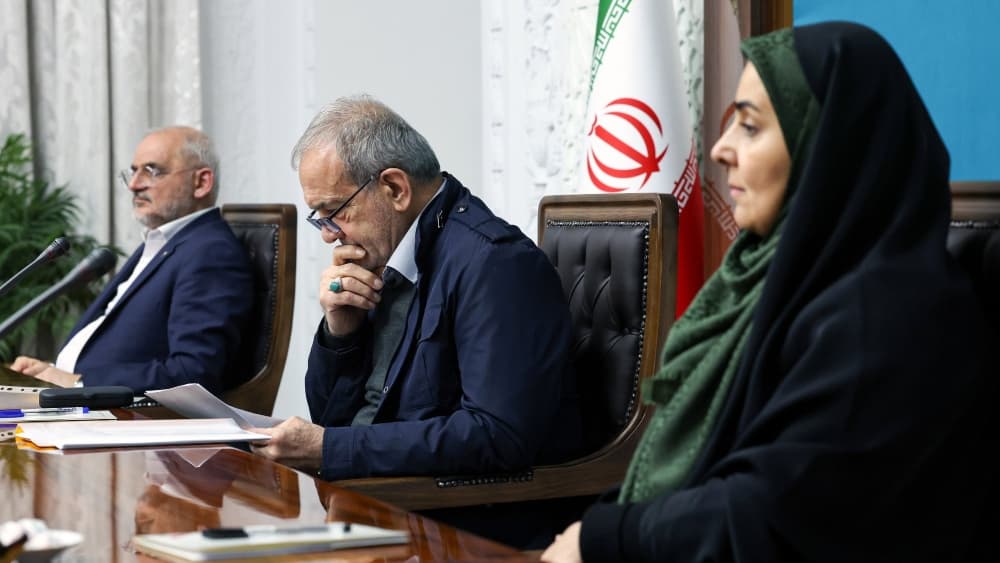
ISLAMABAD: Iranian President Masoud Pezeshkian, in a tweet late Wednesday, outlined terms to end the war in the Middle East, reaffirming his country's commitment to regional peace.
"The only way to end this war [...] is recognizing Iran’s legitimate rights, payment of reparations, and firm international guarantees against future aggression," he said in a post on X.
He said he had earlier spoken with the leaders of Russia and Pakistan, reaffirming Iran's commitment to peace in the region.
Meanwhile, Iran's Revolutionary Guards warned that they would strike "economic centers and banks" linked to US and Israeli interests.
The defiance from Tehran came as fighting around the strategic Strait of Hormuz — the waterway carrying a fifth of the world's oil — sent shock waves through energy markets, prompting emergency releases from global reserves and a limited draw on US stockpiles.
Oil prices have surged since Feb. 28, when the United States and Israel launched air strikes on Iran that killed its supreme leader and plunged the Middle East into conflict.
Retaliatory Iranian missile strikes and drone attacks have brought shipping through the strait almost to a halt, forcing governments to scramble to contain the fallout, while US President Donald Trump said Iran was "pretty much at the end of the line."
"Doesn't mean we're going to end it immediately, but they are," Trump told reporters.
He said Iran's navy and air force had been destroyed, that it was close to running out of missiles and that US forces could knock out the electricity supply "within one hour" — leaving the country with a reconstruction that could take a generation.
But the US leader indicated that he would rather show restraint than take actions that would make it "almost impossible for them to rebuild their country."
The president had earlier said the United States must "finish the job" in Iran, adding that US forces had struck 28 Iranian mine-laying vessels.
He said Washington would tap US strategic reserves "a little" to help stabilize markets roiled by the war, and his administration later announced that he had authorized the release of 172 million barrels, beginning next week.
The International Energy Agency agreed to release a record 400 million barrels.
Israel's military, however, signaled the campaign was far from finished, and that it still had "a broad bank of targets."
Economic shock
With the conflict in its 12th day, Iran's Revolutionary Guards warned Wednesday they would strike "economic centers and banks" linked to US and Israeli interests, prompting more international firms to evacuate staff from Dubai.
The United States and Israel "must consider the possibility that they will be engaged in a long-term war of attrition that will destroy the entire American economy and the world economy," Ali Fadavi, an adviser to the Guards' commander-in-chief, told state television.
Iran said it targeted two commercial vessels in the Gulf after they entered the Strait of Hormuz, "after ignoring the warnings" of its navy.
Analysts warn that a prolonged disruption to shipping through the strait — which also carries roughly a third of the fertilizer used in global food production — would deliver a severe economic shock, particularly in Asia and Europe.
The UN Security Council passed a resolution demanding Iran halt attacks on Gulf states, prompting the Islamic republic's ambassador to the United Nations to accuse it of a "blatant misuse" of its mandate.
The conflict has already disrupted two pillars of the Gulf economy — energy production and commercial aviation.
On Wednesday, drones fell near Dubai airport, injuring four people, authorities said. Others struck fuel tanks at Oman's Salalah port, according to the Oman News Agency.
'Wave of strikes'
In an apparent first since the war began, Israeli drones also struck targets in Tehran on Wednesday evening, killing members of the security forces, Iran's Fars news agency reported.
The Israeli military later said it was carrying out a "wide-scale wave of strikes" after the IRGC announced just after midnight on Thursday that it had carried out a joint missile operation with Hezbollah against targets in Israel.
Pentagon officials have meanwhile briefed US lawmakers that the cost of the war exceeded $11.3 billion in its first six days, The New York Times reported, citing people familiar with the classified briefing.
The conflict has continued to spill across the region.