

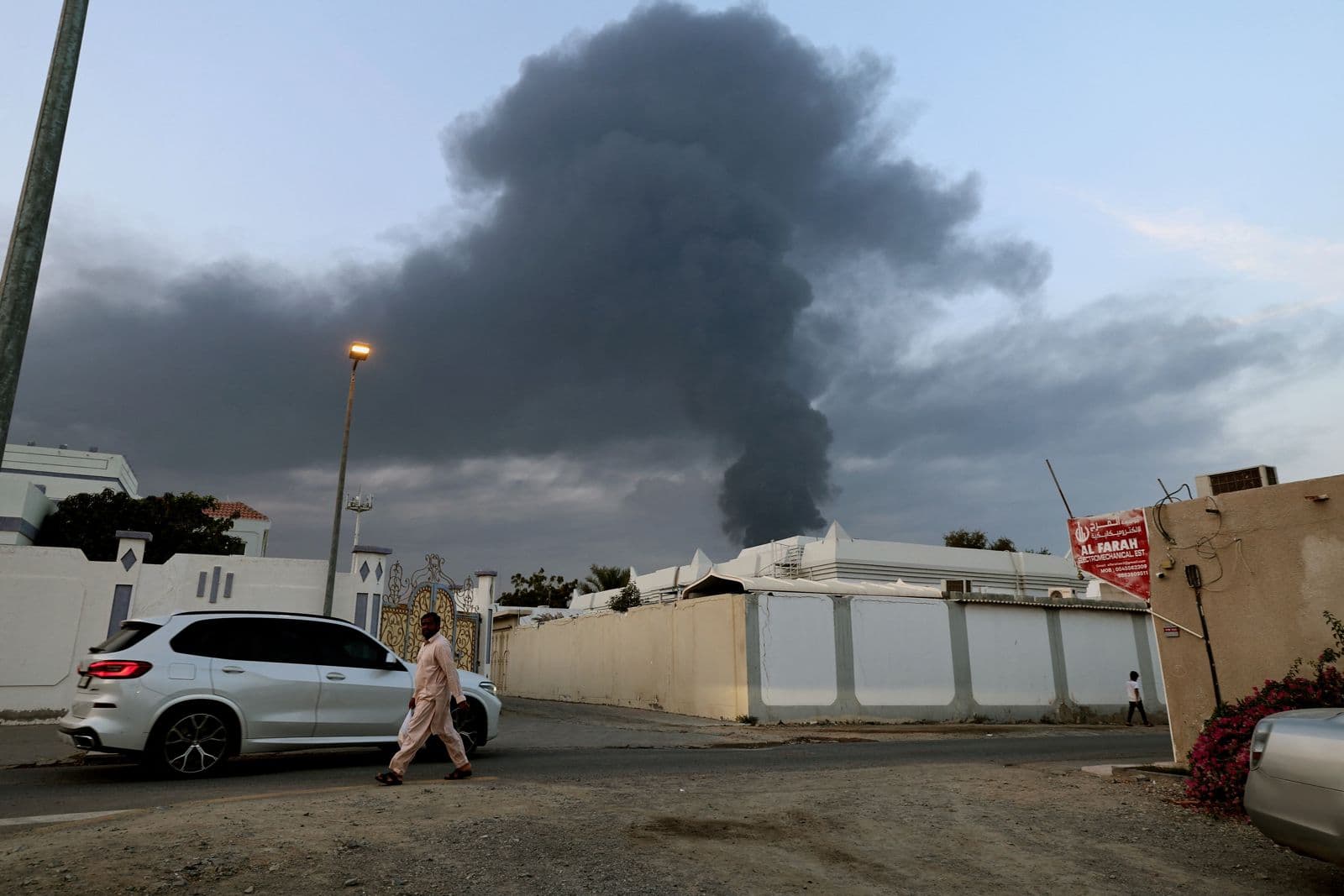
US–Israeli strikes on Natanz nuclear facility have reportedly caused no radioactive contamination, according to Iranian officials, as renewed Israeli attacks in Lebanon have displaced more than 58,000 people in just two days.
Israel says it has launched 'broad wave' of strikes on Iran
Published: March 3, 2026 | 22:49 GMT
Israel's military said it has launched a "broad wave of strikes" on targets in Iran, after the Islamic republic launched three separate missile barrages at Israeli territory in recent hours.
The military said the targets of its latest strikes include "launch sites, aerial defence systems, and additional infrastructure."
Canada PM urges 'all parties' in Iran war to respect intl law
Published: March 3, 2026 | 22:49 GMT
Canadian Prime Minister Mark Carney on Wednesday urged "all parties" in the conflict unleashed by US-Israeli strikes on Iran to respect the international rules of engagement.
Speaking in Sydney, Carney said "Canada reaffirms that international law binds all belligerents."
"We implore all parties, including the United States and Israel, to respect the rules of international engagement," he said, adding: "Canada calls for a rapid de-escalation of hostilities and is prepared to assist in achieving this goal".
Munitions debris falls in Tel Aviv area after new wave of Iran missiles: police
Published: March 3, 2026 | 21:20 GMT
Munitions debris fell late Tuesday in the Tel Aviv area, where a woman suffered mild shrapnel injuries, police said, after Iran launched two waves of missiles toward Israel within 30 minutes.
"A short time ago, reports were received by the Israel police regarding the fall of munition debris in the Tel Aviv District. Police officers and bomb disposal experts are operating to secure and isolate the affected areas," the force said in a statement reporting the first wave of missiles.
Minutes later, the military reported a second wave of missile launches from Iran, which were followed by blasts, AFP journalists reported.
Khamenei to be buried in holy city of Mashhad: Iranian media
Published: March 3, 2026 | 21:20 GMT
Iran's slain supreme leader Ayatollah Ali Khamenei will be buried in the holy city of Mashhad, the Fars news agency said according to AFP.
He was originally from Mashhad, Iran's second-largest city, where his father is buried at the Imam Reza shrine.
Before the burial, a "large farewell ceremony" will be held in Tehran, the Revolutionary Guards said on their Telegram account.
No date for the burial was disclosed.
Israeli airspace to 'gradually' reopen overnight Wednesday-Thursday: minister
Published: March 3, 2026 | 21:14 GMT
Israel's transport minister said the country will gradually reopen its airspace overnight between Wednesday and Thursday, after it was closed to civilian flights as the US and Israel launched strikes on Iran.
The initial approved flights will be to repatriate Israelis, a transport ministry spokesperson told AFP, adding that there will be no departures for now.
"The airspace will reopen gradually starting already on the night between Wednesday and Thursday, and of course subject to security developments," Miri Regev said during a press conference at Tel Aviv's Ben Gurion Airport.
The reopening had initially been scheduled for next week but was moved up "following security assessments with professional and security experts," Regev said.
Sharon Kedmi, director general of the Israel Airports Authority, told reporters the re-opening will begin "very cautiously, with one aircraft per hour during the first 24 hours -- a narrow-body aircraft."
"After 24 hours, if everything works as planned, we will increase to two narrow-body aircraft per hour or one wide-body aircraft," he added.
Israel closed its airspace to civilian flights after announcing the launch of a campaign of "preventive strikes" against Iran together with the US.
Macron says US, Israel acted 'outside international law' in Iran strikes
Published: March 3, 2026 | 20:45 GMT
French President Emmanuel Macron said that the United States and Israel's military operations in Iran were conducted "outside international law," but placed primary blame on the Islamic Republic, AFP reported.
"The United States of America and Israel decided to launch military operations, conducted outside international law, which we cannot approve of," said Macron.
But "the Islamic Republic of Iran bears primary responsibility for this situation," Macron added, citing their "dangerous" nuclear program, support for regional proxies, and orders to shoot "its own people" during protests in January.
Trump says US navy could escort tankers through Hormuz Strait
Published: March 3, 2026 | 20:40 GMT
President Donald Trump said the US navy would escort oil tankers through the Strait of Hormuz if needed amid the Iran war, and ordered Washington to provide insurance for shipping, AFP reported.
"If necessary, the United States Navy will begin escorting tankers through the Strait of Hormuz as soon as possible. No matter what, the United States will ensure the FREE FLOW of ENERGY to the WORLD," Trump said on his Truth Social platform.
Turkey foreign minister says Iran regime change would bring 'risks for the region'
Published: March 3, 2026 | 20:40 GMT
Turkey's foreign minister said that the United States should limit its attacks on Iran to degrading its military capabilities as forcing regime change would causes "risks" for the region.
Attacking military targets and regime change were the two main options for the war, Foreign Ministeer Hakan Fidan said in a television interview. "Moving toward the second (regime change) means introducing very different scenarios and risks for the region," he declared.
Fire near US consulate in Dubai after drone attack: govt statement
Published: March 3, 2026 | 20:15 GMT
A drone attack caused a fire near the US consulate in Dubai, a government statement said according to AFP, a day after the US embassy in Riyadh was hit by an Iranian strike.
"Dubai authorities have confirmed that a fire resulting from a drone-related incident near the US Consulate has been successfully contained," the official Dubai Media Office posted on X.
Turkey foreign minister says Iran regime change would bring 'risks for the region'
Published: March 3, 2026 | 19:10 GMT
Turkey's foreign minister said Tuesday that the United States should limit its attacks on Iran to degrading its military capabilities as forcing regime change would causes "risks" for the region.
Attacking military targets and regime change were the two main options for the war, Foreign Ministeer Hakan Fidan said in a television interview.
"Moving toward the second (regime change) means introducing very different scenarios and risks for the region," he declared.
Iran says 'no radioactive contamination' detected at Natanz nuclear site after strikes
Published: March 3, 2026 | 17:05 GMT
Iran said on Tuesday it had detected "no radioactive contamination" as a result of US-Israeli air strikes at the weekend on its underground fuel enrichment facility at Natanz.
"No leak of radioactive material has been recorded at this complex, thanks to preventative measures and data logged by the monitoring system," the Atomic Energy Organisation of Iran said in a statement quoted by news agency ISNA.
The underground fuel enrichment site at Natanz was previously targeted by bombings in June during the 12-day war with Israel.
Israeli attacks on Lebanon displace more than 58,000 in two days: authorities
Published: March 3, 2026 | 17:05 GMT
Israel's attacks on Lebanon have displaced more than 58,000 people, Lebanese authorities said on Tuesday, as the Israeli military continues its strikes following a Hezbollah rocket launch.
The government's disaster and management unit said that more than 58,000 people have been displaced, double the amount it had reported on Monday.
Russian top diplomat urges de-escalation in call with Iran's FM
Published: March 3, 2026 | 17:05 GMT
Russian top diplomat Sergei Lavrov urged de-escalation in the Middle East war in a call with Iranian Foreign Minister Abbas Araghchi on Tuesday, Moscow's Foreign Ministry said.
Lavrov "confirmed a fundamental position in favour of de-escalating the situation and rejecting the use of force," the ministry said.
It said Lavrov also stressed the need to "ensure the safety of the civilian population and civil infrastructure in all countries of the region."
Loud explosions heard across Doha, Dubai, Abu Dhabi: AFP reporters, residents
Published: March 3, 2026 | 17:00 GMT
Loud explosions were heard across the cities of Doha, Dubai and Abu Dhabi on Tuesday, according to AFP reporters and residents, as Iran pressed a campaign of missile and drone barrages across the Gulf.
Journalists heard loud explosions reverberating in the Qatari capital and in Dubai in the United Arab Emirates while two residents told AFP they heard explosions in UAE capital Abu Dhabi.
Trump says 'everything has been knocked out' in Iran
Published: March 3, 2026 | 17:00 GMT
US President Donald Trump on Tuesday boasted of wide damage on Iran inflicted by the US-Israel attack, which he said was going well.
"Just about everything's been knocked out," Trump told reporters as he met German Chancellor Friedrich Merz.
Iraq reduces production at key oil field after Strait of Hormuz disruption
Published: March 3, 2026 | 16:10 GMT
Iraq reduced production at a major oil field on Tuesday after the Strait of Hormuz was effectively closed, according to an official document and oil ministry sources.
The document, which was confirmed by two ministry sources, indicated that the operation manager at Iraq's Rumaila oil field ordered a reduction of "production and pumping... by 100 percent from" the south part of the field starting early Tuesday afternoon.
The document stated that the closure of the Strait of Hormuz caused a "shortage of tankers" in Iraq's southern ports, which led to stockpiling "reaching critical levels".
Israeli and US strikes on Tuesday hit the Tehran building of a body tasked with electing Iran's new supreme leader, local media reported.
"The American-Zionist criminals attacked the Assembly of Experts building in Qom," south of Tehran, according to the Tasnim news agency.
Local media showed footage of the building severely damaged in the strikes. Iran's supreme leader Ayatollah Ali Khamenei was killed in US and Israeli strikes on Saturday.
Israel says hit ballistic missile production sites across Iran
Published: March 3, 2026 | 15:14 GMT
Israel's military said Tuesday its air force had struck industrial sites "throughout Iran" that were used to produce weapons including ballistic missiles, on the fourth day of a joint US-Israel attack on the latter.
"During strikes conducted throughout Iran, the IDF (military) targeted industrial sites used by the Iranian regime to produce weapons, particularly ballistic missiles," the military said in a statement.
Israel's Netanyahu vows to strike Hezbollah with 'even greater force'
Published: March 3, 2026 | 15:12 GMT
Israel’s Prime Minister Benjamin Netnanyahu said his country will strike Lebanon-based Hezbollah with “even greater force.”
Meanwhile, Hezbollah said it targeted an Israeli tank on the edge of a Lebanese border village on Tuesday, hours after Israel's defense minister ordered his troops to take control of more strategic positions inside Lebanon.
In a statement, the armed group said: "In response to the criminal Israeli aggression... and after monitoring movements by the Israeli enemy army in Tel Nahas on the outskirts of Kfar Kila, our fighters targeted a Merkava tank with appropriate weapons and scored a direct hit."
Earlier Tuesday a Lebanese army source told AFP Israel was undertaking a ground incursion "from Kfar Kila and the Khiam plains" along the Lebanon-Israel border.
Tehran's Mehrabad airport targeted by strikes: Iranian media
Published: March 3, 2026 | 15:07 GMT
One of Iran's two airports, Mehrabad, which mainly handles domestic flights, was targeted on Tuesday by strikes as the United States and Israel kept up their bombardment for a fourth day.
The Mehr news agency published photos showing a cloud of grey smoke rising into the sky behind what appeared to be a runway. "The American-Zionist terrorists attacked the area around the Mehrabad airport" in the capital's west, it said.
Iranian media outlet says 'US and Israeli fighters' struck central Tehran
Published: March 3, 2026 | 14:31 PM
The Tasnim news agency said on Tuesday that "US and Israeli fighters" struck central Tehran on the fourth day of the war between Iran, the United States and Israel.
Tasnim aired a video filmed in central Tehran – which is home to numerous government buildings – that showed smoke rising into the sky.
"Significant damage has been observed to homes in the neighborhood" near Enghelab Square, Tasnim reported. AFP was not immediately able to verify the extent of the damage.
Two Turkish journalists detained in Israel
Published: March 3, 2026 | 14:06 GMT
Two Turkish journalists in Israel to cover the Iran war were detained in Tel Aviv on Tuesday while filming a live broadcast, Turkish officials and Israeli police said.
Burhanettin Duran, Türkiye’s presidential communications chief, said in a post on X that CNN Turk reporter Emrah Cakmak and cameraman Halil Kahraman had been detained in Israel.
They were arrested while shooting a live broadcast in Tel Aviv with Israel's police saying they "allegedly filmed a security facility".
US embassy warns of imminent attack on eastern Saudi city
Published: March 3, 2026 | 13:22 GMT
The US embassy in Riyadh warned Tuesday of an imminent missile and drone attack on Dhahran, the eastern Saudi city hosting much of the kingdom's Gulf coast energy installations.
"There is a threat of imminent missile and UAV attacks over Dhahran. Do not come to the U.S. Consulate," the embassy posted on its official X account. The alert followed a drone attack hours earlier on the US mission in Riyadh that caused a small fire on the grounds amid Iran's retaliatory strikes across the Gulf.
Saudi Arabia's massive Ras Tanura refinery, operated by state-owned Aramco and one of the Middle East's largest, partially shut down Monday after a drone strike. The world's top oil exporter has most of its petroleum infrastructure along the eastern coast facing Iran.
Iranian media outlet says 'US and Israeli fighters' struck central Tehran
Published: March 3, 2026 | 14:21 GMT
New explosions in Tehran
Published: March 3, 2026 | 14:07 GMT
New explosions were heard in the east and southeast of Tehran on Tuesday, according to AFP journalists who saw a plume of grey smoke rise in the sky on the fourth day of US-Israeli strikes.
It was not clear which sites had been targeted. The Mehr and Tasnim agencies both reported explosions, without providing details.
Israel army says has begun 'large scale' strikes in Tehran
Published: March 3, 2026 | 13:58 GMT
The Israeli air force launched a new wave of strikes in Tehran on Tuesday, the military said, marking the fourth day of its campaign against the Islamic republic.
"The military has launched a ninth wave of strikes in Tehran. The Air Force has now begun a large-scale wave of strikes targeting the Iranian terror regime's infrastructure in Tehran," the military said in a statement.
Iraq security forces seize rockets aimed at Baghdad airport: official
Published: March 3, 2026 | 12:51 GMT
Iraqi security forces seized on Tuesday nine rockets and a launchpad that were set up to target Baghdad International Airport, a government spokesperson told AFP.
"Security forces foiled an attempt to target Baghdad International Airport," said Saad Maan, the spokesperson of the government's security media cell.
They "seized a launchpad loaded with nine rockets ready for launch in the Abu Ghraib area", near Baghdad.
Trump says 'too late' for Iran to seek talks
Published: March 3, 2026 | 12:25 GMT
US President Donald Trump said Tuesday that it was too late for talks with Iran even though Tehran wants them.
"Their air defense, Air Force, Navy, and Leadership is gone. They want to talk. I said 'Too Late!'" Trump wrote in a Truth Social post, two days after saying he had agreed to talks, amid the joint Israeli-US bombardment of Iran.
Israel calls on countries to cut ties with Iran during envoy meeting
Published: March 3, 2026 |12:54 GMT
Foreign Minister Gideon Saar on Tuesday urged countries to cut their ties with Iran during a virtual meeting with around 60 envoys stationed in Israel, as it pressed its military campaign against the latter.
"The foreign minister told the ambassadors that following the Iranian regime's attacks on all its neighbours and the massacre of its own people, countries around the world must cut off their relations with it," a statement issued by Saar's office said, without specifying whether the 60 envoys' countries had ties with Iran in the first place.
Hezbollah says targeted Israeli military site
Pubished: March 3, 2026 - 12:35 GMT
Hezbollah announced it targeted a military facility in Israel in its fourth attack on Tuesday, as Israel continued to strike Lebanon including the capital Beirut.
The group said in a statement it had targeted the Maayan Baruch site in northern Israel with rockets, "in response to the criminal Israeli aggression that struck dozens of Lebanese cities and towns, including Beirut's southern suburbs".
The latest round of fighting between Hezbollah and Israel started early Monday when Hezbollah launched rockets towards Israel in retaliation for the killing of Iranian supreme leader Ali Khamenei in US-Israeli attacks on Saturday.
Israel army says struck senior Iranian commander in Tehran
Published: March 3, 2026 - 12:31 GMT
The Israeli military said it hit a high-ranking Iranian commander in Tehran on Tuesday, in the fourth day of the war which started with US and Israeli strikes.
"A short while ago, the (Israeli military) struck a senior Iranian terror regime commander in Tehran," an army statement said, without providing further details.
Loud explosions in Iranian capital
Published: March 3, 2026 | 12:01 GMT
Loud explosions rocked the Iranian capital on Tuesday, AFP journalists said. The explosions were heard from locations in central Tehran, the journalists said. It was not immediately clear what was targeted.
New series of strikes on Beirut southern suburbs
Published March 3, 2026 | 11:46 GMT
A series of airstrikes on Tuesday afternoon hit Beirut's southern suburbs, an area where Hezbollah holds sway, without prior warning, while the Israeli army announced it had targeted "several Hezbollah terrorists".
Lebanon's state news agency said "a new series of intense Israeli air raids" targeted the suburb and caused "extensive damage to buildings". A live broadcast by AFP showed plumes of smoke rising from the area.
Drone crashes near Omani port, two others downed: state media
Published: March 3, 2026 | 11:38 AM GMT
Oman downed two drones, while another crashed near its Salalah port on Tuesday, state media said, as Iran continues to target civilian and military infrastructure in the Gulf over US and Israeli attacks.
"A security source reported that two drones were shot down over the Dhofar Governorate, and a third crashed near the port of Salalah area, with no casualties or material damage reported," the Oman News Agency said in a statement.
Qatar says thwarted Iran attacks on airport
Published: March 3, 2026 | 10:56 AM GMT
Qatar's military thwarted attacks on Hamad International Airport, the Gulf state's foreign ministry spokesman said on Tuesday, as Iran pressed a retaliatory campaign across the Gulf.
"There were attempts to attack Hamad International Airport, they were all thwarted... the missiles were downed by our defensive measures, and none of them have reached the airport," Majed al-Ansari told a press conference, adding that Qatar had not been in contact with Iran since the start of the strikes.
Meanwhile, the country's foreign ministry stated it was not in communication with Iran.
Iran Guards warn 'gates of hell will open more and more' on US, Israel
Published: March 3, 2026 10:47 GMT
Iran's Revolutionary Guards warned on Tuesday they would unleash more intense attacks on the United States and Israel as the war raged for the fourth day.
"The enemy must await continuous punitive attacks; the gates of hell will open more and more, moment by moment, upon the United States and Israel," the Guards spokesman Ali Mohammad Naini told state TV.
Iranian missile hits central Israel: Report
Published: March 3, 2026 | 10:29 GMT
A missile carrying a fragmentation warhead has struck the central Israeli city of Petah Tikva, Israel’s Channel 12 is reporting.
The Times of Israel reported that fragments from an Iranian missile had made impact in central Israel, causing damage. No injuries have been reported.
Explosions heard in Doha, Manama: AFP correspondents
Published: March 3, 2026 | 10:23 GMT
AFP journalists in the Bahraini and Qatari capitals heard more explosions on Tuesday, as Iran carried out a fourth day of attacks on Gulf countries.
The correspondents said they heard several blasts in Manama and air raid sirens sounded, while explosions were also heard in Doha.
Saudi condemns 'unjustified' Iran attack on US embassy in Riyadh
Published: March 3, 2026 | 10:03 GMT
Saudi Arabia condemned on Tuesday an overnight Iranian attack on the US embassy in Riyadh, as Tehran keeps up its retaliation campaign in the Gulf over US and Israeli strikes.
The Saudi foreign ministry in a statement expressed "its strongest condemnation and rejection of the heinous attack that targeted the US Embassy building in Riyadh", describing it as "cowardly and unjustified".
Israel army says struck Iran's presidential office, security council building
Published: March 3, 2026 | 09:54 AM GMT
The Israeli military on Tuesday said it had carried out air strikes on Iran's presidential office and the National Security Council building in Tehran as part of its ongoing campaign against the Islamic republic.
"The Israeli Air Force... struck and dismantled facilities within the leadership compound of the Iranian terrorist regime in the heart of Tehran" overnight, the military said.
"During the strike on the compound, numerous munitions were dropped on the presidential office and the building of the Supreme National Security Council," it added.
Israel orders troops to seize new positions in Lebanon
Published: March 3, 2026 | 09:23 GMT
Israel on Tuesday ordered the military to take control of more positions in Lebanon, where the army pulled back some of its forces after Hezbollah attacked Israeli bases in support of its backer, Iran.
"Prime Minister Benjamin Netanyahu and I have authorised the Israel Defense Forces (IDF) to advance and take control of additional strategic positions in Lebanon in order to prevent attacks on Israeli border communities," Defence Minister Israel Katz said in a statement.
France deploys jets over UAE to protect its military bases
Published: March 3, 2026 | 09:23 GMT
France has deployed Rafale fighter jets over the United Arab Emirates to protect its naval and air bases against Iranian attacks, Foreign Minister Jean-Noel Barrot said Tuesday.
France has hundreds of navy, air force and army personnel based in the United Arab Emirates. Its Rafale aircraft are stationed at the Dhafra base near Abu Dhabi.
"These Rafales and their pilots are mobilised to ensure the security of our facilities," Barrot told the BFMTV broadcaster in response to a question on French action in the United Arab Emirates over the weekend to neutralise Iranian drones.
"They have carried out operations to secure the airspace above our bases."
Hezbollah says targeted three Israeli sites
Published: March 3, 2026 | 08:33 GMT
Lebanese fighter group Hezbollah on Tuesday said it targeted three Israeli military bases in response to Israeli strikes on the group's strongholds in Lebanon, including the southern Beirut suburbs.
Israel continues to carry out successive air raids, particularly on Beirut's southern suburbs and the south of the country, after issuing evacuation warnings to residents, while Lebanese authorities on Monday recorded the displacement of around 29,000 people from areas hit by the strikes.
Israel announced Tuesday morning it had begun a new round of "simultaneous strikes in Tehran and Beirut".
The Israeli military also said it had deployed troops to several locations in southern Lebanon in what it described as a "forward defence" measure along the border.
Defence Minister Israel Katz said he "authorized the Israel Defense Forces (IDF) to advance and take control of additional strategic positions in Lebanon in order to prevent attacks on Israeli border communities".
Drones hit fuel tank in Oman port: state media
Published: March 3, 2026 | 08:03 GMT
Drones targeted an Omani port on Tuesday, hitting a fuel tank, state media said, as Iran presses its retaliation campaign on the Gulf in response to US and Israeli strikes.
"A security source reported that fuel tanks at the commercial port of Duqm were targeted by a number of drones, one of which hit a fuel tank. The resulting damage was contained without any human casualties," the Oman News Agency said in a statement.
China urges all sides to maintain safety in Hormuz Strait
Published: March 3, 2026 | 07:48 GMT
China called on all sides involved in the Middle East war to maintain safety in the Strait of Hormuz, a vital shipping route for oil and gas.
"China urges all parties to cease military operations immediately, avoid further escalation of tensions, maintain the safety of shipping lanes in the Strait of Hormuz, and prevent a greater impact on the global economy," Beijing's foreign ministry spokeswoman Mao Ning told a news conference.
Loud explosions heard in Iranian capital: AFP journalists
Published: March 3, 2026 | 07:18 GMT
Loud explosions rocked Iran's capital on Tuesday, AFP journalists said, as the war with the United States and Israel entered its fourth day.
The blasts were heard in northern Tehran, but it was not immediately clear what was hit, the reporters said. Iranian media also reported explosions in Karaj city, outside of Tehran, as well as the central city of Isfahan.
US embassy in Kuwait closes indefinitely over 'regional tensions'
Published: March 3, 2026 | 06:56 GMT
The US embassy in Kuwait on Tuesday said it was closed until further notice, a day after an AFP correspondent saw smoke rising from the mission following Iranian attacks on the country.
"Due to ongoing regional tensions, the US Embassy in Kuwait will be closed until further notice. We have cancelled all regular and emergency consular appointments," the embassy said in a statement on X.
US cancels all consular services in Saudi Arabia following attack on embassy
Published: March 3, 2026 | 06:32 GMT
The US Embassy in Riyadh has suspended all services at its missions across Saudi Arabia following an attack on the facility.
Routine and emergency appointments scheduled for Tuesday have been cancelled. A shelter-in-place order is in effect at US missions in Riyadh, Jeddah and Dhahran, according to a statement posted on X.
The embassy urged US citizens to avoid the premises until further notice and to review their personal safety plans.
Iran war can go on forever'
President Donald Trump said the US can sustain a prolonged war with Iran, claiming munitions stockpiles—especially mid-tier weapons—are at record levels and effectively “unlimited.”
In a post on his social media platform Social Truth, he said top-end weapons supplies are solid but below target, with additional reserves stored abroad.
Published: March 3, 2026 | 05:55 GMT
He argued that wars can be fought “forever,” and “very successfully,” using these reserves, which he said surpass “other countries finest arms.”
Trump blamed former president Joe Biden for depleting high-end inventories by sending vast military aid to Ukraine. He said his administration has rebuilt US capacity and declared the country “stocked and ready to win.”
Earlier, Trump signaled imminent retaliation after suspected Iranian drones struck the US embassy in Riyadh, as US Central Command confirmed that six American service members have been killed since the start of the war with Iran.
Iran's Guards say targeted US air base in Bahrain: state media
Published: March 3, 2026 | 05:33 GMT
Iran's Revolutionary Guards targeted a United States air base in Bahrain, the Islamic republic's elite force said in a statement carried on Tuesday by the official IRNA news agency.
"The IRGC announced that... its naval forces carried out a large-scale drone and missile attack at dawn on the US air base in the Sheikh Isa area of Bahrain," IRNA posted on Telegram, using the acronym for Iran's Islamic Revolutionary Guard Corps.
The force said in its statement that 20 drones and three missiles were launched, "destroying the base's main command headquarters," without providing evidence.
Tehran's latest claimed attack came after its military launched salvos across the Gulf region in retaliation for US and Israeli strikes on Iran that began on Saturday.
Four witnesses told AFP early Tuesday that explosions were also heard and clouds of smoke seen in Saudi Arabian capital Riyadh's diplomatic quarter, home to foreign embassies and diplomats' residences.
Two drones hit the US embassy and sparked a fire, a Saudi defence ministry spokesman said.
In Qatar, the military intercepted two ballistic missiles early Tuesday, the country's defence ministry said, after AFP reporters heard loud explosions across Doha.
US says 'destroyed' command facilities of Iran's Guards
Published: March 3, 2026 | 05:29 GMT
US military officials said Monday they destroyed command posts of Iran's Revolutionary Guards as well as Iranian air defense and missile launch sites, in the Middle Eastern war that broke out over the weekend.
"US forces have destroyed Islamic Revolutionary Guard Corps command and control facilities, Iranian air defense capabilities, missile and drone launch sites, and military airfields during sustained operations," US Central Command wrote in an X post.
New series of powerful explosions heard in Tehran: report
Published: March 3, 2026 | 02:11 GMT
Four powerful explosions were heard and felt by AFP journalists after midnight in Tehran, as local media reported blasts across the city.
The four explosions were heard at 1:15 am local time Tuesday (21:45 GMT Monday), shaking the windows of apartments. The targets were unclear.
With fighter jets flying over the capital, AFP journalists earlier saw huge columns of smoke rising from Tehran's historic centre and the east of the city. The Mehr and Tasnim agencies reported explosions in these areas.
Trump suggests US to retaliate 'soon' over embassy strike in Riyadh
Published: March 3, 2026 | 02:11 GMT
President Donald Trump suggested that the United States would retaliate "soon" after its embassy in the Saudi capital Riyadh was struck by two suspected Iranian drones.
Speaking to the NewsNation network, Trump said "you'll find out soon" how the United States would respond, without providing further detail, after the US embassy confirmed a drone attack that caused "a limited fire and minor material damage."
After the attack, the embassy issued a shelter-in-place notification for US citizens in Jeddah, Riyadh, and Dhahran.
Qatar defense ministry says intercepted two ballistic missiles
Published: March 3, 2026 | 02:11 GMT
Qatar's military intercepted two ballistic missiles early morning, the country's defense ministry said in a statement, after AFP reporters heard loud explosions across Doha.
Qatar was able to "intercept and neutralise two ballistic missiles that targeted several areas within the country," the ministry said in a statement, adding the "threat was dealt with immediately upon detection."
New explosions heard in Riyadh: Report
Published: March 3, 2026 | 01:42 GMT
New explosions were heard in Riyadh early, an AFP journalist and residents said, as Iran pressed on with its campaign of retaliatory strikes across the Gulf.
The explosions could be heard in the centre of the Saudi capital, with one resident saying they "heard a bang and the house shook". Earlier in the morning, Saudi's defense ministry confirmed two drones had struck the US embassy in Riyadh, starting a small fire.
Attack by two drones on US embassy in Riyadh sparks 'limited' fire: Report
Published: March 3, 2026 | 01:27 GMT
An attack by two drones on the US embassy in Riyadh sparked a small fire, a Saudi defense ministry spokesman said in a statement.
"The US Embassy in Riyadh was attacked by two drones, according to initial assessments. The attack resulted in a limited fire and minor material damage to the building," the statement said after witnesses told AFP they had seen smoke over the building housing the US diplomatic mission.
A source close to the Saudi army told AFP, speaking on condition of anonymity to discuss the sensitive issue, that Saudi air defense intercepted four drones targeting Riyadh's diplomatic quarter in the attack.
In the aftermath, the US embassy issued shelter in place notification for citizens in Jeddah, Riyadh, and Dhahran.
Six US military members killed since start of Iran war: CENTCOM
Published: March 3, 2026 | 00:08 GMT
A total of six US military personnel have been killed since the start of the Iran war, US Central Command (CENTCOM) said Monday, raising the death toll from four.
"US forces recently recovered the remains of two previously unaccounted for service members from a facility that was struck during Iran's initial attacks in the region," CENTCOM said in a post on X.
US State Department urges Americans to 'depart now' from much of Middle East
Published: March 2, 2026 | 23:50 GMT
The State Department on Monday urged Americans to leave much of the Middle East including Egypt and Gulf states due to the US-Israeli war on Iran.
The State Department "urges Americans to DEPART NOW from the countries below using available commercial transportation, due to serious safety risks," Mora Namdar, the assistant secretary of state for consular affairs, wrote on X, listing 14 countries.
Hezbollah says attack on Israel was 'defensive act'
Published: March 2, 2026 | 23:48 GMT
The Lebanese fighter group Hezbollah said just after midnight that its rocket and drone attack on Israel was a "defensive act" after more than a year of Israeli strikes despite a ceasefire, AFP reported.
"For fifteen months, Israeli aggression against Lebanon has continued through killing, destruction, bulldozing, and all forms of criminal acts," a statement from the Iran-backed group said, making no mention of the recent killing of Iran's supreme leader, unlike a previous missive.
The group's "response against a military barracks in the usurping entity is a defensive act and a legitimate right", it added.
US would 'love' Iranians to topple government but not war objective: Rubio
Published: March 2, 2026 | 21:44 GMT
US Secretary of State Marco Rubio voiced support for toppling Iran's Islamic authorities but said it was not the objective of the US and Israeli war against Tehran, AFP reported.
"We hope that the Iranian people can overthrow this government and establish a new future for that country. We would love for that to be possible," Rubio told reporters.
"But the objective of this mission is the destruction of their ballistic missile capabilities and of their naval capabilities," he said.
The US secretary of state said that United States would not "deliberately" target a school, after Iran said 168 people died in an alleged US-Israeli strike.
"The United States would not deliberately target a school. Our objectives are missiles, both the ability to manufacture them and the ability to launch them," Rubio told reporters, while adding that the Pentagon was investigating the alleged incident.
Guards general says Iran 'will burn any ship' trying to pass through Hormuz
Published: March 2, 2026 | 21:35 GMT
A general in Iran's Revolutionary Guards threatened to "burn any ship" seeking to navigate the Strait of Hormuz, a vital route for oil and gas shipments, AFP reported.
"We will burn any ship that tries to pass through the Strait of Hormuz," General Sardar Jabbari said in a post on the Guards' Telegram channel. "We will also attack oil pipelines and will not allow a single drop of oil to leave the region. Oil price will reach $200 in the coming days."
US embassy in Amman says staff temporarily evacuated due to threat
Published: March 2, 2026 | 20:56 GMT
The US embassy in the Jordanian capital Amman said it had temporarily evacuated its staff due to an unspecified threat, AFP reported.
"Out of an abundance of caution, all personnel at the US Embassy have temporarily departed the embassy compound due to a threat," it said in a security alert posted on social media.
Jordan is among countries across the Middle East that have been responding to Iranian counterattacks against a joint US-Israeli campaign that killed its supreme leader.
US hit more than 1,250 targets in first 48 hours of Iran war: US military
Published: March 2, 2026 | 20:07 GMT
The United States hit more than 1,250 targets in the first 48 hours of the war against Iran, the US military said, up from more than 1,000 during the first day of the conflict, AFP reported.
Targets struck included command-and-control centers, ballistic missile sites, Iranian navy ships and submarines, and anti-ship missile sites, according to a fact sheet released by the US Central Command, which is responsible for American forces in the region.
Iran accuses US, Israel of attacking nuclear site at Natanz: state media
Published: March 2, 2026 | 18:30 GMT
Iran accused Israel and the United States on Monday of having attacked its nuclear facility at Natanz, one of the main targets of the previous conflict between the three countries last June.
"The criminal regimes of the United States and Israel, pursuing their aggression, again targeted the Natanz nuclear site on Sunday afternoon in two brutal attacks," Iran's atomic energy chief Mohammad Eslami said in a letter to the UN's nuclear watchdog quoted by the IRNA news agency.
The UN agency's head had said on Monday that there was "no indication" any nuclear installations had been hit.
Trump lists 'clear' Iran war objectives as conflict spreads
Published: March 2, 2026 | 18:00 GMT
President Donald Trump on Monday sought to counter criticism that his war on Iran lacked clear purpose, listing four explicit goals including ensuring the country never obtained a nuclear weapon.
He said the strikes were the "last, best chance" to hit Iran, an arch foe of the United States for decades.
"Our objectives are clear," he told an event at the White House after US officials gave a changing variety of reasons for the US-Israeli offensive.
"First, we're destroying Iran's missile capabilities... Second, we're annihilating their navy... Third, we're ensuring that the world's number-one sponsor of terror can never obtain a nuclear weapon.
"Finally we are ensuring the Iranian regime can't continue to arm, fund and direct terrorist armies outside of their borders," he said.
UAE Ministry of Defense says intercepted missiles, drones
Published: March 2, 2026 | 16:09 GMT
The UAE Ministry of Defense announced that the country’s air defenses "successfully" intercepted 9 ballistic missiles, 6 cruise missiles, and 148 drones on Monday.
According to the ministry, since the beginning of the Iranian attack, 174 ballistic missiles were detected heading toward the United Arab Emirates. Of these, 161 were destroyed, while 13 fell into the sea. A total of 689 Iranian drones were detected, with 645 intercepted and 44 landing within the country’s territory. Additionally, 8 cruise missiles were detected and destroyed, though some collateral damage occurred.
Iran govt urges people to rally in Tehran to support Islamic republic
Published: March 2, 2026 | 16:00 GMT
The Iranian government has urged people to gather evening across Tehran in support of the Islamic republic and to pay tribute to supreme Ali Khamenei, who was killed at the weekend.
The appeal was broadcast on state television on the third day of strikes by the United States and Israel, which on Monday vowed to intensify its campaign against "key elements of the regime".
Qatar air force shoots down two aircraft from Iran: defence ministry
Published: March 2, 2026 | 15:55 GMT
Qatar's air force shot down two aircraft inbound from Iran on Monday, Doha's defence ministry said in a statement after the Islamic republic earlier targeted gas facilities in the Gulf state.
"Qatar Emiri Air Force successfully shot down two (SU24) aircraft coming from the Islamic Republic of Iran. They also successfully intercepted seven ballistic missiles through air defenses, and intercepted five drones by Qatar Emiri Air Force and Qatar Emiri Navy Forces, which targeted several areas in the state today," the defence ministry said.
One dead as ship in Bahrain port struck by 'unknown projectiles'
Published: March 2, 2026 | 15:15 GMT
Unidentified projectiles hit an oil tanker at a Bahrain port on Monday, causing a fire that was extinguished, local authorities said, with the ship's owner reporting that one crew member was killed.
"US-flagged tanker Stena Imperative was struck by two unknown projectiles in the Port of Bahrain at 02:57 UTC (0257 GMT)," private maritime security company Vanguard Tech said in a statement.
It added that "all crew members are safe and have evacuated the vessel."
The vessel's Swedish owner, Stena Bulk, also told AFP that "mariners have reported no injuries and a damage assessment is being conducted."
"One shipyard worker was reported deceased, and authorities report two shipyard workers were injured," Lena Alvling, General Manager of Marketing & Corporate Events, told AFP.
China backs Iran, urges US and Israel to halt military operations
Published: March 2, 2026 | 14:30 GMT
Chinese Foreign Minister Wang Yi held a phone conversation with Iranian counterpart Seyed Abbas Araghchi, during which Beijing expressed support for Iran’s sovereignty and called for an immediate de-escalation of regional tensions.
According to a statement shared by China’s foreign ministry spokesperson on X, China said it supports Iran in safeguarding its sovereignty, security, territorial integrity and national dignity, as well as its legitimate rights and interests.
Beijing also urged the United States and Israel to immediately cease military operations, warning that continued escalation risks expanding the conflict across the wider Middle East.
Macron says France to increase number of nuclear warheads
Published: March 2, 2026 | 14:30 GMT
President Emmanuel Macron said Monday France would increase the number of its nuclear warheads as he laid out how the European Union's only atomic arsenal could protect the continent.
"An upgrade of our arsenal is essential," he said from France's Ile Longue nuclear submarine base. "That's why I ordered an increase in the number of nuclear warheads in our arsenal."
Macron added however that France - which holds the world's fourth-largest nuclear arsenal, estimated at around 290 warheads - would no longer be disclosing details on its contents.
US embassy Beirut renews call for citizens to leave Lebanon
Published: March 2, 2026 | 14:00 GMT
The US Embassy in Lebanon renewed its call for citizens to leave Lebanon immediately as the Middle East war expanded to Lebanon.
"We urge US citizens not to travel to Lebanon. If you are in the country, depart Lebanon NOW," the US embassy said on Monday, as Israeli strikes pounded Beirut's southern suburbs, and dozens of villages mainly in south Lebanon.
No US troops on ground in Iran now but 'we'll go as far as we need': defense secretary
Published: March 2, 2026 | 13:40 GMT
US Defense Secretary Pete Hegseth said Monday there are currently no American troops on the ground in Iran, but left the option open, saying "we'll go as far as we need."
When asked if the United States had boots on the ground, Hegseth told a news conference: "No, but we're not going to go into the exercise of what we will or will not do," adding: "We'll go as far as we need to go."
Khamenei's wife dies after being wounded in strikes: Iranian media
Published: March 2, 2026 | 12:55 GMT
The wife of Iran's slain supreme leader Ayatollah Ali Khamenei died Monday after succumbing to wounds sustained during the US-Israeli attack, Iranian media reported.
Mansoureh Khojasteh Bagherzadeh, 79, had been in a coma since strikes on Saturday killed Khamenei, the Tasnim news agency said.
Saudi military raises readiness levels after attacks: source close to the army
Published: March 2, 2026 | 12:45 GMT
Saudi Arabia's military raised its readiness levels after multiple attacks by Iran, a source close to the army told AFP on Monday, while another warned of a possible military response if its oil infrastructure is targeted.
"The Saudi army has raised its readiness to full alert," the source close to the military told AFP after the incident.
"It depends if this is seen as a direct attack on Aramco by the Iranian leadership or a rogue drone that just came close," a source close to the Saudi government told AFP Monday.
"At this stage I think Saudi will watch and wait."
Saudi Arabia would target "Iranian oil facilities if Iran mounts a concerted attack on Aramco", the source said.
US military announces death of fourth American troop in Iran war
Published: March 2, 2026 | 12:40 GMT
Four US service members have been killed following Iran’s initial attacks, the US military as major combat operations continue in the region.
In a statement issued from Tampa, Florida, US Central Command (CENTCOM) said that as of 7:30 am Eastern Time , March 2, four American troops had died.
The fourth service member, who had been seriously wounded during Iran’s initial strikes, later succumbed to their injuries, the statement said.
“Major combat operations continue and our response effort is ongoing,” CENTCOM added, signaling that US military actions remain underway.
European gas prices jump 45% after Qatar halts LNG output
Published: March 2, 2026 | 12:40 GMT
European gas prices extended gains after state-run energy firm QatarEnergy halted liquefied natural gas production following Iranian attacks on facilities at two of its main gas processing bases.
The Dutch TTF natural gas contract, considered the European benchmark, jumped almost 45 percent to more than 46 euros.
Gas prices earlier gained more than 20 percent on fears that the Iran war would cut supplies in the Gulf region.
Israel says killed Hezbollah intelligence chief in Sunday strike
Published: March 2, 2026 | 12:35 GMT
The Israeli military said it killed the head of Hezbollah's intelligence services, Hussein Moukalled, in a strike in Beirut on Sunday as Israel traded fire with the Lebanese armed group.
"The IDF now confirms that in a precise strike in Beirut last night (Sunday), the terrorist Hussein Moukalled, who served as the head of Hezbollah's intelligence headquarters, has been eliminated," the army said in a statement on Monday.
EU says 'no immediate' energy supply concerns from conflict
Published: March 2, 2026 | 12:30 GMT
The EU said Monday it had "no immediate" energy supply concerns linked to the widening Iran war, with the bloc's underground gas storage at "adequate levels" of around 30 percent of capacity.
"Our analysis is that there is no immediate security of supply concern for the European Union," European Commission spokeswoman Anna-Kaisa Itkonen told journalists, adding Brussels had asked member states to share their national assessments by the end of the day.
"So, we're not taking any emergency measures or anything like this. There is no shortage. There is no emergency. Our gas imports are well diversified," she added.
'Concerted' Iranian attack on oil facilities could trigger military response: source close to Saudi govt
Published: March 2, 2026 | 12:25 GMT
A concerted Iranian attack on Saudi oil facilities could trigger a military response from the kingdom, a source close to the Saudi government told AFP on Monday, after drones hit an oil refinery.
The massive Ras Tanura refinery on Saudi Arabia's Gulf coast went into partial shutdown on Monday after the strike by two drones, three days into the Middle East war.
"It depends if this is seen as a direct attack on Aramco by the Iranian leadership or a rogue drone that just came close," the source told AFP, referring to the giant state oil company.
"At this stage I think Saudi will watch and wait."
Three US F-15E jets downed over Kuwait in apparent friendly fire incident: Centcom
Published: March 2, 2026 | 11:20 GMT
US Centcom said in a statement issued on Sunday on X that three US F-15E Strike Eagles went down over Kuwait due to an apparent friendly fire incident.
The statement read: “At 11:03 p.m. ET, March 1, three U.S. F-15E Strike Eagles flying in support of Operation Epic Fury went down over Kuwait due to an apparent friendly fire incident.”
“During active combat—that included attacks from Iranian aircraft, ballistic missiles, and drones — the U.S. Air Force fighter jets were mistakenly shot down by Kuwaiti air defenses.”
It added: “All six aircrew ejected safely, have been safely recovered, and are in stable condition. Kuwait has acknowledged this incident, and we are grateful for the efforts of the Kuwaiti defense forces and their support in this ongoing operation.”
The statement concluded: “The cause of the incident is under investigation. Additional information will be released as it becomes available.”
One person killed as oil tanker hit off Oman coast
Published: March 2, 2026 | 11:05 GMT
One person was killed in an attack on an oil tanker off Muscat that also caused an explosion and a fire, the Omani authorities said Monday, as Iran presses on with its Gulf retaliation campaign.
"The oil tanker MKD VYOM, flying the flag of the Republic of the Marshall Islands, was attacked by an unmanned boat 52 nautical miles off the coast of Muscat Governorate. The tanker was carrying approximately 59,463 metric tons of cargo," the Omani maritime security center said in a statement.
"The attack resulted in a fire and explosion in the main engine room, killing one crew member, an Indian national," it added.
'Iran drones target Qatar power plant'
Published: March 2, 2026 | 11:05 GMT
Two Iranian drones targeted a power plant in Qatar and a separate energy facility on Monday, the Qatari defense ministry said, on the third day of Iranian retaliatory strikes against countries in the region.
One drone targeted a water tank belonging to a power plant in Mesaieed south of Doha and another targeted an energy facility in Ras Laffan on the north coast, Qatar's main site for production of liquefied natural gas, the ministry said.
There were no reports of casualties, it added.
Loud explosions heard in Tehran: AFP journalists
Published: March 2, 2026 | 11:05 GMT
Loud explosions were heard on Monday in several parts of the Iranian capital, AFP journalists said, on the third day of war with Israel and the United States.
The ongoing blasts shook apartment buildings in central Tehran and were also felt in the city's east, the journalists reported.
It was not immediately clear what was the target.
Minister says UK 'not at war'
Published: March 2, 2026 | 11:00 GMT
An Iranian drone hit the runway of a UK air force base in Cyprus on Monday, hours after Prime Minister Keir Starmer said Britain would not join the US-Israeli conflict with Iran.
He said that mistakes of the Iraq war had been "learned".
Starmer announced late on Sunday that he had agreed to the United States' request to use British bases for "specific and limited defensive purpose".
Middle East Minister Hamish Falconer insisted on Monday that "the UK is not at war".
"Let me be really clear: the UK took a deliberate decision not to be part of the first wave of strikes conducted by the United States and Israeli governments.
"But in the face of reckless attacks from Iran on a whole range of allies in the region... we took the decision, as the Prime Minister announced last night, to support the US's request to use our bases in order to conduct defensive actions," he added.
EU chief urges Iran de-escalation to 'stop conflict spreading'
Published: March 2, 2026 | 11:00 GMT
EU chief Ursula von der Leyen called Monday for urgent de-escalation to prevent the US-Israeli conflict with Iran from "spreading" across the Middle East.
The European Commission chief slammed "reckless and indiscriminate attacks by Iran and its proxies against sovereign territories across the region," after strikes hit a British air base in Cyprus and a Saudi oil facility.
"We must work hard to de-escalate and stop the conflict spreading," von der Leyen told reporters in Brussels, warning "the stability of the region is of the utmost importance."
Iran Guards say targeted Israel PM Netanyahu's office
Published: March 2, 2026 | 11:00 GMT
Iran's Revolutionary Guards said on Monday their missile attacks have targeted the office of Israeli Prime Minister Benjamin Netanyahu and the headquarters of the Israeli air force commander.
"The office of the criminal prime minister of the Zionist regime and the headquarters of the regime's air force commander were targeted," the Guards said in a statement carried by Fars news agency.
It said Kheibar missiles were used in the attack.
Vessel in Bahrain port struck
Published: March 2, 2026 | 11:00 GMT
A ship was hit at a Bahrain port Monday, causing a fire that was extinguished and no casualties, a British maritime security agency reported, as Iran presses its retaliation campaign in the Gulf.
"UKMTO received a report of an incident in the Port of Bahrain. The Company Security Officer reported that the vessel had been struck by two unknown projectiles causing a fire. The fire has been extinguished and the vessel remains in port. All members of the ships crew are safe and have evacuated the vessel," the United Kingdom Maritime Trade Operations (UKMTO) said.
No reason for Lebanon ground invasion 'imminently'
Published: March 2, 2026 | 11:00 GMT
Israel's military said Monday there was no reason to launch a ground invasion of Lebanon "imminently" after an overnight attack from Lebanese armed group Hezbollah prompted Israel to retaliate with air strikes.
"There is nothing on the ground that constitutes going into ground invasion... imminently," military spokesman Lieutenant Colonel Nadav Shoshani told journalists on whether Israel would send troops in Lebanon.
"In the short term, immediate time, the answer would be no," Shoshani added.
Series of blasts heard over Jerusalem: AFP journalists
Published: March 2, 2026 | 11:00 GMT
A series of new explosions were heard above Jerusalem on Monday, AFP journalists reported, after the Israeli military said it had detected fresh missiles launched from Iran.
"A short while ago, the IDF identified missiles launched from Iran toward the territory of the State of Israel. Defensive systems are operating to intercept the threat," the military said in a statement.
Conflict closes Dubai, Abu Dhabi stock markets
Published: March 2, 2026 | 11:00 GMT
The stock exchanges in Dubai and Abu Dhabi will be closed on March 2 and 3 due to the ongoing conflict in the region, the UAE's financial regulatory authority announced Sunday.
The Emirates have been hit by Iranian strikes since Saturday in response to joint Israeli-US attacks on the Islamic republic.
"The Authority confirms that it will continue to closely monitor developments in the region and assess the situation on an ongoing basis, taking any further measures as necessary," the authority said in a statement.
"All concerned parties are advised to follow official UAE Capital Market Authority, ADX and DFM channels for updates regarding the resumption of trading."
Iranian missiles targeting Saudi base near Riyadh intercepted
Published: March 2, 2026 | 10:05 GMT
Iranian missiles targeting an air base near the Saudi capital of Riyadh were intercepted on Monday, a Gulf source briefed on the matter told AFP, as Iran fired wide-ranging barrages across the region.
"Iranian missiles targeting Prince Sultan Air Base were intercepted again on Monday morning," said the source.
Two witnesses also told AFP they heard explosions over the city of Kharj southeast of Riyadh on Monday.
Senior Hezbollah 'operative' struck in Beirut
Published: March 2, 2026 | 10:05 GMT
Israel's military said Monday it struck a senior Hezbollah "operative" in Beirut, with the defense minister saying the Lebanese group's chief Naim Qassem is "a marked target".
"A short while ago, the (Israeli military) precisely struck a senior Hezbollah terrorist in Beirut," the military said. AFPTV showed smoke rising from the southern Beirut district of Dahiyeh, a stronghold of Hezbollah.
Israel's Defense Minister Israel Katz said on X that Iran-backed Hezbollah's chief was now "a marked target for elimination".
Strikes kill three Iran Guards members
Published: March 2, 2026 | 10:05 GMT
US and Israeli strikes on Iran have killed three Revolutionary Guard members and five army personnel, according to separate official statements on Monday.
"Three members of the Islamic Revolutionary Guard Corps were killed" in an attack on a detachment in the western Lorestan province, an official IRGC statement said, according to the ISNA news agency.
In a separate attack on the western city of Khorramabad, "five members of the Iranian army were killed", Tasnim news agency said, quoting an army statement.
Some operations halted at Saudi refinery
Published: March 2, 2026 | 09:15 GMT
Saudi Arabia's energy ministry said some operations at its massive Ras Tanura refinery on the Gulf coast had been halted on Monday, following an attack that caused a fire at the complex.
"Some operational units at the refinery were shut down as a precautionary measure, without any impact on the supply of petroleum products to local markets," an official source at the ministry said in a statement published by the Saudi Press Agency.
IAEA head urges 'utmost restraint'
Published: March 2, 2026 | 09:15 GMT
The head of the UN's nuclear watchdog said on Monday the situation in the Middle East was "very concerning", urging "utmost restraint" after Israeli-US strikes on Iran and its retaliatory missile attacks.
IAEA chief Rafael Grossi also said up to now his agency had "no indication" that any of the nuclear installations have been damaged or hit in Iran.
The Vienna-based International Atomic Energy Agency (IAEA) held an extraordinary session on Iran on Monday at the request of Russia, a key ally of Tehran, following the same request by Iran over the weekend.
"I reiterate my call on all parties to exercise maximum restraint to avoid further escalation," Grossi said in his statement, released by the IAEA, as he opened the closed-door session.
Israel to increase strikes on 'key elements' of Iranian regime'
Published: March 2, 2026 | 09:15 GMT
Israel's military said Monday it was intensifying its campaign against Iran and would step up strikes on "key elements of the regime".
"We will increasingly strike the key elements of the regime and continue to intensify the damage," military spokesman Brigadier General Effie Defrin said during a televised briefing.
France 'ready' to defend Gulf countries, Jordan
Published: March 2, 2026 | 09:00 GMT
France is "ready" to defend Gulf countries and Jordan against Iran if necessary, Foreign Minister Jean-Noel Barrot said Monday.
"To allied countries that have been deliberately targeted by the missiles and drones of the (Iranian) Revolutionary Guards and dragged into a war they did not choose -- Saudi Arabia, the United Arab Emirates, Qatar, Iraq, Bahrain, Kuwait, Oman, and Jordan -- France expresses its full support and complete solidarity," he said.
"It stands ready... to take part in their defence."
France, Germany and the United Kingdom said Sunday they were ready to defend their interests and those of their allies in the Gulf if needed.
UNESCO-listed Golestan Palace 'damaged'
Published: March 2, 2026 | 09:00 GMT
Iran's UNESCO-listed Golestan Palace in Tehran has been damaged in US and Israeli strikes, local media reported Monday.
"Following the joint US-Israeli attack on Arag square in southern Tehran on Sunday evening, parts of the Golestan Palace... were damaged," the ISNA news agency reported, adding that windows, doors, and mirrors were hit by reverberations from blasts.
Iran's Mehr news agency carried a similar report.
'No indication' Iran nuclear installations hit: IAEA
Published: March 2, 2026 | 09:15 GMT
UN nuclear watchdog head Rafael Grossi on Monday said his agency had "no indication" that any nuclear installations in Iran had been damaged or hit in the US-Israeli strikes.
"Efforts to contact the Iranian nuclear regulatory authorities... continue, with no response so far. We hope this indispensable channel of communication can be re-established as soon as possible," Grossi said as he opened a special session on Iran of the board of governors of the International Atomic Energy Agency (IAEA).
Smoke rises from Kuwaiti power station
Published: March 2, 2026 | 09:15 GMT
Smoke billowed over a power station in northern Kuwait, three witnesses told AFP on Monday, as Iran carried out a third day of retaliatory strikes in the Gulf.
Kuwait was hit hard on Monday with black smoke rising from the US embassy, an AFP correspondent saw, while US warplanes crashed in the country, without causing casualties.
Saudi oil refinery targeted
Published: March 2, 2026 | 09:15 GMT
A Saudi oil refinery along the Gulf coast was targeted in an attack on Monday, a source familiar with the incident told AFP, as Iran launched a fresh barrage at countries across the region.
The source said the attack caused a fire at the Ras Tanura refinery but the blaze had already been extinguished.
A Saudi defense ministry spokesman said two drones had targeted the refinery and been intercepted, according to a statement posted by the Saudi Press Agency on X.
The Ras Tanura complex along the kingdom's eastern Gulf coast is home to one of the largest refineries in the entire Middle East and a cornerstone to the kingdom's energy sector.
The facility has a capacity of 550,000 barrels per day.
The complex also serves as one of the world's biggest oil ports.
Israel simultaneously striking targets in Iran, Lebanon
Published: March 2, 2026 | 09:15 GMT
Israel's military said Monday it was carrying out simultaneous strikes in Iran and Lebanon, warning Hezbollah it would "pay a heavy price" for opening fire on Israel.
"Even at this moment, hundreds of Air Force aircraft are striking simultaneously in Lebanon and Iran," military spokesman Brigadier General Effie Defrin said during a televised briefing.
"Hezbollah opened fire last night. It knew exactly what it was doing. We had warned it — and it will pay a heavy price."
555 people killed in Iran
Published: March 2, 2026 | 09:15 GMT
A total of 555 people have been killed across Iran in US and Israeli strikes that began two days ago, the Iranian Red Crescent said Monday.
"Following the Zionist-American terrorist attacks carried out in various regions of our country, 131 cities have been affected to date and, regrettably, 555 of our compatriots have been killed," the humanitarian group said in a post on Telegram.
European stock markets slide
Published: March 2, 2026 | 09:15 GMT
European stock markets tumbled in early trading Monday, as investors sought safety amid the Iran conflict, with many indices including Paris and Frankfurt shedding more than two percent.
London was less affected, dropping 0.8%, with losses capped by the share price of military equipment maker BAE Systems soaring more than seven percent.
London-listed Shell and BP each won around five percent as oil and gas prices soared, while shares in French energy giant TotalEnergies gained a similar amount.
US Ali Al Salem airbase in Kuwait 'targeted'
Published: March 2, 2026 | 08:27 GMT
Iran's army said Monday it targeted the US Ali Al Salem air base in Kuwait as well as vessels in the Indian Ocean after the killing of the Islamic Republic's supreme leader in US and Israeli strikes.
"Missile units of the army's ground and naval forces operating from various locations targeted the US Ali Al Salem air base in Kuwait as well as enemy vessels in the northern Indian Ocean over the past hours," the army said in a statement.
It added that "15 cruise missiles" were used in the attacks.
EU chief says bloc 'firmly' behind member states
Published: March 2, 2026 | 08:27 GMT
EU chief Ursula von der Leyen on Monday said the bloc was solidly behind member states after an Iranian drone crashed into a British base on Cyprus.
"While the Republic of Cyprus was not the target, let me be clear: we stand collectively, firmly and unequivocally with our Member States in the face of any threat," she said.
Iranian drone hits runway of UK base in Cyprus
Published: March 2, 2026 | 08:27 GMT
An Iranian drone hit the runway of a UK military base in Cyprus on Monday, prompting the EU to vow solid backing for member states as the US-Israeli conflict with Iran spread.
Cyprus President Nikos Christodoulides said that just after midnight (2200 GMT), "a Shahed unmanned aerial vehicle crashed into the military facilities of the British Bases in Akrotiri, causing minor material damage".
Britain's foreign minister said the drone had hit a runway.
"This is an unmanned drone strike specifically on the airport runway... we're not able to provide further information and detail at this point, but obviously all of the precautionary measures are being taken around the base," Yvette Cooper told Sky News.
Several US warplanes crashed, crew survived: Kuwait Defense Ministry
Published: March 2, 2026 | 08:27 GMT
Several American warplanes crashed in Kuwait on Monday morning, but their crew survived, Kuwait's Defense Ministry said, as Iran pressed on with a third day of strikes in the Gulf.
"Several US warplanes crashed this morning. Confirming that all crew members survived," a defence ministry spokesman said in a statement, adding that the cause was under investigation.
"Authorities immediately initiated search and rescue operations, evacuating the crews and transporting them to a hospital for medical evaluation and treatment. He noted that their condition is stable," the statement added.
Missile attack launched on Tel Aviv, Haifa
Published: March 2, 2026 | 08:27 GMT
Iran's Revolutionary Guards said Monday they had launched missile strikes on Israel's government in Tel Aviv as well as security and military centres in Haifa and an attack on east Jerusalem.
"Among the targets of this tenth wave were a targeted strike on the Zionist regime's government complex in Tel Aviv, attacks on military and security centres in Haifa, and a strike on east Jerusalem," said a Guards statement carried by state TV.
It said Kheibar ballistic missiles were used in the attack.
Iran's Yazd province hit
Published: March 2, 2026 | 07:27 GMT
An Iranian official said Monday that the country's central Yazd province had been hit by Israeli and US strikes on the third day of the conflict.
Several locations "in the cities of Ardakan and Yazd, and one location on the Yazd-Mehriz road, were attacked in American and Israeli strikes," said the province's deputy governor Esmail Dehestani, according to the official IRNA news agency.
Day-trip crossings suspended at Iran-Turkiye border
Published: March 2, 2026 | 07:27 GMT
Turkiye and Iran have mutually suspended day-trip crossings at three border gates, the Turkish trade minister announced on Monday.
"Same-day passenger crossings at all three customs gates have been mutually suspended," Trade Minister Omer Bolat wrote on X, adding, however, that there was "no extraordinary situation" at the gates.
"Iran is allowing its own citizens to enter their country via Turkiye... we are also allowing our own citizens and third-country nationals to enter our country from Iran," he said.
‘US war plane downed’
Published: March 2, 2026 | 07:14 GMT
Russia Today reported on Monday that a “US war plane was downed” in Kuwait, adding that there was no confirmation from either the US or Kuwait.
It also shared a purported video of a plane crashing to the ground.
Israeli, US strikes kill 27 in northwest Iran
Published: March 2, 2026 | 06:55 GMT
An Iranian official said Monday that US and Israeli strikes over two days have left at least 27 people dead in Iran's northwest.
"The number of martyrs who have fallen over the past two days in the province as a result of Israeli and American attacks reached 27," said Majid Farshi, director general of the East Azerbaijan province crisis management department, as quoted by the official IRNA news agency.
Explosions heard near Iraq's Erbil airport
Published: March 2, 2026 | 06:55 GMT
Loud bangs were heard on Monday near Iraq's Erbil airport, which hosts US-led coalition troops, an AFP journalist said.
Earlier Monday, an AFP photographer said that air defense systems downed drones near the airport.
Since the start of the US-Israel campaign against Iran, drones have repeatedly been intercepted over Erbil, which is also home to a major US consulate complex.
US embassy in Kuwait says 'do not come to embassy'
Published: March 2, 2026 | 06:40 GMT
The US embassy in Kuwait said Monday that people should not come to the facility, as an AFP correspondent saw smoke rising from the diplomatic mission on Iran's third day of retaliatory Gulf attacks.
"There is a continuing threat of missile and UAV attacks over Kuwait. Do not come to the Embassy. Take cover in your residence on the lowest available floor and away from windows. Do not go outside," the embassy said in a statement.
"US Embassy personnel are sheltering in place," it added.
Smoke rising from US embassy in Kuwait
Published: March 2, 2026 | 06:30 GMT
Black smoke was seen rising from the US embassy in Kuwait City on Monday after the latest volley of Iranian strikes, an AFP correspondent saw.
Sirens earlier sounded over the city following the latest Iranian attacks, which started across the oil-rich Gulf region on Saturday.
Israeli strikes on Lebanon kill 31
Published: March 2, 2026 | 06:20 GMT
Israeli strikes on Lebanon have killed at least 31 people and wounded 149, the Lebanese health ministry said on Monday, as Israel's military threatened to intensify its attacks following Hezbollah rocket fire.
The ministry said in a statement that "Israeli enemy raids" on Beirut's southern suburbs and southern Lebanon "have resulted, in an initial count, in the killing of 31 citizens and the wounding of 149 citizens".
Israel army chief has said that the Lebanon fighting could take "many" days.
Blasts heard in Jerusalem
Published: March 2, 2026 | 05:34 GMT
Explosions were heard in Jerusalem on Monday, an AFP journalist said, after the Israeli military said it had "identified missiles launched from Iran", triggering air raid sirens.
There were no immediate reports of any direct impact, and the blasts could be the result of attempts to intercept incoming missiles.
Two drones downed near Erbil airport
Published: March 2, 2026 | 05:30 GMT
Air defense systems intercepted at least two drones early Monday near Iraq's Erbil airport, an AFP photographer saw.
Since the start of the US-Israel campaign on Iran, drones have repeatedly been intercepted over Erbil, which hosts US-led coalition troops and is also home to a major US consulate complex.
One dead in Bahrain
Published: March 2, 2026 | 05:28 GMT
AFP reported fresh explosions were heard in Bahrain's capital. Bahrain's Interior Ministry reported one dead in Iranian attacks.
Several loud blasts heard across Doha
Published: March 2, 2026 | 05:26 GMT
Loud explosions were heard across the Gulf cities of Dubai, Doha, and Manama on Monday as Tehran pressed into a third day of strikes against Gulf neighbors in response to US-Israeli air raids.
AFP reporters said they heard several loud blasts in the Qatari and Bahraini capitals, as well as in the United Arab Emirates' most populous city.
Israel to intensify attacks on Lebanon
Published: March 2, 2026 | 04:55 GMT
A senior Israeli general said on Monday the military would intensify its attacks on Lebanon, after launching strikes in response to rocket fire claimed by Hezbollah.
"Hezbollah chose the Iranian regime over the State of Lebanon and initiated an attack on our civilians... they will pay a heavy price," said Rafi Milo, head of the Israeli military's Northern Command.
"The strikes continue, their intensity will increase," he was quoted as saying in a military statement.
Iran 'will not negotiate with US'
Published: March 2, 2026 | 04:37 GMT
Iran "will not negotiate with the United States", Ali Larijani, the head of Tehran's Supreme National Security Council, said on Monday.
In a post on X, Larijani denied media reports that Iranian officials had sought to initiate talks with the Trump administration following a wave of US-Israeli strikes on Iran over the weekend, which came after Tehran and Washington held nuclear negotiations.
US leader Donald Trump's "delusional fantasies" have plunged the Middle East into chaos, the powerful head of Tehran's Supreme National Security Council said on Monday.
"Trump plunged the region into chaos with his 'delusional fantasies' and now fears more American troop casualties," Ali Larijani wrote on X, following a wave of US-Israeli strikes on Iran.
Three potential leaders
Published: March 2, 2026 | 03:04 GMT
US President Donald Trump said he has shortlisted three potential leaders for Iran after launching a campaign to topple its clerical regime, as Israel ordered residents of dozens of Lebanese towns to evacuate ahead of imminent strikes against Hezbollah.
Swissurge return to diplomacy as Middle East erupts
Published: March 2, 2026 | 03:04 GMT
Switzerland urged a return to diplomacy as Tehran launched retaliatory strikes across the Gulf on Sunday — three days after mediated talks in Geneva between the United States and Iran, AFP reported.
Swiss President Guy Parmelin said on X that "all parties must protect civilians and civilian infrastructure, de-escalate immediately and return to diplomacy."
Parmelin, who visited Kuwait and the UAE last month, said he spoke with his Emirati counterpart and Kuwait's crown prince on Sunday, on the need to "prevent further regional destabilization."
Son of Iran's last shah urges people to 'shout' down government
Published: March 2, 2026 | 03:24 GMT
The exiled son of Iran's last shah urged Iranians to stage nightly street protests to help overthrow the government as US and Israel maintain massive air strikes on the country's military and leadership, AFP reports.
US-based Reza Pahlavi said the death of Iran's supreme leader, Ayatollah Ali Khamenei, on the first day of the war Saturday means the current regime is now "drawing its final breaths."
"I ask you, while maintaining your security, to demonstrate your satisfaction with and support for the crushing of the Islamic Republic through nightly chants, and to shout your demands for Iran's future," Pahlavi, 65, wrote on X on the second day of the US and Israeli attacks.
"My strength comes from your strength and your support," he wrote.
Pahlavi urged the "remaining officials of this republic of terror" to hand over power without bloodshed.
Iran’s Araghchi calls for ‘immediate, concrete, and effective measures’ from UN
Published: March 2, 2026 | 03:15 GMT
Mediator Oman says 'door to diplomacy' between US, Iran still open
Published: March 2, 2026 | 02:45 GMT
The foreign minister of Oman, who mediated recent talks between Iran and the United States, said the "door to diplomacy remains open," AFP reported.
"I want to be very clear — the door to diplomacy remains open," Omani Foreign Minister Badr Albusaidi said on X.
"Talks in Geneva made genuine progress towards an unprecedented agreement between Iran and the United States and although the hope was to avoid war, war should not mean that the hope of peace is extinguished. I still believe in the power of diplomacy to resolve this conflict."
Australia says 115,000 nationals stuck in Middle East
Published: March 2, 2026 | 02:26 GMT
Australia said it has 115,000 nationals in the Middle East who are unable to fly out because of airspace closures during the conflict unleashed by US-Israeli strikes on Iran.
The government said it hoped commercial flights would resume to help Australians in the region flee.
"We have about 115,000 Australians in the region. So that is a lot of people. The best way to get them home would be for commercial flights to return, because that is at scale," Foreign Minister Penny Wong told reporters.
"There's conflict in the region. We've seen loss of life across the region, and airspace is not open. So, whether or not it is an Australian flight or a commercial flight, the flights are not able to occur."
Asked if Australia would repatriate people, she said the government wanted to see if commercial flights would resume and that it was "engaging" with airlines.
The government set up an online crisis portal to register citizens and permanent residents, as well as their immediate families, who were in Israel, Iran, Qatar, or the United Arab Emirates, she said.
The foreign minister said US-Israeli strikes that killed Iran's supreme leader Ayatollah Ali Khamenei were a matter for the United States and Israel to explain.
"No one mourns the death of the supreme leader," she added.
Israel tells Lebanon residents to evacuate ahead of strikes
Published: March 2, 2026 | 02:26 GMT
The Israeli military told residents of about 50 towns and villages in Lebanon to evacuate, warning of imminent attacks against Hezbollah militants, following rocket fire at Israel.
"For your safety, evacuate your homes immediately and move at least 1,000 meters (0.6 miles) away from your village to open areas," an army spokeswoman said in a statement on X, listing localities in the country's south and east.
7 countries condemn Iran’s ‘indiscriminate’ missile, drone attacks
Published: March 2, 2026 | 02:17 GMT
US, Bahrain, Jordan, Kuwait, Qatar, Saudi Arabia, and UAE issued a joint statement to strongly condemn Iran’s “indiscriminate and reckless missile and drone attacks” across the Middle East, Al Jazeera reported.
According to Al Jazeera, they said these “unjustified strikes” have “targeted sovereign territory, endangered civilian populations, and damaged civilian infrastructure.”
Tehran’s actions represent a dangerous escalation that threatens regional stability, the countries said, adding that they stand united in defense of our citizens.
They also firmly reaffirmed their right to self-defense.
Trump says sees three 'good choices' of who could lead Iran
Published: March 2, 2026 | 01:40 GMT
US President Donald Trump said that he had a shortlist of three names to lead Iran after he launched a war to topple Tehran's ruling clerics.
Trump told The New York Times that he had "three very good choices" for who could lead Iran, but he did not name them. "I won’t be revealing them now. Let’s get the job done first," he said.
Britain responding to suspected drone strike at Cyprus base: defense ministry
Published: March 2, 2026 | 01:040 GMT
British forces are responding to a suspected drone strike at its military base in Cyprus, the defense ministry said Monday, with no casualties reported.
The strike hit the RAF Akrotiri base at midnight, said the ministry, adding that its forces were handling a "live situation".
Hezbollah says it launched rockets, drones at Israel
Published: March 2, 2026 | 01:01 GMT
Lebanon's Iran-backed Hezbollah fighter group said it launched rockets and drones at Israel overnight in retaliation for the killing of Iranian supreme leader Ayatollah Ali Khamenei, AFP reported.
In a statement, the group said it launched "a barrage of missiles and a swarm of drones" at Israel "in retaliation for the pure blood of... Ayatollah Imam Sayyid Ali Al-Husseini Khamenei... and in defence of Lebanon and its people, and in response to the repeated Israeli attacks."
Israel says strikes Tehran, Hezbollah targets 'across Lebanon'
Published: March 2, 2026 | 01:01 GMT
The Israeli military said it launched "large-scale strikes" on Tehran on Monday, two days since the start of a US-Israeli campaign against Iran.
"The Israeli Air Force [...] has begun an additional wave of strikes against" Iran, the military said in a statement.
It also said that they launched a wave of strikes against Hezbollah "across Lebanon" as well, after rocket fire claimed by the Iran-backed fighter group.
The statement said that "in response to Hezbollah's projectile fire toward the State of Israel,” Israeli forces had "begun striking targets of the Hezbollah terrorist organization across Lebanon."
UAE summons Iranian Ambassador to note strongly worded protest
Published: March 2, 2026 | 00:16 GMT
The United Arab Emirates’ foreign office summoned the Iranian Ambassador to the UAE, and handed him a strongly worded protest note, the ministry said in a post on X.
“The Ministry informed him of the UAE's condemnation and protest in the strongest terms against the Iranian terrorist attacks, emphasizing that targeting its territory constitutes a flagrant violation of its sovereignty, a threat to its national security, and a clear breach of all international conventions, resolutions, and norms,” it said.
The foreign office added that the escalation “endangered innocent civilians in a dangerous and irresponsible manner, disregarding the UAE's clear position that it will not allow its territory to be used for any military operation against Iran.”
Pakistan designates Baku as evacuation base for nationals seeking safe return
Published: March 2, 2026 | 00:08 GMT
The Pakistan embassy in Azerbaijan said that under the directives of Prime Minister Shehbaz Sharif, the government has "designated Baku as the evacuation base for Pakistan nationals seeking safe transit amid the evolving situation in Iran."
In a post on X, the embassy said that the "team on ground in Astara facilitated safe crossing of 31 Pakistan nationals, ensuring onward movement to Baku for return to Pakistan.
"We remain committed to safe and quick relocation of our citizens back to Pakistan," the embassy said in a post on X.
Rubio, top US officials to make Iran case to Congress Tuesday
Published: March 2, 2026 | 23:01 GMT
Top US officials, including Secretary of State Marco Rubio, will make the case Tuesday to Congress for the attack on Iran, the White House said, as Democrats and some Republicans question its rationale, AFP reported.
Rubio, Defense Secretary Pete Hegseth, CIA Director John Ratcliffe and military chief General Dan Caine "will brief the full membership of both chambers of Congress on Tuesday," White House spokesman Dylan Johnson said.
US can use UK bases for missile strikes on Iran: Starmer
Published: March 1, 2026 | 22:10 GMT
British Prime Minister Keir Starmer said he had agreed to let the United States use UK bases to fire "defensive" strikes aimed at destroying Iranian missiles and their launchers, AFP reported.
But in a video address posted to social media, he added: "We were not involved in the initial strikes on Iran and we will not join offensive action now.
"But Iran is pursuing a scorched-earth strategy, so we are supporting the collective self-defence of our allies and our people in the region."
Starmer added: "Our decision that the UK would not be involved with the strikes on Iran was deliberate.
"Not least because we believe that the best way forward for the region and for the world is a negotiated settlement."
Trump tells Iranians to rise up, 'America is with you'
Published: March 1, 2026 | 21:30 GMT
US President Donald Trump urged Iranians to rise up to topple the Islamic republic a day after a joint US-Israeli attack killed the supreme leader, AFP reported.
"I call upon all Iranian patriots who yearn for freedom to seize this moment to be brave, be bold, be heroic, and take back your country. America is with you," Trump said in a video address.
Trump also warned Iran's security forces to surrender or be killed, after the US military said it destroyed the headquarters of the elite Revolutionary Guards.
"I once again urge the Revolutionary Guard, the Iranian military, and police to lay down your arms and receive full immunity or face certain death. It will be certain death. It won't be pretty," Trump said in a video address.
"Sadly, there will likely be more before it ends," Trump said in a video address. "But America will avenge their deaths and deliver the most punishing blow to the terrorists who have waged war against, basically, civilization."
EU reinforces Red Sea naval mission with two French ships: diplomat
Published: March 1, 2026 | 21:23 GMT
The EU is to reinforce its naval mission in the Red Sea with additional vessels as Iran's retaliation to US-Israeli strikes threatens maritime traffic, a European diplomat said accord to AFP.
Two new French ships will join the EU's Aspides mission, bringing to five the number of warships taking part, the diplomat told AFP on condition of anonymity, after foreign ministers from the bloc's 27 nations held talks on Iran.
Saudi defense minister calls Bahrain’s National Security Advisor
Published: March 1, 2026 | 19:27 GMT
Saudi Arabia’s Minister of Defense Khalid Bin Salman has conducted a phone call with Bahrain’s National Security Advisor Major General Sheikh Nasser bin Hamad Al Khalifa and the two discussed the Iranian aggression that targeted the two countries.
The pair affirmed solidarity against any violations that affected their security and stability, the Saudi defense minister said in a post on X.
Several injured in Jerusalem after Iran missile barrage: Report
Published: March 1, 2026 | 19:10 GMT
Israel's Magen David Adom emergency services said they were treating six people with injuries in the Jerusalem area on Sunday after the latest salvo of missiles fired from Iran.
"In the Jerusalem region, MDA EMTs and paramedics are providing medical treatment to a man approximately 50 years old in moderate condition, and 5 individuals in mild condition," an MDA statement said.
In a separate statement, Israeli police said searches were being conducted in the Jerusalem area "following reports of interceptor fragments from munitions falling in several locations."
It followed a series of loud blasts heard above the city by AFP journalists, after the Israeli military said it had detected missiles launched from Iran.
Trump says war on Iran could last four weeks: Report
Published: March 1, 2026 | 18:15 GMT
US President Donald Trump said he envisages a four-week military operation against Iran, where American and Israeli strikes have killed the country's supreme leader and crippled its defense capabilities, AFP reported.
"It's always been a four-week process. We figured it will be four weeks or so," he told British newspaper the Daily Mail, the latest of several interviews with media outlets.
"As strong as it is, it's a big country, it'll take four weeks — or less," Trump said.
Trump says 'we expect casualties' after three US service members die: Report
Published: March 1, 2026 | 18:14 GMT
US President Donald Trump said that American soldiers dying during strikes on Iran was to be expected in a war that was nevertheless a "great deal," AFP reported.
"We have three, but we expect casualties, but in the end it's going to be a great deal for the world," Trump told NBC after the Pentagon announced three US service members had been killed during military strikes on Iran.
France, Germany, UK ready to take 'defensive action' against Iran
Published: March 1, 2026 | 18:07 GMT
France, Germany, and the UK have said they were ready to defend their interests and those of its allies in the Gulf if necessary, by taking "defensive action" against Iran, AFP reported.
The three countries' leaders were "appalled by the indiscriminate and disproportionate missile attacks launched by Iran against countries in the region, including those who were not involved in initial US and Israeli military operations," said the joint statement.
"We will take steps to defend our interests and those of our allies in the region, potentially through enabling necessary and proportionate defensive action to destroy Iran's capability to fire missiles and drones at their source," it added.
France to step up military 'posture' in Gulf: Macron
Published: March 1, 2026 | 18:01 GMT
French President Emmanuel Macron announced that the country would do more to protect its citizens and bases in the Middle East, as well as support countries targeted by Iran, AFP reported.
The strikes have led France to "step up its defensive posture to stand alongside those with whom we have defense treaties," he said after the second defense council meeting on the conflict in as many days.
It was necessary to "adjust our stance in light of recent developments, which nothing justifies and which we will not let pass," he said, indicating a possible surge in French military resources in the region.
France is also making arrangements to repatriate its citizens once the airspace is reopened, he added.
Mideast to 'lose greatly' from long war: EU
Published: March 1, 2026 | 17:54 GMT
The EU's top diplomat warned that the Middle East "stands to lose greatly from any drawn-out war," urging Iran to refrain from indiscriminate attacks in retaliation, AFP reported.
"The events unfolding in Iran must not lead to an escalation that could threaten the Middle East, Europe and beyond, with unpredictable consequences, also in the economic sphere," Kaja Kallas said, speaking on behalf of the EU's 27 nations after an emergency meeting of foreign ministers.
Trump spoke to Israel, Bahrain, and UAE leaders: White House official
Published: March 1, 2026 | 17:54 GMT
White House Press Secretary Karoline Leavitt said that US President Donald Trump spoke with the leaders of Israel, Bahrain and the United Arab Emirates.
In a post on X, the White House official said that Trump also briefed the leaders on the shooting in Austin, Texas.
Israeli military says struck dozens of Iranian military command centers
The Israeli military said it struck dozens of Iranian military command centers on Sunday, including headquarters belonging to the Islamic Revolutionary Guard Corps, as per an Israeli military statement.
The Israeli army reported it had dealt a 'severe blow' to Iran's command and control centres, according to AFP.
The military "struck dozens of the regime's military command centres, including headquarters belonging to the IRGC, intelligence headquarters, IRGC Air Force command centres, and internal security headquarters," the military said in a statement.
"The completed wave of strikes has dealt a severe blow to the terrorist regime's command-and-control capabilities, eliminating personnel within its most critical headquarters," the statement added.
Indian National Congress condemns Khamenei's assassination
The Indian National Congress condemned the targeted assassination of Iran’s Supreme Leader, Ali Hosseini Khamenei, in a military strike carried out without a formal declaration of war. The party extended condolences to Khamenei’s family, the people of Iran, and the global Shia community, expressing solidarity during the crisis.
The statement said that India’s foreign policy, rooted in dialogue, respect for international law, and principles of non-violence and non-alignment, opposed such conflicts and interventions.
The INC said the use of force to destabilize a sovereign state, whether in Iran or Venezuela, violates the UN Charter, including Articles 2(4) and 2(7). It stated that every nation’s citizens have the right to determine their political future, and external attempts at regime change are incompatible with a rules-based international order.
Police station hit
Strikes hit a police station in Rey city, near Tehran, with casualties reported, according to Iran's Tasnim News Agency.
UAE embassy closed
The United Arab Emirates announced Sunday the closure of its embassy in Tehran and the withdrawal of its ambassador from Iran, following Iranian attacks on the Gulf country,
Tehran hospital struck
Iranian media outlets reported Sunday that a hospital in Tehran was struck by strikes, AFP reported, citing state media.
Hezbollah vows confrontation
Lebanon-based group Hezbollah said Sunday it would confront the United States and Israel over strikes on Iran, as per a statement from Hezbollah chief Naim Qassem.
The group organized a gathering of thousands of supporters in Beirut’s southern suburb in support of Iran, AFP reported, amid concerns from Lebanese authorities about possible intervention.
Lebanese President Joseph Aoun said following an emergency meeting of the Higher Defence Council that “the decision of war and peace rests solely with the Lebanese state."
Hezbollah also called on mosques to recite the Quran and hold mourning ceremonies for Iran’s supreme leader, Ayatollah Ali Khamenei.
The US embassy in Beirut announced it would be closed on Monday, without giving a reason.
Nine killed in Israel
An Iranian missile strike Sunday in Beit Shemesh, Israel, killed at least nine people and left 11 missing, according to Israeli police, cited by AFP.
Police said more than 45 injured were evacuated, and search operations for missing persons continued. Emergency services Magen David Adom also confirmed nine fatalities.
Dozens of rescue personnel worked at the strike site, removing bodies and searching for survivors, AFP photographers at the scene reported.
Dubai, Abu Dhabi markets suspended
Dubai’s and Abu Dhabi’s stock exchanges will remain closed until Tuesday due to the ongoing regional conflict, according to the UAE financial regulatory authority, AFP reported.
Iran state media struck
Parts of Iran’s national radio and television headquarters in the capital, Tehran, were hit in strikes on Sunday, according to the country’s state media.
Officials said broadcasting has continued as usual.
Erbil bases attacked
Iraqi pro-Iranian group Saraya Awliya al-Dam said it launched drone attacks on US bases in Erbil on Sunday, according to the group’s statement.
Drone intercepted near Qatar
Britain’s Defence Ministry said Sunday that a Royal Air Force Typhoon jet operating from Qatar destroyed an Iranian drone approaching Qatari territory, according to the UK ministry.
Trump says navy sunk ships
Trump said US military operations have destroyed and sunk nine Iranian naval ships, calling some “relatively large and important,” as per his social media post.
The US President wrote, “I have just been informed that we have destroyed and sunk 9 Iranian Naval Ships, some of them relatively large and important. We are going after the rest — They will soon be floating at the bottom of the sea, also! In a different attack, we largely destroyed their Naval Headquarters. Other than that, their Navy is doing very well!”
IRGC says it struck US carrier
Iran’s Islamic Revolutionary Guard Corps reported on Sunday that it fired four ballistic missiles at the US aircraft carrier USS Abraham Lincoln, as reported by Iranian state media. The carrier is one of two recently deployed to the region and the closest to Iranian shores.
However, the US Central Command rejected the IRGC’s claim, saying the USS Abraham Lincoln was not hit and that the missiles “didn’t even come close,” according to a CENTCOM statement posted on social media. CENTCOM added that the carrier continues launching aircraft to counter Iranian threats and protect American interests.
Cyber operations reported
According to news reports, cyber operations coincided with the joint US–Israeli strikes on Iran, including hacks of news websites and a religious app.
Meanwhile internet access across the country dropped sharply.
As per The Jerusalem Post, government and military services were also targeted, though this was not independently verified.
War risk surcharge introduced
German shipping group Hapag-Lloyd is introducing a war risk surcharge for cargo to and from the Upper Gulf, Arabian Gulf, and Persian Gulf from March 2 until further notice, according to a company statement on its website.
Explosions in Iraq's Erbil
New explosions were heard Sunday evening in Erbil, the capital of Iraq's northern Kurdistan region which hosts US bases.
Loud bangs shook the city, which is home to a US consulate and American troops, an AFP journalist said.
Trump: Iran's 'new leadership' wants to talk
US President Donald Trump said that Iran's new leadership wants to talk to him and that he has agreed, according to an interview with the Atlantic magazine.
"They want to talk, and I have agreed to talk, so I will be talking to them. They should have done it sooner. They should have given what was very practical and easy to do sooner. They waited too long," Trump said.
The US President did not specify who he would be speaking with.
Israel launches fresh wave of strikes
The Israeli Air Force has carried out a new wave of strikes on the Iranian capital, the Israeli Defense Forces (IDF) reported Sunday.
“For the first time since the start of Operation ‘Roaring Lion’: The IDF is striking targets that belong to the Iranian terror regime in the heart of Tehran,” a statement said.
Three US military personnel killed
Three US service members were killed and five seriously wounded during the operation against Iran, the Pentagon said Sunday, without releasing further details.
The announcement marks the first reported US military casualties since Washington launched large-scale strikes on Iran a day earlier.
Saudi Arabia intercepts missile
Saudi Arabia reported Sunday it intercepted Iranian missiles targeting Riyadh’s international airport and the Prince Sultan Airbase that houses US military personnel.
“Air defenses successfully intercepted Iranian missiles near Riyadh airport and Prince Sultan Airbase on Sunday afternoon,” an unidentified source, requesting anonymity to discuss sensitive matters, told AFP news agency.
The interception did not disrupt navigation or cause any human or material losses. An eyewitness near the airport said they “saw and heard the air defence intercept the missile in the sky”.
Dubai, Abu Dhabi, Kuwait, and Manama airports have also been targeted by Iranian attacks with authorities reporting one death in the Emirati capital in the “incident” at the facility.
Ships hit in Strait of Hormuz
Two ships were attacked in the Strait of Hormuz on Sunday, maritime security agencies said, as Iran pressed a second day of strikes in response to US-Israeli air raids.
One ship, off the coast of Oman, was "struck by an unknown projectile above the waterline. Although the engine room was originally reported as on fire it has now been reported that the fire is under control," the British maritime security agency UKMTO said in a statement.
In a separate incident, another vessel was "struck by an unknown projectile causing a fire. The fire has been extinguished and the vessel intends to continue on its voyage," UKMTO said.
The private maritime security company Vanguard Tech indicated that the second vessel, a tanker, was located approximately 17 nautical miles northwest of Mina Saqr in the United Arab Emirates.
On Sunday, Iranian state television said an oil tanker was "sinking" after being struck while transiting the Strait of Hormuz.
"The fate of the offending oil tanker that was struck while attempting to illegally pass through the Strait of Hormuz is that it is now sinking," state TV reported, without elaborating.
Images broadcast by the television station showed thick black smoke billowing from the burning tanker.
The strait is a key transit point for the global oil trade, through which a quarter of the world's oil and a fifth of its liquefied natural gas pass.
On Saturday, Iran's Revolutionary Guards closed the shipping lane, warning that it was dangerous due to US and Israeli attacks.
Maersk suspends vessel transit
Maersk, the major container shipping company, said on Sunday it was halting passage through the narrow Strait of Hormuz in the Gulf, next to Iran, for "safety" reasons.
"We are suspending all vessel crossings in the Strait of Hormuz until further notice," the Danish group said in an online advisory. "The safety of our crews, vessels and customers' cargo remains our key priority," it said.
It made the announcement after Iran's Revolutionary Guards declared the strait closed, and state media in Oman -- which sits on the other side of the strait -- said Sunday an oil tanker off its coast was targeted and four of its crew hurt.
Vessels to 'safe shelter'
MSC has told its vessels in the Gulf to head to safe shelter and has suspended all bookings for worldwide cargo to the Middle East, the global container shipping company said Sunday, as reported by AFP.
"As a precautionary measure, MSC has instructed all vessels currently operating in the Gulf region, as well as those en route to the area, to proceed to designated safe shelter areas until further notice," it said in a statement.
"MSC has suspended all bookings for worldwide cargo to the Middle East region until further notice," it added.
Israel death toll rises
The death toll from Iran's missile attack on Israel rose to eight Sunday, AFP reported. Iran's retaliatory campaign against the United States and Israel spread across the region following a joint strike that killed Supreme Leader Ayatollah Ali Khamenei.
Missile intercepted over Syria
Meanwhile, AFP reported that Israel intercepted an Iranian missile over Syria on Sunday, citing a Syrian Interior Ministry source. The interception produced a loud explosion heard across Damascus, the source said. AFP journalists in the capital confirmed hearing the blast.
Kuwait reports casualties
One person was killed and 32 others injured in Kuwait since the start of Iran's retaliation campaign, the Kuwaiti Health Ministry said Sunday, as per AFP. Ministry spokesman Abdullah al-Sanad said all 32 of the injured were foreign nationals.
Iran vows to leave enemies “hopeless”
Iran's president said Sunday that an interim leadership council had "started work" following Khamenei's death, Iranian state media reported. In a video message broadcast on Iranian state television, the president vowed that the country's armed forces would leave its enemies "hopeless."
Israelis celebrate Khamenei's death
Israelis took to the streets of Tel Aviv on Sunday to celebrate the death of Khamenei, AFP reported. Khamenei was killed the previous day in a US-Israeli joint attack. Khamenei had led Iran since 1989 and was widely regarded in Israel as the architect of decades of hostility toward Israel.
Ayatollah Alireza Arafi to lead interim council
Iran named Ayatollah Alireza Arafi to its interim leadership council, which will be at the helm of the country following the assassination of supreme leader Ayatollah Ali Khamenei, on Sunday, AFP reported.
"The Expediency Discernment Council has elected Ayatollah Alireza Arafi as a member of the interim leadership council," said expediency council spokesman Mohsen Dehnavi in a post on X.
The interim council, which will also include the president and the head of the judiciary, will lead the country until the Assembly of Experts "elects a permanent leader as soon as possible".
‘Half of Iran's missile stockpiles’
The Israeli military on Sunday said it had destroyed roughly half of Iran's missile stockpiles, adding the Islamic republic had been producing dozens of surface-to-surface missiles each month.
"During the operation, we destroyed approximately half of the Iranian regime's missile stockpiles and prevented the production of at least 1,500 additional missiles," military spokesman Brigadier General Effie Defrin said in a televised statement.
"The regime had recently been producing dozens of surface-to-surface missiles per month and intended to increase production to hundreds per month."
'Never experienced before'
Iran's security chief Ali Larijani vowed on Sunday to hit the US and Israel with a force never seen before following their strikes on the Islamic republic which killed the country's supreme leader.
"YESTERDAY IRAN FIRED MISSILES AT THE UNITED STATES AND ISRAEL, AND THEY DID HURT. TODAY WE WILL HIT THEM WITH A FORCE THAT THEY HAVE NEVER EXPERIENCED BEFORE," said Larijani in a post on X.
Avenging Khamenei's killing 'legitimate duty and right'
Iran's President Masoud Pezeshkian said Sunday that avenging the killing of supreme leader Ayatollah Ali Khamenei in US-Israeli strikes was a right and obligation of the Islamic republic.
"The Islamic Republic of Iran considers it its legitimate duty and right to avenge the perpetrators and masterminds of this historic crime," said Pezeshkian in a statement carried by state TV.
Iran's President Masoud Pezeshkian said Sunday that the killing of supreme leader Ayatollah Ali Khamenei in US and Israeli strikes was a "declaration of war against Muslims".
"The assassination of the highest political authority of the Islamic Republic of Iran and a prominent leader of Shiism worldwide... is perceived as an open declaration of war against Muslims, and particularly against Shiites, everywhere in the world," Pezeshkian said in a statement carried by state TV.
Pakistan offers condolences
Pakistan Prime Minister offered his “most sincere condolences” at the martyrdom of Ayatollah Khamenei.
“The Government and the people of Pakistan join the people of Iran in their hour of grief and sorrow,” he said in a statement.
PM Sharif also expressed concern over “the norms of international law”. He added, “It is an age old convention that the Heads of State/Government should not be targeted.”
‘Explosions heard in east of Saudi capital Riyadh’
AFP correspondents and residents in Riyadh heard loud explosions in the east of the Saudi capital on Sunday, as Iran presses on with a second day of retaliatory strikes across the Gulf.
Residents in eastern Riyadh told AFP they heard several loud bangs and saw smoke rising, with correspondents also hearing the explosions.
UK says 'few people will mourn'
UK Defense Secretary John Healey said Sunday that "few people will mourn" Ayatollah Ali Khamenei, in the British government's first public response to the Iranian supreme leader's death in US-Israeli strikes.
"Iran and the regime he's led for so long, it's a source of evil, murdering its own citizens and sponsoring and exporting terror, including to countries like Britain," Healey told Sky News.
He added that "the concern now, of course, is this regime is lashing out... in an increasingly indiscriminate and widespread way, and people will be really concerned that it's not just military targets".
Air France suspends Beirut, Dubai and Riyadh flights
Air France cancelled its flights scheduled for Sunday to Beirut, Dubai and Riyadh as a result of Israeli-US strikes on Iran and Tehran's retaliation, the airline said in a statement.
Those suspensions came on top of the previously announced cancellation of its flights to Tel Aviv in Israel.
"Air France will provide further information on its flight schedule to these destinations for the following days at a later date," the French flag carrier said in a statement.
Oman says oil tanker targeted
Oman said an oil tanker was targeted off the coast of an exclave in the UAE on Sunday, with its crew evacuated and four of them injured, as Iran carried out retaliatory Gulf strikes.
"The Maritime Security Centre announced that the oil tanker (SKYLIGHT), flying the flag of the Republic of Palau, was targeted 5 nautical miles north of the port of Khasab in the governorate of Musandam," the Oman News Agency said on X.
"All crew members of the tanker, consisting of 20 people, including 15 Indians and 5 Iranians, were evacuated. Initial information indicates that four members of the ship's crew sustained varying injuries," it added.
Strikes targeting 'heart of Tehran'
Israel army says it has begun striking targets in the “heart of Tehran”, AFP reported on Sunday afternoon.
Israel army's Home Front Command said that it has mobilised about 20,000 reservists.
Meanwhile, several explosions were heard in Tehran on Sunday afternoon, according to an AFP journalist.
Oman port targeted by drones
The US embassy in Oman asked staff and citizens to shelter in place Sunday, citing unspecified "activity" outside the capital Muscat, as Iran conducts a second day of retaliatory strikes across the Gulf.
"Due to ongoing activity outside of Muscat, the US Embassy in Oman has instructed staff to shelter-in-place (ie, take cover). We recommend all Americans in Oman do the same until further notice," the embassy said in a post on X.
Oman, a key mediator in the US-Iran talks, had so far been spared Iranian attacks. It was unclear what the activity mentioned by the embassy was.
Iraq's top Shiite cleric urges Iranians to maintain unity
Iraq's top Shiite Muslim cleric, Grand Ayatollah Ali Sistani, mourned on Sunday Iran's supreme leader and urged Iranians to remain united.
"With deep sorrow, I extend my condolences to the noble Iranian people and all Muslims on the martyrdom" of Ayatollah Ali Khamenei, whose "unique role in leading the Islamic Republic of Iran for many years is evident to all", said Sistani, himself born in Iran.
"The great Iranian people are expected to maintain their unity, to stand firm and thwart the aggressors' sinister goals," he added in a statement.
Iran army says targeted US bases in Iraq, Gulf
Iran's army said it targeted on Sunday US bases in Iraq's Kurdistan region and in the Gulf in response to Israeli and US strikes that killed supreme leader Ayatollah Ali Khamenei.
"A few minutes ago, pilots of the air forces of the Islamic Republic of Iran successfully bombed US bases in the countries of the Persian Gulf and in the Kurdistan region of Iraq over several phases of operations," Iran's army said in a statement carried by state TV.
Crowds in Iran south call for vengeance
Crowds gathered on Sunday in Iran's south to call for vengeance following the killing of supreme leader Ali Khamenei in US and Israeli attacks, local media reported.
Demonstrators carrying portraits of Khamenei in the city of Shiraz called on the armed forces to avenge his death, a video carried by Tasnim news agency showed.
Similar gatherings took place elsewhere in Iran including in Tehran and the central city of Yazd.
Protesters try to storm Baghdad zone housing US embassy
Hundreds of Iraqis, many dressed in black, attempted Sunday to storm Baghdad's fortified Green Zone, where the US embassy is located, after the killing of Iran's supreme leader, Ali Khamenei.
Ali, a masked protester, told AFP "the martyrdom of Sayyed Ali Khamenei has hurt us".
"We are here because we want the withdrawal of the occupying American forces from Iraq," referring to US-led coalition troops who have recently reduced their presence and are now mostly stationed in northern Iraq.
AFP journalists near the Green Zone reported a heavy security deployment and the closure of the zone's entrance, but protesters kept trying to break in.
Protesters, who had gathered since early Sunday, hurled stones at security forces, who responded with tear gas.
A security source told AFP earlier that "their attempts have been thwarted so far, but they keep trying".
An AFP journalist said protesters, some holding flags of pro-Iran armed groups, cursed the security forces and chanted "for you Khamenei".
Iraq declares three days of mourning
Iraq announced on Sunday a three-day mourning period after the death of Iran's supreme leader Ayatollah Ali Khamenei.
Government spokesman Bassem al-Awadi said in a statement that "with deep sorrow, we extend our condolences to the noble people of Iran and the entire Muslim world" after Khamenei was killed in "a blatant act of aggression".
He said the government had announced three days of mourning, while urging an immediate cessation of military operations that "are driving the region to unprecedented levels of violence".
Blasts heard over Jerusalem
Air raid sirens sounded and explosions were heard over Jerusalem on Sunday after the Israeli military said it had detected missiles launched from Iran towards Israel.
"Sirens were sounded in several areas across the country, following the identification of missiles launched from Iran toward the State of Israel," the military said.
"At this time, the Israeli Air Force is operating to intercept and strike threats where necessary to remove the threat."
More explosions heard in Dubai, Doha and Manama
Fresh blasts were heard across Dubai, Doha and Manama on Sunday morning as Iran carried out strikes in retaliation for US and Israeli attacks that killed the supreme leader and other top officials.
AFP reporters heard blasts in Dubai, Bahrain's capital Manama and Qatar, where AFP correspondents saw thick black smoke rising on the clear morning horizon in the south of Doha. Shortly after, another wave of blasts reverberated through Dubai.
The new explosions came after a day of Iranian strikes in the UAE capital Abu Dhabi, as well as strikes on military bases and civilian infrastructure across the Gulf -- except for mediator Oman.
Iran's armed forces chief of staff killed
Iran's armed forces chief of staff Abdolrahim Mousavi was killed along with other senior generals in US and Israeli strikes on the country, state TV reported on Sunday.
State TV listed the name of Mousavi along with defence minister Aziz Nasirzadeh, Revolutionary Guards chief Mohammad Pakpour, and head of the defence council Ali Shamkhani as among those killed during Saturday's strikes.
It said they were killed "during a Defence Council meeting", adding that other names will be announced later.
Transition process
Iran's security chief Ali Larijani said the transition process following the killing of supreme leader Ayatollah Ali Khamenei will begin from Sunday.
"An interim leadership council will soon be formed. The president, the head of the judiciary and a jurist from the Guardian Council will assume responsibility until the election of the next leader," said Larijani, the head of Iran's top security body, the Supreme National Security Council, who was an adviser to Khamenei.
"This council will be established as soon as possible. We are working to form it as early as today," he said in an interview broadcast by state TV.
Death toll of students rises to 108
The death toll from the Israeli attack at Shajareh‑Tayyebeh Girls’ Elementary School in Minab on Saturday morning has risen to at least 108 students, Iran's Tasnim News Agency reported on Sunday, citing local authorities. 92 others have been injured, the report said.
Some victims remain trapped under the rubble, and rescue efforts are ongoing, it added.
Mourners gather in Tehran
Thousands of mourners gathered on Sunday in the center of Iran's capital after the death of Iran's supreme leader Ayatollah Ali Khamenei, according to AFP journalists.
The mourners, dressed mostly in black and some crying, with many waving Iran's flags and holding photos of Khamenei.
Iran's Press TV reported a large crowd of people in Isfahan came out on the streets to mourn the death of the Supreme Leader.
IRGC chief killed
Iran's judiciary confirmed on Sunday that US and Israeli strikes killed the chief of the Revolutionary Guards and another top security adviser.
The Guards' commander, General Mohammad Pakpour, and Ali Shamkhani, the head of the national defence council, were "martyred" in Saturday's attacks, the Iranian judiciary's Mizan online news portal reported.
Supreme Leader killed
Earlier, Iranian media reported on Sunday that the daughter, son-in-law and granddaughter of Supreme Leader Ali Khamenei were killed in US and Israeli airstrikes.
According to Fars News Agency and other local outlets, the deaths were confirmed after contact was established with sources within the Supreme Leader’s household. The reports described the family members as having been “martyred” in the attacks.
Earlier, Fars and Tasnim News Agency had also reported the death of Khamenei himself, adding that Iran declared 40 days of public mourning following the announcement.
US President Donald Trump wrote on social media on Saturday that Khamenei was dead, calling it “the single greatest chance for the Iranian people to take back their country.”
The reported deaths followed joint US and Israeli airstrikes targeting Iranian military and government sites.
The claim has sparked global attention amid escalating tensions across the Middle East, but officials caution that Iran has not verified the report.
UAE says 137 missiles, Burj Al Arab hit
Meanwhile, the UAE said the vast majority of the 137 missiles and 209 drones fired at its territory by Iran were destroyed or intercepted, the defence ministry said Sunday, as Tehran launched a barrage of projectiles at Gulf states after being attacked by the US and Israel.
"The ministry expressed that it is on high alert and readiness to deal with any threats, and that it is taking all necessary measures to firmly confront everything that targets the disruption of the country's security and stability, and affirmed that the safety of citizens, residents and visitors represents an utmost priority that cannot be compromised," the ministry said a statement posted on X.
In a separate development, the Dubai Media Office confirmed that Iranian attacks had caused damages to Burj Al Arab, and the Dubai International Airport.
"Authorities confirm that a drone was intercepted, and debris caused a minor fire on the Burj Al Arab's outer facade. Civil Defence teams responded immediately and brought the incident under control. No injuries have been reported," the Dubai Media Office says on X.
It also confirmed that a concourse at Dubai International Airport sustained minor damage in an incident, which was quickly contained.
Four people were injured and received medical attention, it said.
Iran targets Israeli bases, defence ministry
The statement comes as Iran's Revolutionary Guards said they had targeted the Israeli defence ministry and military bases among other targets with a fresh wave of strikes late on Saturday.
"The Israeli army naval base in Haifa Port, the regime's warship dock in Haifa, the Ramat David air base, the regime's Ministry of War in the Hakeryat area, the Beit Shams military-industrial complex and the Ishtod military-industrial complex are among the targets during the third and fourth waves," the Guards said in a statement on Telegram.
Strikes near Khamenei compound reported
Earlier, the United States and Israel carried out coordinated strikes on Iran early Saturday, sharply escalating tensions across the Middle East. President Donald Trump said the operation aimed to significantly degrade Iran’s military capabilities and prevent it from developing a nuclear weapon.
Iran’s Foreign Ministry said the country would defend its territory, while the Islamic Revolutionary Guard Corps said it launched retaliatory actions. Iranian officials said drones and missiles were fired toward Israel, and strikes were directed at US military facilities in Bahrain, Kuwait and Qatar.
The developments followed weeks of pressure by Washington on Tehran to accept limits on its nuclear program, alongside a visible US military buildup in the region. The pressure campaign unfolded as Iran has faced domestic unrest after nationwide protests.
The judiciary reported that Saturday’s attack on a girls’ school in southern Iran has claimed 85 lives, following US and Israeli strikes on the Islamic Republic.
“The number of martyrs at the girls’ school in Minab has risen to 85,” the Mizan Online website cited the local prosecutor’s office as saying. Separately, state media in the United Arab Emirates said one person, identified as a Pakistani national, was killed when shrapnel from an Iranian missile strike landed in the capital.
Israel’s Channel 12 reported that 30 bombs were dropped on a compound linked to Iran’s Supreme Leader Ayatollah Ali Khamenei during Saturday’s joint US-Israeli operation. Analyst Amit Segal said Khamenei was underground but likely not in his personal bunker.
EU to hold emergency talks on Iran escalation
EU foreign policy chief Kaja Kallas said foreign ministers will hold extraordinary talks Sunday to address Iran and rapidly unfolding regional developments, warning the escalation risks dragging the Middle East into broader war.
Drone, missile debris damages buildings in Bahrain
Bahrain’s interior ministry said three residential buildings in Manama and Muharraq were damaged by drone strikes and debris from intercepted missiles. Iran’s Revolutionary Guards said they targeted the US Fifth Fleet. Bahrain closed schools and the US embassy announced it would shut Sunday.
Pentagon says no US casualties, minimal damage
The Pentagon said Iranian retaliatory attacks caused no US casualties and only minimal damage to American installations. US Central Command said its forces intercepted hundreds of Iranian drones and missiles.
Three Kuwaiti soldiers injured by missile debris
Kuwait’s defense ministry said three soldiers were injured by shrapnel after air defences engaged Iranian missiles and drones near Ali Al Salem Air Base. Authorities reported limited material damage and no fatalities.
Kuwait summons Iranian ambassador
Kuwait summoned Iran’s ambassador to protest strikes on the country, according to the foreign ministry, following Iranian retaliatory attacks across the Gulf.
US confirms first combat use of one-way attack drones
The US military said it used low-cost, single-use attack drones in combat for the first time, signaling expanded battlefield adoption of technology widely used in the Ukraine war.
UK PM speaks with Qatar, UAE leaders
British Prime Minister Keir Starmer spoke separately with Qatar’s Emir and the UAE president, discussing the escalating regional situation, according to Downing Street.
Protests erupt near US embassy in Baghdad
Several hundred protesters gathered near Baghdad’s Green Zone, chanting anti-US and anti-Israel slogans. Security forces blocked attempts to breach restricted areas, AFP journalists reported.
Iran Red Crescent reports over 200 killed nationwide
Iran’s Red Crescent said at least 201 people were killed and 747 wounded in U.S.-Israeli strikes, affecting 24 provinces. The organization said it remains on nationwide alert.
Erdogan condemns strikes on Iran, Gulf retaliation
Turkish President Recep Tayyip Erdogan said he was “deeply disturbed” by US-Israeli attacks on Iran and condemned Tehran’s retaliatory strikes on Gulf states, urging urgent action to stop the conflict.
US political split emerges over Iran strikes
Republicans largely backed President Donald Trump’s decision to strike Iran, while senior Democrats questioned the legality and warned against another prolonged Middle East conflict.
Qatar hit by dozens of missiles and drones
Qatar was targeted by at least 44 missiles and eight drones, officials said. An early-warning radar in northern Qatar was damaged. Authorities suspended all public events and hotel entertainment until further notice.
Palestinian Authority condemns Iranian attacks on Arab states
The Palestinian Authority said it strongly condemned Iranian strikes on Arab countries, rejecting violations of sovereignty, without referencing earlier US-Israeli attacks.
Iran says Strait of Hormuz closed to shipping
Iran’s Revolutionary Guards said the Strait of Hormuz was unsafe and closed to ships due to US-Israeli attacks and Iranian responses, according to Tasnim news agency.
Explosion at Dubai landmark The Palm
Two witnesses told AFP they heard an explosion and saw a plume of smoke rising from Dubai's famed man-made island, The Palm, as Iran carried out retaliatory strikes in the Gulf following US and Israeli attacks.
One of the witnesses said he saw thick black smoke rising from a hotel on the palm and heard ambulances rushing towards the scene.
Dubai residents and AFP correspondents in the city heard several loud bangs following that explosion.
Pakistan ready to play role in promoting peace
Prime Minister Shehbaz Sharif said on Saturday he spoke with Saudi Crown Prince Mohammed bin Salman to convey Pakistan’s strong condemnation of what he described as a dangerous regional escalation following Israel’s attack on Iran and subsequent developments in the Gulf region.
In a statement, the prime minister said Pakistan stands in full solidarity with Saudi Arabia and its brotherly Gulf countries during what he called a critical period for regional security.
Sharif added that Pakistan remains ready to play a constructive role in efforts to promote peace and stability, expressing hope that the spirit of Ramadan would help ease tensions across the region.
Saudi crown prince calls Gulf leaders
Saudi Crown Prince Mohammed bin Salman spoke by phone on Saturday with the leaders of the United Arab Emirates, Bahrain, Qatar, Kuwait, and Jordan, according to the Saudi foreign ministry.
During the calls, the crown prince reaffirmed Saudi Arabia’s full solidarity with the “brotherly countries” and expressed the Kingdom’s readiness to mobilize all its capabilities in their support, the statement said, following Iranian missile strikes targeting US bases across the region.
Turkiye urges 'all parties' to halt hostilities
Turkiye on Saturday called on "all parties" to end the spiral of violence initiated with US-Israeli strikes on Iran, and broadened with Tehran's retaliation against Gulf states and Israel.
"The events that began with Israel and the US attacking Iran, and continued with Iran targeting third countries, are of a nature that risks the future of our region and global stability," a foreign ministry statement said, urging "all parties to cease hostilities immediately".
China calls for 'immediate halt' to Iran escalation
China warned against any further escalation in the Middle East on Saturday, calling for an "immediate halt" to violence after the United States and Israel launched attacks on Iran, which has retaliated with missiles.
"China calls for an immediate halt to military actions, urges avoiding further escalation of tensions, and encourages the resumption of dialogue and negotiations to maintain peace and stability in the Middle East," Beijing's foreign ministry said.
"Iran's national sovereignty, security, and territorial integrity should be respected," it added.
More explosions heard in Abu Dhabi, Manama, Doha
Residents and AFP correspondents in the Emirati, Qatari, and Bahraini capitals heard more explosions on Saturday, as Iran launched waves of retaliatory strikes in the Gulf following US and Israeli attacks.
An AFP correspondent in Manama heard at least two blasts, with journalists in Qatar reporting a new wave of explosions. Residents in Abu Dhabi also heard explosions.
Russia
The Russian Embassy in Iran advised Russian nationals to exit the country via Armenia or Azerbaijan after US and Israeli strikes. The attacks targeted Iranian leadership, escalating tensions in the Middle East, with Donald Trump saying the operation aimed to eliminate a US security threat and offer Iranians an opportunity to challenge their government.
Qatar, Saudi urge 'immediate halt' to escalation
Qatari Emir Sheikh Tamim bin Hamad Al Thani and Saudi Arabia's de facto leader Crown Prince Mohammed bin Salman on Saturday urged a halt to escalation and return to dialogue after Iranian missiles targeted countries across the Gulf.
On a call "both sides emphasised the necessity of an immediate halt to any escalatory actions and a return to the dialogue table to preserve regional security and prevent a slide toward broader confrontations," the Qatari ruler's office said in a statement.
Iran says all sites involved are 'legitimate targets'
Foreign Minister Abbas Araghchi said Saturday all sites involved in the Israeli and US strikes on Iran were "legitimate targets" for the Islamic republic's armed forces.
"The Iranian armed forces consider as legitimate targets the sites from which the US and Zionist operations were carried out as well as the sites of all actions against Iran's defensive operations," Araghchi said on Iranian TV.
Kuwait intercepts missiles targeting US Base
Kuwait's defence ministry said its forces intercepted missiles targeting a military base hosting US and other foreign personnel, as Iran wages retaliatory strikes on US assets in the Gulf after US and Israeli attacks.
"Ali Al Salem Air Base was targeted by a number of ballistic missiles. This morning, the Kuwaiti Air Defence Force successfully intercepted them," said defence ministry spokesman Colonel Saud Abdulaziz Al-Atwan.
France warns escalation must stop
French President Emmanuel Macron said the current escalation posed a broad risk.
“The current escalation is dangerous for everyone,” Macron said. “It must stop.”
Saudi Arabia condemns regional violations
The Saudi Ministry of Foreign Affairs said the kingdom “condemns and denounces in the strongest terms” what it described as Iranian aggression and violations of the sovereignty of the United Arab Emirates, Bahrain, Qatar, Kuwait and Jordan.
In a statement, Saudi Arabia said it stands in “full solidarity” with the affected countries and is prepared to place its capabilities at their disposal in support of any measures they may take. The statement also warned of “grave consequences” arising from continued breaches of state sovereignty and international law.
Pakistan urges diplomacy
Pakistan’s Foreign Office said Deputy Prime Minister and Foreign Minister Mohammad Ishaq Dar received a call from Iran’s Foreign Minister Seyed Abbas Araghchi. The two discussed the evolving situation in Iran and the wider region.
According to the statement, Dar “strongly condemned the unwarranted attacks against Iran” and called for an immediate halt to escalation. He urged the urgent resumption of diplomacy to achieve what Pakistan described as a peaceful, negotiated resolution to the crisis.
Military posture and planning
Israeli officials said the operation followed months of joint planning with Washington.
Ahead of earlier US-Iran talks in Geneva, the United States had expanded its military presence in the region, deploying additional aircraft, warships and troops as part of an effort to pressure Tehran diplomatically. US officials said the buildup added more than 10,000 American service members to the region.
Trump addresses Iranians
More than an hour after the strikes began, Trump issued a public statement confirming US involvement in what he described as “major combat operations.”
In a video message posted on social media, Trump said the decision was driven by broader concerns beyond Iran’s nuclear program, citing decades of hostility since the 1979 revolution. He urged civilians to seek safety and later called on Iranians to challenge their leadership.
“When we are finished, take over your government,” Trump said. “It will be yours to take.”
The message followed Trump’s public frustration a day earlier over stalled negotiations aimed at limiting Iran’s nuclear capabilities.
Iranian retaliation and regional alerts
Bahrain said a missile attack targeted the headquarters of the U.S. Navy Fifth Fleet. Witnesses in Kuwait reported hearing sirens and explosions, and blasts were also reported in Qatar, where the Al Udeid Air Base hosts thousands of U.S. personnel.
Iraq and the United Arab Emirates temporarily closed their airspace, while warning sirens were heard in Jordan.
In northern Israel, an apartment building was damaged and shrapnel fell in several areas, according to police and local media. Israeli military spokesperson Lt. Col. Nadav Shoshani said there were no significant direct hits, and emergency services reported no injuries from the missile barrages.
Iranian-aligned Houthi officials in Yemen said the group intends to resume attacks on Red Sea shipping routes and on Israel. The officials spoke on condition of anonymity, citing the absence of a formal announcement by the group’s leadership.
Explosions reported in Tehran
Israel confirmed launching strikes shortly after explosions were reported in Tehran early Saturday. One impact was reported near offices associated with Iran’s Supreme Leader, Ayatollah Ali Khamenei. His location was not immediately known, and there was no public appearance reported in recent days.
Israeli Defense Minister Israel Katz said the operation was conducted “to remove threats.” An official briefed on the planning said Iranian military facilities, symbols of government authority and intelligence-related sites were among the targets. The official spoke on condition of anonymity to discuss nonpublic details.
Air-raid sirens sounded across Israel as authorities warned residents of potential incoming missile fire.
This live blog is closed now. Follow our daily updates on the US-Israel war on Iran here.