Anti-Taliban resistance groups multiply as Afghanistan's armed opposition gradually evolves

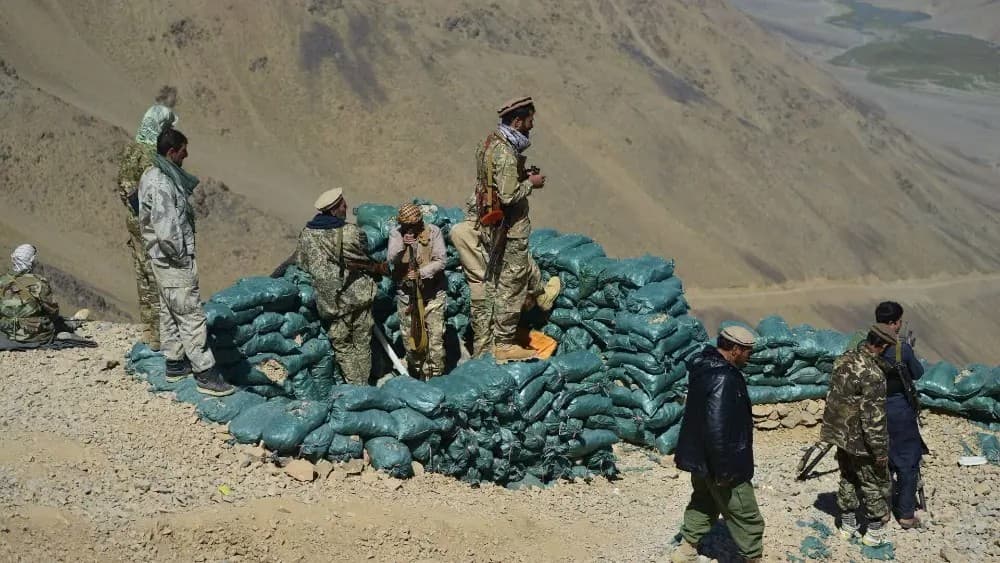
In this undated picture, fighters of anti-Taliban forces are seen on a hilltop in Badakhshan province of Afghanistan (@janansh48)
ISLAMABAD: Nearly five years after the Taliban returned to power, a growing number of anti-Taliban armed groups have emerged or expanded their activities across Afghanistan, signalling an evolving resistance movement despite the Taliban's continued grip on power.
Although none of the groups currently pose a significant military challenge to the Taliban administration, security analysts say their increasing number reflects persistent political, economic and social grievances that continue to fuel armed opposition.
Much of the information surrounding these organizations comes from statements issued by the groups themselves, posts on social media platforms such as X and Telegram, and reporting by Afghan media outlets.
While some attacks have been independently verified by researchers and open-source analysts, many operational claims remain difficult to confirm because of limited access to conflict areas and restrictions on independent reporting inside Afghanistan.
The National Resistance Front (NRF), led by Ahmad Massoud, remains the largest and most organized anti-Taliban movement.
Operating primarily in the Panjshir Valley and parts of Baghlan, Takhar and Badakhshan provinces, the NRF has repeatedly claimed attacks on Taliban checkpoints, patrols and military positions.
Although many of its battlefield claims cannot be independently verified, analysts generally regard the NRF as the most established armed opposition force because of its defined command structure, experienced former Afghan security personnel and sustained operational presence.
The Afghanistan Freedom Front (AFF), reportedly led by former Afghan military officials, including former Chief of Army Staff General Yasin Zia, has also expanded its operations over the past year.
The group has claimed responsibility for targeted attacks against Taliban personnel in Kabul, Kandahar, Baghlan, Parwan and several northern provinces. Security researchers say some of its operations, including grenade attacks and ambushes, have been independently verified, although the overall scale of its activities remains limited.
Smaller groups emerge
Beyond the NRF and AFF, several smaller organizations have also begun claiming attacks against Taliban targets, suggesting that Afghanistan's armed opposition is becoming increasingly fragmented while expanding geographically.
One such group, Sepahiyan-e-Mihan (Patriotic Soldiers Front), recently attracted attention after claiming attacks on Taliban positions and convoys in Afghanistan's northeastern Badakhshan province.
According to Afghanistan International, little is publicly known about the organization. However, its reported activities have fuelled debate over whether Afghanistan is entering a new phase of organized resistance against Taliban rule.
Local sources quoted by the broadcaster said the group's ranks include former members of the now-defunct Afghan National Defense and Security Forces, political activists and residents of Badakhshan who have grown increasingly dissatisfied with Taliban governance.
Another organization, the Afghanistan Islamic National and Liberation Movement (AINLM), led by former Afghan Special Forces commander Abdul Mateen Sulaimankhail, has presented itself as one of the few predominantly Pashtun anti-Taliban groups.
The movement says it operates in several provinces and has claimed attacks against Taliban forces. However, independent verification of many of its operational claims remains limited, making it difficult to assess the group's operational reach or military capabilities.
Another recently emerged organization, the Afghanistan Liberation Movement (ALM), has also begun publicizing its activities. In a statement issued on July 27, the group claimed responsibility for an ambush on a Taliban convoy near Kang district in Nimroz province, alleging six Taliban members were killed and a truck carrying narcotics was destroyed.
The claims could not be independently verified, and there was no immediate public comment from the Taliban.
Several other organizations have also surfaced in recent months, including the National Guardians Front of Afghanistan, the National Independence Front of Afghanistan and the Republican Front of Afghanistan.
Each has claimed responsibility for attacks on Taliban positions in different parts of the country, often releasing videos and statements through social media. Analysts caution, however, that little is publicly known about their leadership, manpower or logistical networks, making independent assessment difficult.
Unlike earlier resistance organisations that were largely rooted in specific ethnic or regional constituencies, these newer groups claim to operate across multiple provinces, a pattern some researchers describe as unusual in Afghanistan's traditionally localised insurgent landscape.
Other previously announced organisations, including the Freedom Corps, Freedom and Democracy Front, Liberation Front of Afghanistan, Soldiers of Hazaristan, and armed networks reportedly affiliated with former Balkh governor Ata Mohammad Noor, have also declared their opposition to Taliban rule. However, researchers say there is little publicly available evidence that these organizations have conducted sustained or coordinated military operations.
Why are new groups emerging?
Analysts say the emergence of new resistance groups reflects broader political and socio-economic conditions rather than a dramatic shift in Afghanistan's military balance.
In a 2023 analysis, David Loyn, senior visiting research fellow in the War Studies Department at King's College London, argued that the Taliban have struggled to transition from an insurgent movement to a governing authority, with many government ministries headed by clerics lacking administrative experience.
Loyn wrote that during its two-decade insurgency, the Taliban consolidated influence through intimidation, killing thousands of tribal elders and religious scholars while portraying the former Afghan government as corrupt and overly dependent on Western support.
Separately, an article published in the Review of Afghanistan Development argues that Afghanistan's deteriorating political, economic and social conditions have created fertile ground for armed opposition.
The study says worsening economic hardship, restrictions on political participation, shrinking civil liberties and growing public dissatisfaction have encouraged scattered opposition elements to organize, build local support networks and coordinate activities across different regions.
According to the assessment, the broader geographic footprint claimed by some of the newer resistance groups suggests an effort to move beyond traditional ethnic and regional strongholds through local recruitment and community-based support networks.
Despite these developments, analysts say the Taliban continues to exercise firm control over Afghanistan's security institutions and administrative structures.


Latest News
Anti-Taliban resistance groups multiply as Afghanistan's armed opposition gradually evolves
AN HOUR AGO
Why are tech stocks tanking?
3 HOURS AGO

Taliban official for Badakhshan killed in a targeted attack
4 HOURS AGO
'Appy marriages: AI helps hundreds of Japanese wed
4 HOURS AGO

Elimination of Hepatitis C by 2030 still a priority: President, PM Sharif
4 HOURS AGO