


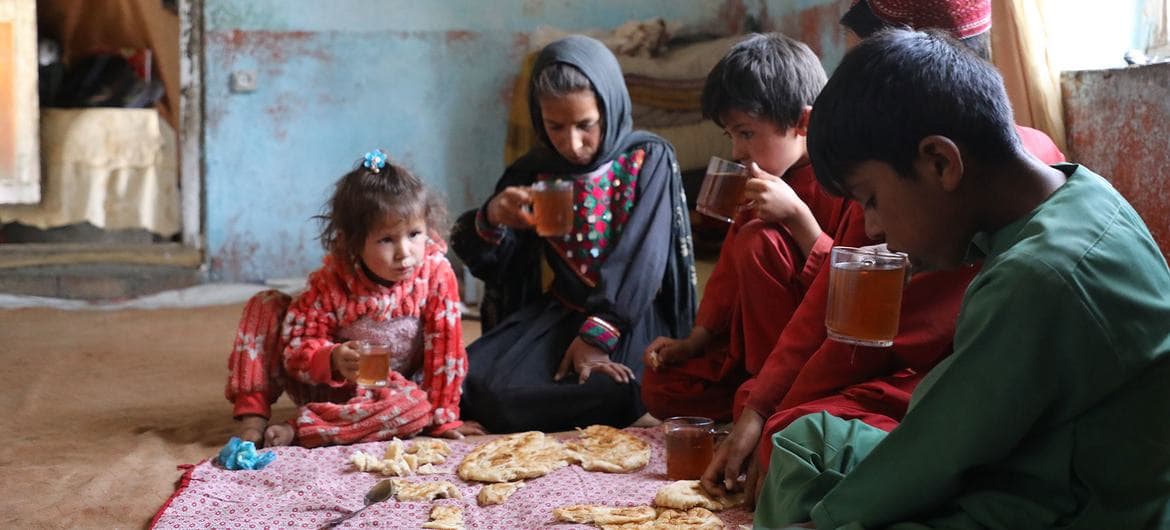
ISLAMABAD: Worsening hunger in Afghanistan is forcing families into desperate measures as unemployment, poverty and cuts to international aid deepen the country’s humanitarian crisis, a BBC World report says.
According to the report, hundreds of men, desperate for work and food, gather each morning in the dusty square of Chaghcharan, Ghor province’s capital, hoping for a few hours’ casual labour to keep their families alive.
Juma Khan, a local resident told BBC World that he has found only three days of work in the past six weeks, earning 150–200 afghani ($2.35–$3.13) . “My children went to bed hungry three nights in a row.”
“I live in fear that my children will die of hunger,” he was quoted as saying.
The United Nations says three in four Afghans cannot meet basic needs and about 4.7 million people are one step away from famine. Severe drought, collapsing livelihoods and steep cuts to international aid since the Taliban returned to power in 2021 have pushed provinces such as Ghor toward catastrophe.
At the square, men scramble for stale loaves when a baker hands them out. Reporters witnessed only three hires during a two-hour period. “I got a call saying my children hadn't eaten for two days,” said Rabani. “I felt like I should kill myself. But then I thought, how will that help my family?”
Families describe unbearable choices. Abdul Rashid Azimi, holding his seven-year-old twins, said he has considered selling them to feed the rest of his children. “I’m willing to sell my daughters,” he said through tears. His wife, Kayhan, said the household survives on bread soaked in hot water; teenage sons polish shoes while another son collects rubbish for cooking fuel.
In another case, a father said he transferred custody of his five-year-old daughter to a relative to pay for surgery for appendicitis and a liver cyst. The arrangement raised 200,000 afghani (about $3,200); the relative agreed custody for up to five years. “If I had money, I would never have taken this decision,” he said. “But then I thought, what if she dies without the surgery?”
Chaghcharan’s provincial hospital shows the human cost. The neonatal unit is overcrowded; most babies are underweight and many struggle to breathe. A pair of premature twins were placed on oxygen; one died a few hours later. Nurse Fatima Husseini said there are days when as many as three infants die. Doctors say essential medicines and equipment are often unavailable and families must buy drugs privately or take sick children home because they cannot afford care.
The Taliban government blames the country’s economic collapse on the previous era and foreign withdrawal and calls for depolitizised humanitarian aid. Donors, including the United States and the United Kingdom, say Taliban restrictions on women and girls and other policy concerns have influenced funding cuts.
Humanitarian agencies warn that without urgent, scaled-up assistance, more families will be forced into desperate measures and more children will die. Aid groups are calling for predictable funding and unrestricted access to reach hard-hit provinces such as Ghor.