


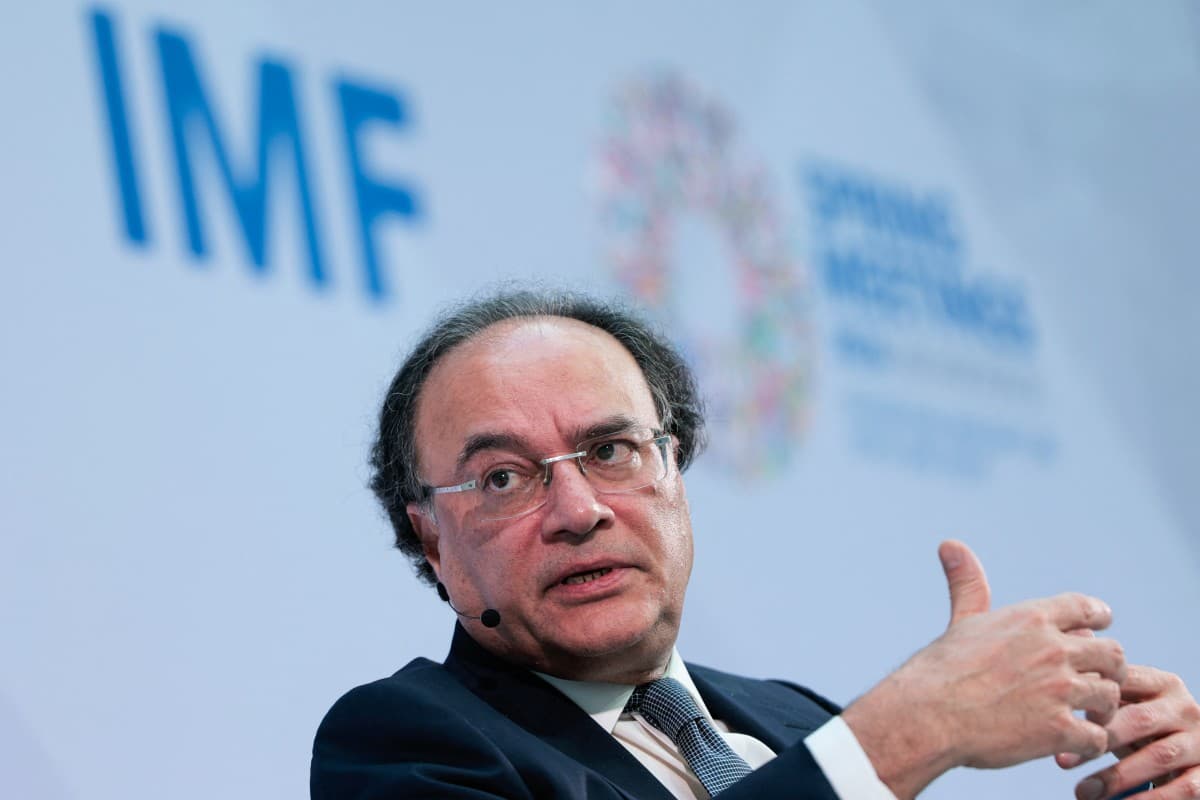
ISLAMABAD: Pakistan’s Finance Minister Muhammad Aurangzeb on Thursday highlighted the country’s forward-looking financing strategy and renewed engagement with international capital markets, underscoring improving macroeconomic stability and sustained reform momentum during high-level engagements at the IMF–World Bank Spring Meetings 2026.
Speaking in an interview with Maria Bartiromo on the Fox Business Network program “Mornings with Maria,” the finance minister said Pakistan is preparing to re-enter global capital markets through diversified instruments, including its inaugural Panda bond issuance and potential Eurobond offerings.
“He noted that the government is preparing for its inaugural Panda Bond issuance, alongside exploring Eurobond and other commercial financing avenues to diversify funding sources and sustain investor confidence,” the Ministry of Finance said in an official statement.
Aurangzeb emphasized that Pakistan’s return to international markets comes after a four-year gap and is part of a broader strategy to strengthen external financing channels and deepen investor engagement.
During a separate meeting with Rothschild & Co., the minister outlined plans for re-accessing capital markets through “Eurobonds, a Panda bond, and dollar-settled rupee-linked transactions” as part of a diversified financing framework.
He noted that the Panda bond issuance is at an advanced stage, with regulatory approvals expected shortly.
The finance minister also welcomed advisory input on liability management operations, describing them as “a strategic tool to help compress Pakistan’s yield curve and strengthen market confidence,” according to the statement.
IMF engagement and external financing outlook
In a separate meeting with Nigel Clarke of the International Monetary Fund, Aurangzeb reviewed programme implementation and Pakistan’s external financing outlook, noting that key economic indicators remain broadly on track.
He informed that the current account performance has been “stronger than expected,” supported by robust remittance inflows, particularly during Ramadan, while foreign exchange reserves are being reinforced through financial support from the Kingdom of Saudi Arabia, including deposit rollover arrangements.
“The Finance Minister outlined Pakistan’s strategy to diversify its financing sources, including plans to access international capital markets through instruments such as an inaugural Panda bond, Eurobond issuances, and local-currency financing to mitigate foreign exchange risks,” the finance ministry said.
Aurangzeb also “appreciated Mr. Clarke’s positive assessment of Pakistan’s programme implementation and financing strategy,” particularly the emphasis on developing multiple funding avenues to enhance economic resilience.
Both sides agreed that geopolitical and regional shocks may persist longer than anticipated, underscoring “the importance of maintaining exchange-rate flexibility and preserving fiscal space, rather than pursuing growth through unsustainable public borrowing,” according to the official statement.
The minister welcomed the forthcoming IMF mission to Pakistan next month for discussions on the federal budget and programme review.
Macroeconomic stability and reform momentum
Aurangzeb said Pakistan’s improving economic fundamentals underpin its re-entry into global markets, citing stable macroeconomic indicators and strengthened fiscal and external buffers.
“He added that the country’s macroeconomic indicators remain stable, supported by strengthened fiscal and external buffers,” the statement said.
The minister noted that remittances remained robust, reaching approximately $3.8 billion in March, while Pakistan also recorded a current account surplus. He expressed confidence that the economy would achieve around 4 percent growth in the current fiscal year and maintain foreign exchange reserves at levels covering about three months of imports.
Highlighting Pakistan’s track record, he said the country had “successfully repaid its USD 1.4 billion Eurobond on time,” reinforcing its commitment to meeting sovereign obligations.
At multiple engagements during the Spring Meetings, Aurangzeb underscored Pakistan’s ongoing reform programme supported by the IMF, including fiscal consolidation, structural reforms, and improvements in public financial management.
He reaffirmed that Pakistan has secured sufficient external financing to meet its fiscal year 2026 obligations.
Global engagement and climate finance push
In meetings with global leaders, including António Guterres, the finance minister highlighted Pakistan’s role in promoting regional stability and addressing global economic challenges, particularly the impact of ongoing Middle East tensions on energy and food security.
“He noted that Pakistan’s leadership is actively engaged in advancing diplomatic efforts… aimed at sustaining the ceasefire and paving the way for further negotiations,” the finance ministry said.
Aurangzeb also pointed to Pakistan’s growing focus on climate finance and sustainable growth, citing support from the World Bank Group under its Country Partnership Framework and collaboration with international partners on blended finance solutions.
“Both sides agreed on the importance of developing a robust pipeline of blended finance transactions… to reduce overall borrowing costs,” the statement said following discussions with financial institutions.
The minister highlighted structural shifts in Pakistan’s economy, including digital transformation, privatization of state-owned enterprises, and expansion of renewable energy capacity, noting that these reforms are aimed at improving governance, enhancing competitiveness, and attracting long-term investment.
Managing global shocks
Addressing external risks, Aurangzeb described the ongoing Middle East situation as a “major global supply shock,” noting its implications for energy procurement, pricing, and logistics.
He said the government’s immediate focus remains on ensuring supply chain continuity, while monitoring second- and third-order impacts on inflation, growth, and the external sector.
“The extent of second and third-order impacts… would depend on the duration and intensity of the conflict,” the statement noted.
Finance chief expresses deep appreciation for China’s long-standing, unwavering support
On the sidelines of the World Bank-IMF Spring Meetings 2026, the finance minister also met his Chinese counterpart Lan Fo’an, where Senator Aurangzeb expressed deep appreciation for China’s long-standing and unwavering bilateral support to Pakistan.
He briefed his Finance Minister Lan on Pakistan’s performance under the IMF program, noting the successful conclusion of a Staff-Level Agreement for the third review under the Extended Fund Facility (EFF) and the second review under the Resilience and Sustainability Facility (RSF), with IMF Executive Board approval expected in early May.
The finance minister informed that Pakistan has successfully repaid its USD 1.4 billion Eurobond and has secured significant additional financial support from Saudi Arabia to strengthen its external position.
He also provided an update on the progress of Pakistan’s inaugural Panda bond issuance, as part of efforts to diversify financing sources and deepen engagement with international capital markets.
Highlighting growing economic linkages, the finance minister noted that the share of Pakistan-China trade settled in Renminbi (RMB) has increased significantly, underscoring the need for an expanded currency swap arrangement to support rising trade volumes.
The finance minister appreciated Minister Lan’s acknowledgement of Pakistan’s active role in facilitating dialogue and promoting stability in the region.