


ISLAMABAD: Bangladesh ended 2025 at a crucial crossroads, facing challenges in political transition, governance reforms, and democratic accountability following the July 2024 Uprising.
The year was marked by active youth participation, highlighting the nation’s demographic dividend and setting a tone for future socio-political developments, said a report published by Bangladesh Sangbad Sangstha (BSS), the state-owned news agency of Bangladesh.
These were some of the major events that shaped 2025 for the country.
Khaleda Zia’s demise
The country lost its former prime minister and Bangladesh Nationalist Party chairperson, Khaleda Zia, on Dec. 30.
Zia was the first woman prime minister of Bangladesh and the second in the Muslim world.
Apart from countrymen and people cutting across their political affiliations, she drew tributes from international leaders, including the premiers of India and Pakistan.
Her funeral prayer drew millions, and she was buried beside the mausoleum of her slain husband, Ziaur Rahman.
Signing of National July Charter
On Oct.17, the landmark “July National Charter 2025” was signed after protracted consultations between the political parties and the National Consensus Commission, headed by the interim government’s Chief Adviser, Professor Dr Muhammad Yunus.
During the signing ceremony, Professor Yunus said Bangladesh "embraced civilization" by signing the document and described the ceremony as the "birth of a New Bangladesh."
The charter contains a seven-point commitment, urging the signatory political parties to uphold it as the will of the people expressed in the July 2024 Uprising and grounded in democratic principles and national consensus.
Launching of NCP
On Feb. 28, the National Citizen Party (NCP), comprising the students and youths who spearheaded the July 2024 Uprising, emerged as a political party vowing to pursue politics of national unity over division and to materialize their vision for a “second republic.”
July martyr Ismail Hossain Rabbi’s sister Mim Akhter announced the top leadership of the NCP central committee at its inaugural rally at Manik Mia Avenue in front of Jatiya Sangsad Bhaban in the capital, with one of the top July 2024 Uprising leaders, Nahid Islam, as its convener and Akhter Hossen as member secretary.
Unveiling of the July Declaration
On August 5, Professor Yunus unveiled the “July Declaration” before the nation at a public gathering at South Plaza of the Jatiya Sangsad Bhaban.
The event was arranged to commemorate the July 2024 Uprising Day.
Tarique Rahman’s homecoming
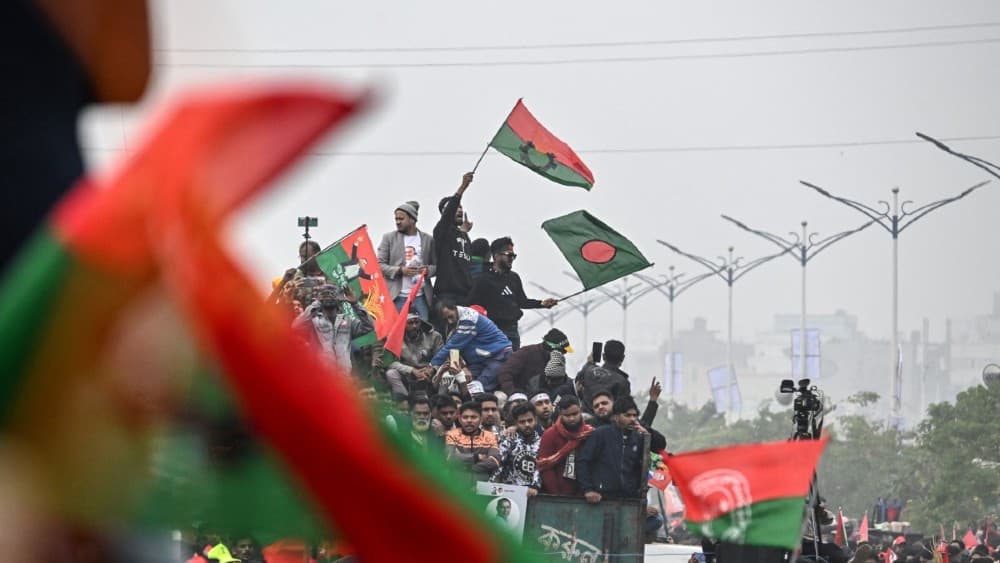
Bangladesh’s transitional political landscape witnessed a significant event when the Bangladesh Nationalist Party Acting Chairman, Tarique Rahman, returned to Bangladesh on Dec. 25 after 17 years in exile in the UK.
Hundreds of thousands of people welcomed him, rallying on the streets stretching from Hazrat Shahjalal International Airport to the July 36 Expressway, popularly known as 300-Feet Road, where he addressed a mammoth public reception.
Referring to a popular quote from US civil rights activist Martin Luther King, “I Have a Dream”, Tarique Rahman said, “I have a plan for the people of my country and for my countrymen,” and sought people’s cooperation to realize his plan.
Disbanding of Awami League
On May 12, the government banned all activities of deposed prime minister Sheikh Hasina’s Awami League and its associated and affiliated organizations under Bangladesh’s tough Anti-Terrorism Act, on allegations of killings, genocide, crimes against humanity, and other grave offences to tame the July uprising, issuing an executive order.
Coinciding with the order, the Election Commission suspended Bangladesh Awami League’s registration on the same day, disqualifying it from contesting the upcoming general elections.
Sheikh Hasina’s trial
On Nov. 17, the International Crimes Tribunal sentenced to death deposed premier Sheikh Hasina and former home minister Asaduzzaman Khan Kamal after their trial in absentia.
The three-judge panel headed by Justice Golam Mortuza Mozumder convicted them on charges of committing crimes against humanity on grounds of superior command responsibility for offences committed during the July Uprising.
Osman Hadi’s killing
The fag-end of the year witnessed the fatal attack on Sharif Osman Hadi, the leader of the cultural group Inqilab Mancha, imbued with the July Uprising spirit, and his subsequent death on Dec. 18, sparking a nationwide protest and uproar.
Hadi’s funeral prayers held at the South Plaza of Jatiya Sangsad Complex drew tens of thousands of people on Dec. 20. The chief adviser, his advisory council members, and senior government officials in civil and military services also attended. Hadi was buried beside National Poet Kazi Nazrul Islam’s Mausoleum on the Dhaka University campus.
Milestone School Tragedy
On July 21, a Bangladesh Air Force training jet crashed into a building on the campus of Milestone School and College at Diabari of the capital’s Uttara area, killing 36 people, mostly school children, with the rest being staff, teachers, and the fighter jet’s pilot.
Over 170 people were injured, with many suffering severe burns; hospitals, especially the National Institute of Burn and Plastic Surgery, were overwhelmed with patients.
Student union elections
After a long impasse, authorities staged central student union elections at premier Dhaka University, Jahangirnagar University, Chittagong University, and Rajshahi University in September and October.
Long-awaited Dhaka University Central Students’ Union elections were held on Sept. 9 after a six-year pause.
Chittagong University Central Students’ Union and Rajshahi University Central Students' Union elections were held on Oct. 15 and 16, respectively, after 35 years, while Jahangirnagar University Central Students' Union polls were held on Sept. 11 after 33 years.
Bangladesh women's football team’s success
On July 2, Bangladesh's women's football team created history by qualifying for the AFC Women's Asian Cup 2026 for the first time, following their outstanding 2-1 triumph over host Myanmar in their second group match at the Thuwunna Stadium in Yangon.
The success earned the team the Ekushey Padak 2025, Bangladesh's second-highest civilian award.
Bangladesh’s U-20 women’s football team won the 2025 SAFF U-20 Women’s Championship, held from July 11 to 21 at the Bashundhara Kings Arena and Sports Ground in Dhaka.