


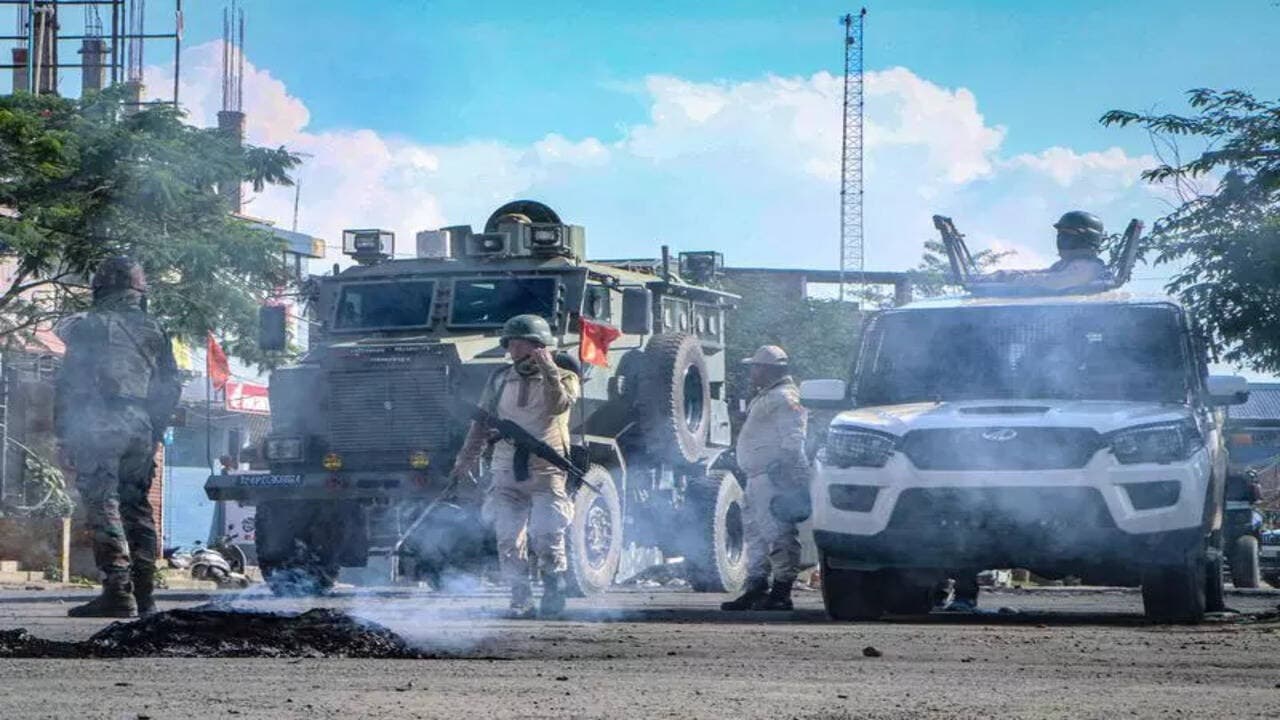
ISLAMABAD: Civil unrest in India’s northeastern state of Manipur has reached a critical point. Thousands from the minority Kuki-Zo community gathered on Jan. 14 in the Churachandpur district to demand an autonomous region as the February 13 deadline for the end of president's rule approaches.
At a meeting in Guwahati, insurgent groups and legislators reaffirmed their stance, stating they would support a new arrangement only if it included a written, time-bound commitment to a separate Union Territory with a legislature for Kuki-Zo regions, The Indian Express reported.
Local media reported that this demand is unlikely to be acceptable to the central BJP government.
In 2026, Human Rights Watch (HRW) continued to report on the "absolute breakdown of law and order" in Manipur, describing the ongoing ethnic conflict as a direct result of divisive Hindu majoritarian policies.
The crisis shows no signs of abating.
Background of the crisis
The BJP government extended the state of emergency in Manipur for six months in August 2025, after initially imposing it in February last year. Ever since, curfews and heavy military presence have further exacerbated conditions by choking the economy.
The US State Department issued a Level 4 travel advisory, urging people not to travel to the area due to an "increased threat of violence and crime."
President's Rule was imposed on Feb. 13, 2025, after the BJP-led state government's authority collapsed and Chief Minister Biren Singh resigned. The elected assembly was put in "suspended animation," leaving Manipur to be administered under the Union Home Ministry's security architecture, The Economic Times wrote.
But the ethnic fracture dates back to May 2023, with severe animosity between the Hindu majority Meitei and the mostly Christian minority Kuki-Zo causing violence and displacement on a massive scale.
Officially, the conflict has left over 260 dead, more than 1,500 injured, and over 60,000 displaced, according to The Economic Times.
Wider implications
Manipur's stalemate is feeding into a wider national storyline: a government that promises order but leans on heavy policy instruments while unrest migrates from one fault line to another.
Outside the northeast, too, farmer platforms are mobilizing against the BJP’s "anti-farmer" measures, such as prepaid smart meters and proposed changes to electricity and seed laws, the Times of India reported.
Recently, The Economist, in its Jan. 8 issue, warned that "Manipur is a warning for the rest of the country."
Whether the BJP government heeds this or not remains to be seen