

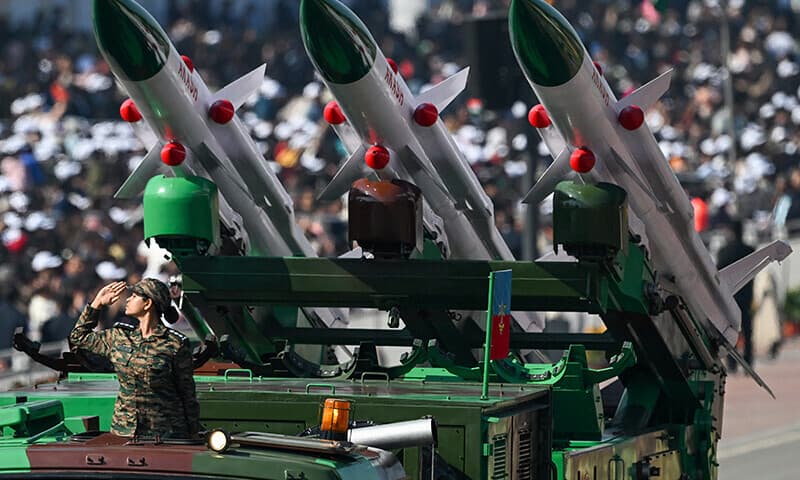
ISLAMABAD: While 235 million Indians struggle in multidimensional poverty, their government has locked in weapons contracts worth over $23 billion in 2025 alone, a military spending spree that analysts warn is accelerating a dangerous arms race across one of the world's most densely populated and nuclear-armed regions.
The scale of the buildup is staggering. The defense ministry in New Delhi signed 193 contracts totaling 2.09 trillion Indian rupees ($23.28 billion) in the 2024-25 cycle, according to India's Press Information Bureau. Domestic manufacturers secured 92% of orders under the "Atmanirbhar Bharat" self-reliance initiative, marking India's most aggressive military expansion in decades.
The timing is stark. India ranks 130th on the UN Human Development Index, with 235 million people facing multidimensional poverty and 269 million vulnerable to falling into poverty, according to the 2025 Global Multidimensional Poverty Index published by the UN Development Programme and Oxford University. Yet the Indian Union Budget for Financial Year 2025-26 allocates 13.45% of total federal expenditure to defense and just 2.54% to education.
An examination of India's weapons contracts reveals a coordinated strategy to achieve military dominance across South Asia while forcing regional neighbors into reactive militarization that diverts resources from development priorities and increases the risk of catastrophic miscalculation.
Arsenal from three continents
The acquisition spree draws from an unlikely coalition of suppliers. India and the US renewed their 10-year Defense Framework Agreement on Oct. 31 during meetings between Indian Defense Minister Rajnath Singh and US Secretary of Defense Pete Hegseth in Kuala Lumpur, according to statements from both defense ministries.
Under the renewed framework, Washington approved $45.7 million in Javelin anti-tank guided missiles and $47.1 million in Excalibur precision-guided artillery shells capable of two-meter accuracy at 70-kilometer range, according to US Defense Security Cooperation Agency notifications. The US also approved 113 additional GE-F404 engines for India's Tejas fighters.
The centerpiece of American military sales remains a $3.9 billion procurement of 31 MQ-9B Predator armed drones with 1,000-kilometer operational range, scheduled for 2029 delivery. Negotiations have advanced for six additional P-8I Poseidon maritime patrol aircraft and co-production of Stryker infantry combat vehicles, according to Indian defense sources.
France and India signed a $7.6 billion Inter-Governmental Agreement in April for 26 Rafale Marine fighters equipped with SCALP cruise missiles offering 300-kilometer standoff range and HAMMER precision munitions, according to the French Defense Ministry. The aircraft will deploy aboard carriers INS Vikrant and INS Vikramaditya.
Russia has continued deliveries of the S-400 Triumf air defense system despite Western sanctions, with three regiments now operational, according to Indian media reports. Indian media reported the systems were utilized during border incidents in May and December. Moscow and New Delhi signed a $248 million contract in March for engines to upgrade India's T-72 tank fleet, including technology transfer for licensed domestic production, according to Russia's state-owned Rostec Corporation.
Indigenous push
Domestic production has accelerated dramatically under the "Atmanirbhar Bharat" initiative. State-owned Hindustan Aeronautics Limited received $6.98 billion for 156 Prachand light combat helicopters, according to company statements. The Defense Acquisition Council approved $28 billion in procurements covering the Nag Missile System Mk-II, BrahMos fire control systems, indigenous medium-altitude long-endurance drones, ground-based electronic intelligence systems and naval surface guns, according to India's Press Information Bureau.
Additional contracts finalized 307 Advanced Towed Artillery Gun Systems valued at $768.5 million, 425,000 close-quarter battle carbines for $308.5 million, and various ammunition types for Pinaka Multi-Barrel Rocket Launchers totaling $1.13 billion, according to Ministry of Defense procurement data. The Cabinet Committee on Security approved development of the Advanced Medium Combat Aircraft fifth-generation fighter program in May, according to government statements.
"The next warfare frontier is swarm drone attacks," said Dr. Masood ur Rehman Khattak, assistant professor of international relations at International Islamic University Islamabad, whose doctoral research examined Indian military strategic thinking and its implications for South Asian deterrence stability. "We saw this in the Russia-Ukraine war, Israel-Iran confrontations and the Pakistan-India standoff in May. India is heavily investing in this domain."
Cost of guns over development
The opportunity cost becomes clear in comparative terms. The $3.9 billion allocated for armed drones alone could fund approximately 15,000 schools or 500 hospitals based on Indian government construction estimates obtained through Right to Information requests.
Trilateral arms race
The spending surge extends beyond South Asia's bilateral dynamics. India faces strategic challenges with China along the disputed Line of Actual Control, where persistent infrastructure buildup by the People's Liberation Army necessitates "modernization and operational preparedness" to maintain the status quo, according to the Ministry of Defence Annual Report 2024-25.
In the Indian Ocean Region, the Indian Maritime Doctrine 2025 formally recognizes the threat of "military encirclement" due to China's expanding naval presence and dual-use base network including facilities at Djibouti, Gwadar and Hambantota.
The competition between India-Pakistan and India-China creates interlocking security dilemmas that ripple through global great power relations. The US has positioned India as a counterweight to Chinese influence through weapons sales and strategic partnerships, while Russia maintains defense cooperation with New Delhi despite Western pressure over Ukraine.
"Countries involved in strategic competition do not compromise on defense expenditure," said Dr. Attiq ur Rehman, a defense analyst specializing in South Asian security, nuclear politics and defense studies. "India has adopted a balanced policy with all great powers — receiving S-400 systems from Russia while maintaining US strategic partnership — positioning itself as an essential customer for nations seeking to constrain Chinese influence regionally."
Regional reckoning
The arms buildup forces reactive militarization across the region. Pakistan has relied primarily on Chinese military assistance, including JF-17 Thunder fighters jointly produced with China and Type 054A frigates, according to Pakistani military sources. Regional states will be forced to divert scarce resources from development priorities into military modernization, perpetuating cycles of competition that benefit no population.
The pattern mirrors historical precedents. Arms buildups preceded the wars of 1965, 1971 and 1999, each time undermining diplomatic efforts and confidence-building measures that had sought to reduce tensions. India launched a massive modernization program following the 1962 Sino-Indian War while Pakistan received substantial American military aid through the 1954 Mutual Defense Assistance Agreement, according to Stockholm International Peace Research Institute military expenditure data.
"The conventional imbalance automatically creates dangerous dynamics," Khattak said. "This dynamic is extremely dangerous for the region. India is now focusing heavily on artillery with extended ranges — systems like Dhanush, ATAGS and Vajra K9 that far exceed the range of older systems. They're adding capabilities systematically, and this creates pressures that make the entire regional security environment more volatile."
Advanced weapons systems lower crisis thresholds and compress decision-making timelines during confrontations, reducing space for diplomatic resolution, according to conflict studies research from the Stockholm International Peace Research Institute.
Dr Rehman noted that the great power competition adds another layer of complexity. "India has positioned itself as essential to constraining Chinese influence, which ensures continued weapons flows from both Western and Russian suppliers despite geopolitical tensions," he said.
Guns-and-butter equation
The 2025 acquisitions fundamentally alter South Asia's military equilibrium. The trajectory threatens to transform one of the world's most densely populated regions into an arena of intensifying military competition, where advanced weapons systems and compressed crisis timelines increase the risks of miscalculation and escalation.
In a region where nuclear-armed neighbors have fought four wars since 1947, where over 500 million people live within potential strike range of the weapons systems India is now deploying (as per UN and SIPRI), and where a single miscalculation could trigger catastrophe on a scale the world has never seen, the $23 billion question is not what India can buy with its defense budget. It is what the entire subcontinent will pay for it.
The Rafale fighters, the Predator drones, the S-400 systems — each represents a choice. Not just between guns and butter, but between a future where South Asia's 2.096 billion people can pursue development and prosperity, or one where they remain hostage to an arms race that enriches defense contractors in Washington, Paris and Moscow while schools go unbuilt, hospitals remain understaffed and hundreds of millions stay trapped in poverty that military spending helps perpetuate.
India's defense ministry calls it strategic autonomy. History may record it as a collective suicide note, written in weapons contracts and signed by governments that chose military dominance over human development in one of the world's most vulnerable regions.