


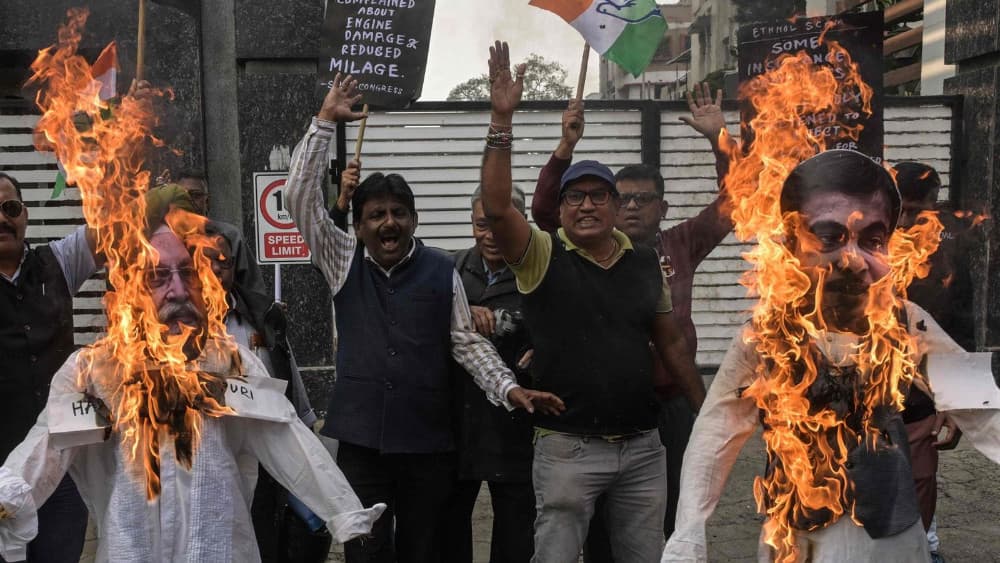
ISLAMABAD: India's decision to accelerate its ethanol blending target has drawn criticism from opposition parties, sparked scrutiny of the ethanol supply chain and raised concerns among motorists about transitioning to higher ethanol fuel blends.
Under 2022 amendments to the National Policy on Biofuels, the Modi government advanced its target of achieving 20% ethanol blending in petrol by 2025-26, moving the deadline forward by five years from the original 2030 schedule. The initiative was designed to reduce crude oil imports and support farmers in sugar- and grain-producing regions.
According to statutory election affidavits filed with the Election Commission of India, Nikhil Gadkari, son of Union Transport Minister Nitin Gadkari, chairs CIAN Agro Industries and Infrastructure Ltd., which operates ethanol distilleries.
Corporate disclosures filed with the Bombay Stock Exchange show the company's quarterly revenue increased from 174.7 million Indian rupees ($1.8 million) in early 2024 to 5.108 billion Indian rupees ($5.35 million) by June 2025. Net profit increased approximately 520-fold over 18 months, the disclosures show.
By October 2025, the company's share price had reached 3,460.15 Indian rupees ($36.30) on the Bombay Stock Exchange. Its market capitalization peaked at 96.830 billion Indian rupees ($1.03 billion), representing a 1,500% increase over 12 months, The Economic Times reported.
Gadkari denied allegations of a conflict of interest.
"My family accounts for less than 0.5% of India's total annual ethanol output," he said, according to India Today.
Congress President Mallikarjun Kharge rejected the explanation, describing the BJP-governed state of Madhya Pradesh as "the epicenter of corruption and plunder," The Times of India reported.
A criminal investigation in Madhya Pradesh uncovered a grain diversion scheme. The Food Corporation of India supplied subsidized rice to ethanol plants at 2,320 Indian rupees ($24.34) per quintal, below the government's estimated procurement cost of 4,100 Indian rupees ($43.01) per quintal, The Indian Express reported.
Administrative officials found that transporters intercepted shipments and diverted rice to private mills, where it was repackaged and returned to government warehouses. Operators then allegedly claimed government contract rates of between 3,900 Indian rupees ($40.91) and 4,000 Indian rupees ($41.96) per quintal, The Indian Express reported.
Authorities arrested four people in connection with the scheme, according to Balaghat police records cited by The Times of India. An Inspector General's investigation found the scam involved more than 550,000 metric tons of rice intended for government nutrition programs.
ABP News reported that authorities sealed 18 private rice mills across Balaghat district. The alleged scam was valued at between 11.6 billion and 12 billion Indian rupees ($121 million to $125 million), according to The Times of India.
On the technical side, vehicle owners reported engine-related problems. Ethanol contains roughly 30% less energy than pure petrol, resulting in fuel economy declines of 2% to 6% in controlled tests, according to the Automotive Research Association of India.
Real-world consumer complaints indicate fuel efficiency losses averaging between 10% and 12%, and as much as 30% in older engines, BBC News India reported. According to the Ministry of Road Transport and Highways' Vahan dashboard, India has approximately 340 million registered vehicles, with more than 200 million predating 2023 and lacking E20 calibration.
Ethanol absorbs atmospheric moisture, which can lead to phase separation and fuel pump failures. Pre-2023 vehicle owner manuals issued by Maruti Suzuki, Toyota and Hero MotoCorp explicitly warned against using fuel containing more than 10% ethanol, The Times of India reported.
On July 4, major automakers, including Maruti Suzuki, publicly assured consumers that E20 fuel was safe, according to the Ministry of Petroleum and Natural Gas. However, the same manufacturers' owner manuals had previously warned against higher ethanol blends, The Times of India reported.
On July 5, protesters gathered at Jantar Mantar in New Delhi to demand greater consumer choice at fuel stations, Financial Express reported. Aam Aadmi Party leader Arvind Kejriwal sent letters to 29 automobile manufacturers seeking written compensation guarantees for vehicle damage allegedly linked to higher ethanol fuel blends.
India's Attorney General described the program as an "ongoing experiment" during Supreme Court proceedings. The government later disputed that characterization, TBS News reported.
The government has continued to defend the ethanol blending program as a key component of its energy strategy, while opposition parties and some consumer groups have called for greater scrutiny of its implementation and its impact on motorists.