


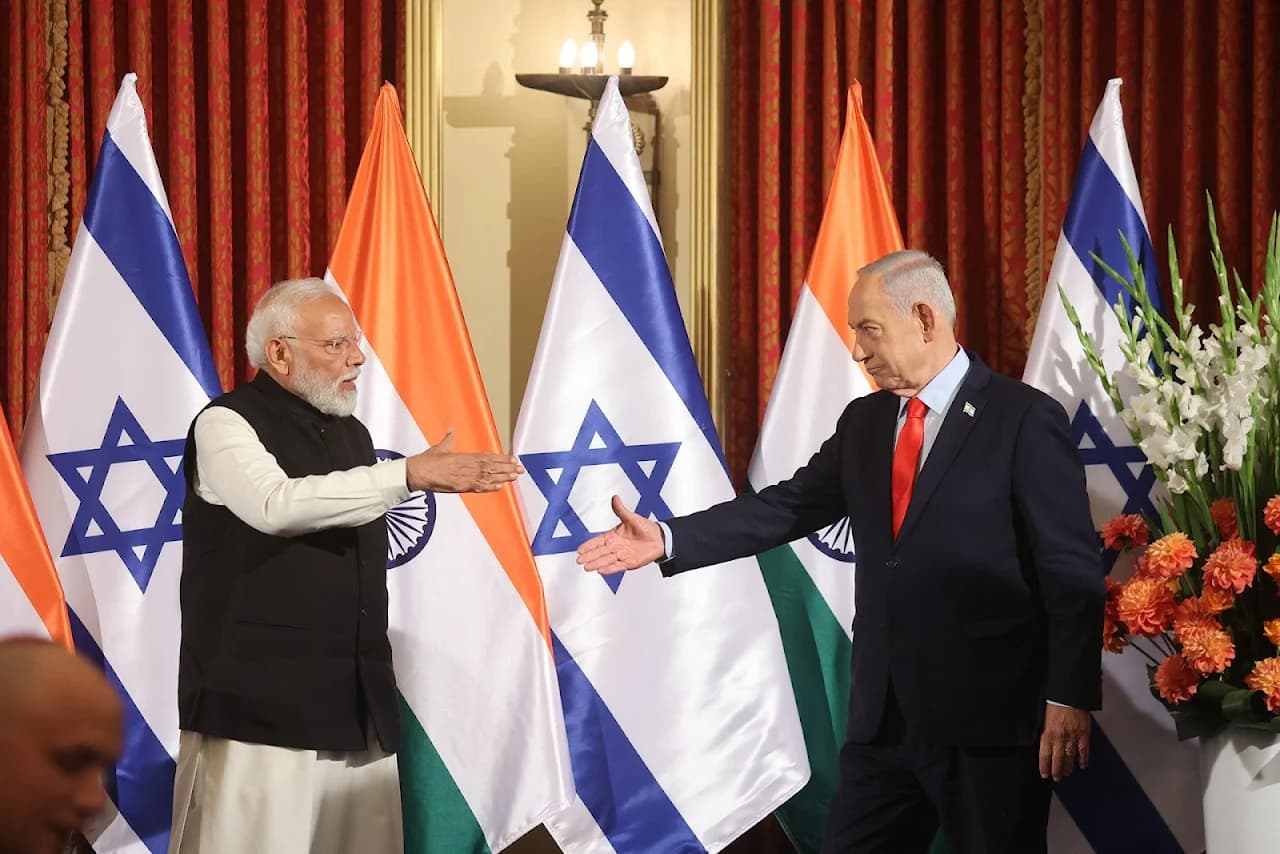
ISLAMABAD: In a recent op-ed, Sonia Gandhi, former president of Indian National Congress, questioned why Prime Minister Modi’s government had gone silent on Gaza. While the question was pointed, its answer, buried in defense contracts, drone factories, and abstention votes, is more damaging than silence alone.
India is not neutral on Israel. It is Israel's largest arms customer, its most important new labor market, and its most strategically significant partner outside the Western alliance. What India calls "balance" is merely a cover for a relationship that has been quietly militarizing for three decades and is now fully in the open.
The foundation was laid not in ideology but in necessity. When the Soviet Union collapsed in 1990, India lost its primary arms supplier, as observed by The Washington Post. This is where Israel stepped in.
When the United States and Western nations imposed military embargoes after India's 1998 nuclear tests, Israel refused to join them, as documented by PR Kumaraswamy in his book India's Israel Policy, published by Columbia University Press.
When India and Pakistan fought in Kargil in 1999, Israel delivered precision munitions and surveillance drones, according to research by Nicolas Blarel published by Oxford University Press.
Under Modi, that pattern of convenience hardened into a doctrine. His 2017 visit to Israel, the first ever by an Indian prime minister, deliberately excluded a stop in Ramallah, the seat of the Palestinian Authority, as reported by the Times of Israel. This was not a scheduling oversight but an unspoken act announcing how India would no longer treat its relationship with Israel as contingent on its relationship with Palestine.
The defense numbers confirm what the diplomacy signals. According to the Stockholm International Peace Research Institute, India accounted for 34% of all Israeli arms exports between 2020 and 2024, with total procurements reaching $20.5 billion.
And India is not merely buying weapons, it is building them together with Israel. A joint venture between India's Adani Corporation and Israel's Elbit Systems is manufacturing the Hermes 900 surveillance drone on Indian soil, according to The Jerusalem Post. The Barak-8 surface-to-air missile system were co-developed by both countries, as reported by The Hindu.
During the May 2025 standoff between India and Pakistan, the former deployed Israeli-made Harop and Harpy loitering munitions in strikes targeting the latter, The Jerusalem Post reported.
India deployed strikes on Pakistan following the Pahalgam attack in Indian Illegally Occupied Jammu and Kashmir on April 2025. As The Stimson Center noted, India had offered no public forensic evidence of its targets to international observers.
What is documented is the weapon, which was combat-tested in Syria (as reported by Atlantic Council’s Digital Forensic Research Lab) and then used near Pakistan's border. That is the practical threat of the India-Israel partnership for a nuclear-armed South Asia.
The economic architecture runs on the same logic. The I2U2 grouping is constructing food and energy corridors combining Indian labor and Israeli technology, as recorded by India's Ministry of External Affairs. The India-Middle East-Europe Economic Corridor places Israel as the Mediterranean gateway linking Indian industry to European markets, reported Al Jazeera.
India has also replaced Palestinian construction workers displaced by Israel's war on Gaza. By late 2024, approximately 32,000 Indian workers had filled those roles, with a bilateral agreement signed in February 2026 committing 50,000 more over five years, according to Al Jazeera. India is not merely aligned with Israel's military campaign, it is economically integrated into its consequences.
India maintains the façade of balance. Its External Affairs Minister Jaishankar calling for a two-state solution at the BRICS Foreign Ministers' meeting in May 2026, reported The Hindu. However, these positions cost nothing and change nothing. India has simultaneously abstained on four Gaza ceasefire resolutions in three years, according to BBC Monitoring. Its Supreme Court dismissed a petition to halt arms exports to Israel, ruling the matter falls within executive authority, according to the Human Rights Resource Centre.
Sonia Gandhi has asked why India is silent. The harder truth is that India is not silent, it is speaking through weapons, workers, and signed agreements. The words are just for everyone else.