


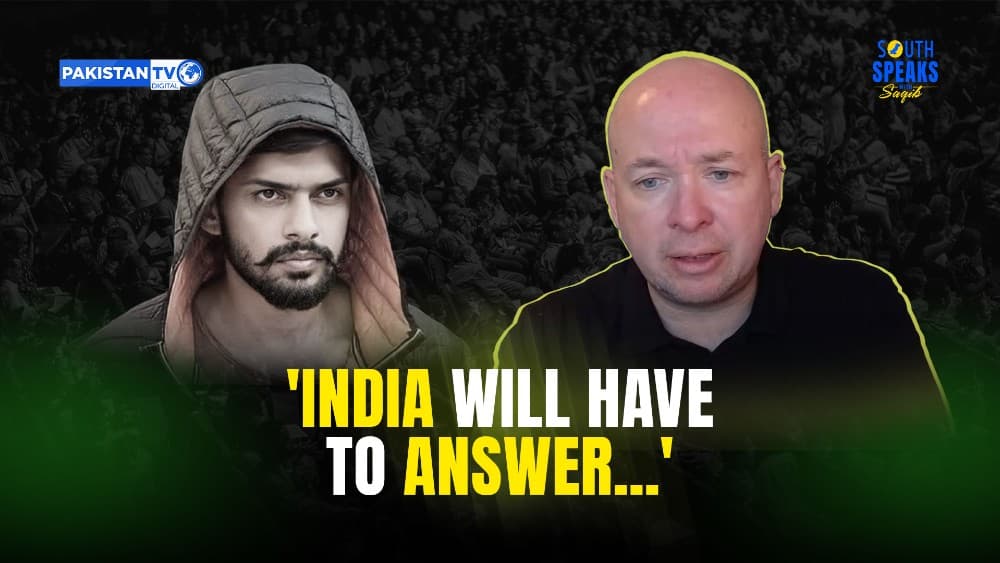
ISLAMABAD: India will face mounting questions over how alleged gangster Lawrence Bishnoi was able to coordinate a transnational criminal enterprise from a maximum-security prison, a Canadian academic has said, following sweeping US racketeering charges targeting the Bishnoi network.
The remarks come after the US Department of Justice and the Federal Bureau of Investigation (FBI) announced the results of Operation Hard Ball, a two-year multinational investigation involving the FBI, the Royal Canadian Mounted Police (RCMP) and other law enforcement agencies. The operation led to charges against 37 defendants across three indictments, including alleged Bishnoi associate Satinderjeet Singh, also known as Goldy Brar.
US prosecutors allege the criminal enterprise engaged in murder-for-hire, kidnappings, extortion, drug trafficking and weapons trafficking across North America. The indictment also alleges that Bishnoi and Brar directed the 2023 killing of Canadian Sikh activist Hardeep Singh Nijjar, a case that has intensified international scrutiny of the alleged network.
Speaking on Pakistan TV Digital's flagship program South Speaks with Saqib, Canadian Professor Robert Huis of Dalhousie University said one of the central questions raised by the investigation was how Bishnoi allegedly maintained operational control while incarcerated.
"The first is to answer the question about how someone like Lawrence Bishnoi, who's in a maximum security prison in India, has been able to orchestrate such criminal activity in North America," Huish said.
He said authorities would ultimately have to explain how an inmate held under maximum-security conditions allegedly retained the communication channels, financial resources and influence necessary to direct criminal operations abroad.
"There's going to have to be answers brought forward to say, how in the world could Bishnoi have organized this from prison?" he said.
Huish described Operation Hard Ball as the culmination of a coordinated international investigation spanning two years.
"Operation Hardball... that's been a two-year investigation... So far, there's been 37 people charged across three indictments," he said, adding that the alleged offences ranged from murder-for-hire and kidnapping to extortion and trafficking in cocaine, methamphetamine and firearms.
He said the current legal strategy adopted by US and Canadian authorities appeared to prioritize criminal prosecution over immediate diplomatic confrontation.
"I think the Canadian government and possibly the US government as well want to see this case dealt with strictly in terms of criminality," Huish said.
The academic noted that previous statements by Canadian officials had raised questions about possible links between the Bishnoi network and Indian authorities. However, he observed that the current US indictment focuses on alleged criminal conduct and does not accuse the Indian government of directing Nijjar's killing.
Huish nevertheless argued that the allegations surrounding Bishnoi's ability to allegedly coordinate crimes while imprisoned would continue to generate international scrutiny.
"That's going to be a hard one for the Indian government to wash away," he said, referring to questions over how the alleged criminal network operated while its purported leader remained behind bars.
Huish also suggested that future court proceedings could provide additional insight into the structure and operations of the alleged enterprise.
"You'd be surprised what can come out in the proceedings," he said, adding that evidence presented during litigation could clarify how the network functioned across multiple jurisdictions.
In a separate interview to Pakistan TV Digital earlier this month, Khalistan movement leader Gurpatwant Singh Pannun welcomed the US indictment, describing it as a significant legal development. Pannun alleged that the Lawrence Bishnoi gang functioned as a proxy for the Indian government rather than an independent criminal organization and accused senior Indian officials of directing transnational operations targeting Sikh activists.
Pannun also alleged that Indian diplomatic missions abroad provided cover for intelligence activities involving surveillance of Khalistan supporters. India has consistently rejected allegations linking its officials to extraterritorial killings and has denied involvement in the murder of Nijjar.
The case has drawn renewed international attention to the alleged activities of the Bishnoi network after Canada designated the Bishnoi Gang as a terrorist entity in 2025. The FBI has since identified Goldy Brar as the alleged head of the organization's North American operations and recently announced a reward of up to $50,000 for information leading to his arrest.
Huish said the investigation extends beyond individual criminal charges, raising broader questions about prison oversight, transnational organized crime and international law enforcement cooperation. While governments are currently pursuing the matter through the courts, he said the legal proceedings could shape future diplomatic discussions as more evidence emerges.