


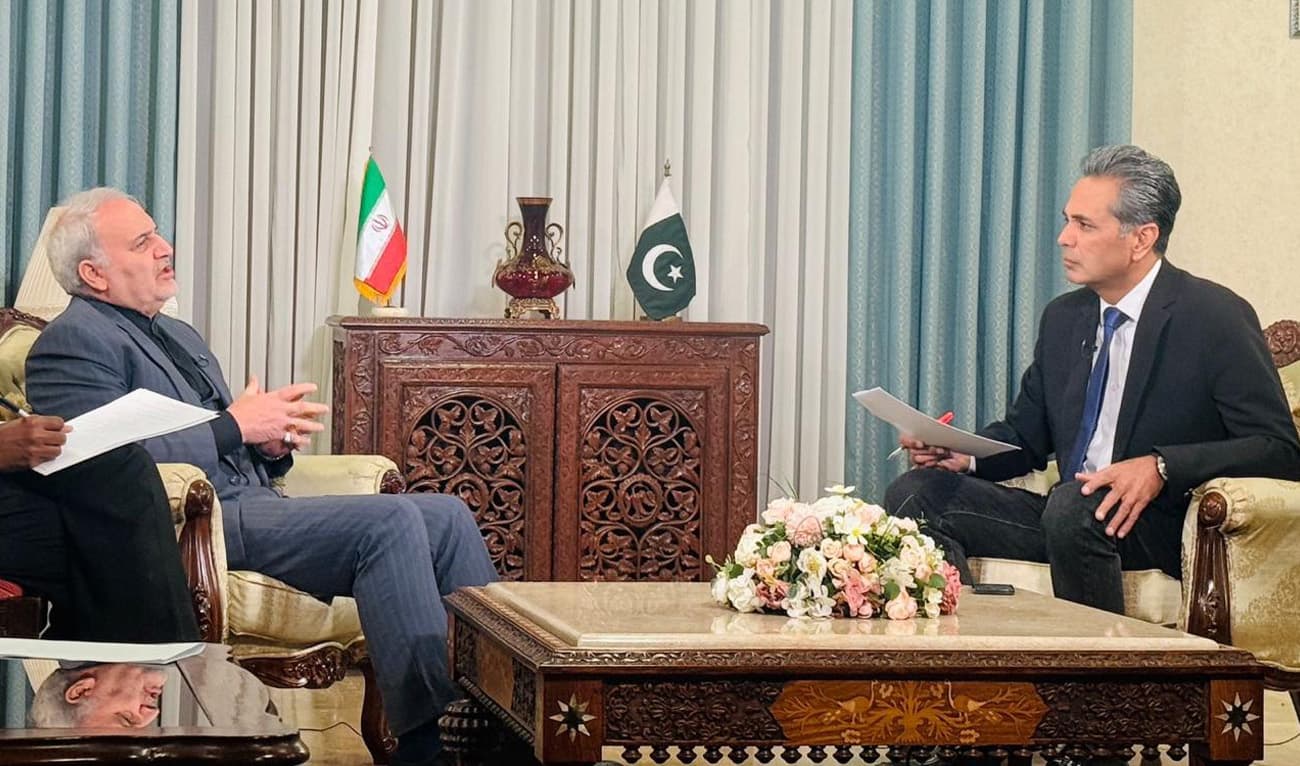
ISLAMABAD: Iran’s Ambassador to Pakistan Dr. Reza Amiri Moghaddam has said that the recent unrest in Iran was not a popular uprising, but a wave of violence driven by “terrorist elements” with foreign backing, claiming that peaceful economic protests were deliberately turned violent.
Speaking to SAMAA TV’s Red Line in an interview with Pakistani journalist Talat Hussain, the ambassador said the unrest, which began as protests by traders and shopkeepers over economic difficulties, was “hijacked” by armed groups late Friday night.
“For three to four days, the protests were completely peaceful,” Dr. Moghaddam said. “Then suddenly, on Friday night, terrorist elements entered, using firearms and bladed weapons, and deliberately created chaos.”
He said the violence lasted “seven to eight hours” and resulted in significant casualties, particularly among Iranian security forces.
“Most of the funeral processions taking place across Iran are of security personnel,” he stated. “In Tehran alone, around one hundred security force martyrs were laid to rest.”
Dr. Moghaddam alleged that attackers targeted civilian and public infrastructure, including “hospitals, schools, mosques, banks, ambulances, vehicles, and police stations,” adding that “people were burned alive in mosques and hospitals.”
He claimed that some arrested individuals had confessed to receiving training, weapons, and instructions. “They admitted they were trained, armed, and taught how to create unrest,” he said. “They were given two agendas: first, to target security forces; and if that was not possible, to target ordinary civilians.”
According to the ambassador, the aim was to maximize casualties and influence public opinion inside and outside Iran. “Their objective was mass killing so that global and domestic opinion could be turned against the Islamic Republic of Iran,” he said.
Addressing criticism that economic grievances reflected broader public anger, Dr. Moghaddam acknowledged hardship caused by decades of sanctions. “We have faced US sanctions for 40 years,” he said. “These sanctions have created economic pressure, and people have genuine difficulties. We do not deny that.”
He stressed that Iran’s leadership supported peaceful protest. “[Iran’s] Supreme Leader [Ayatollah Ali Khamenei] himself recognized the traders’ right to protest and instructed the government to address their issues,” he said, adding that senior officials met with business representatives before violence erupted.
Dr. Moghaddam also slammed the United States and Israel of openly encouraging unrest.
“Their interference is clear from their own statements,” he said. “When foreign leaders publicly tell protesters to seize government buildings, that is not support for protest, it is incitement.”
The ambassador said the violence subsided by Friday morning, after which large public rallies were held in support of the state. “From Sunday onward, the majority of people came out to condemn the violence, condemn the United States and Israel, and support the system,” he said.
He concluded by saying that allowing peaceful protest was “a strength, not a weakness,” but warned that “no country in the world accepts armed groups turning protests into bloodshed.”