


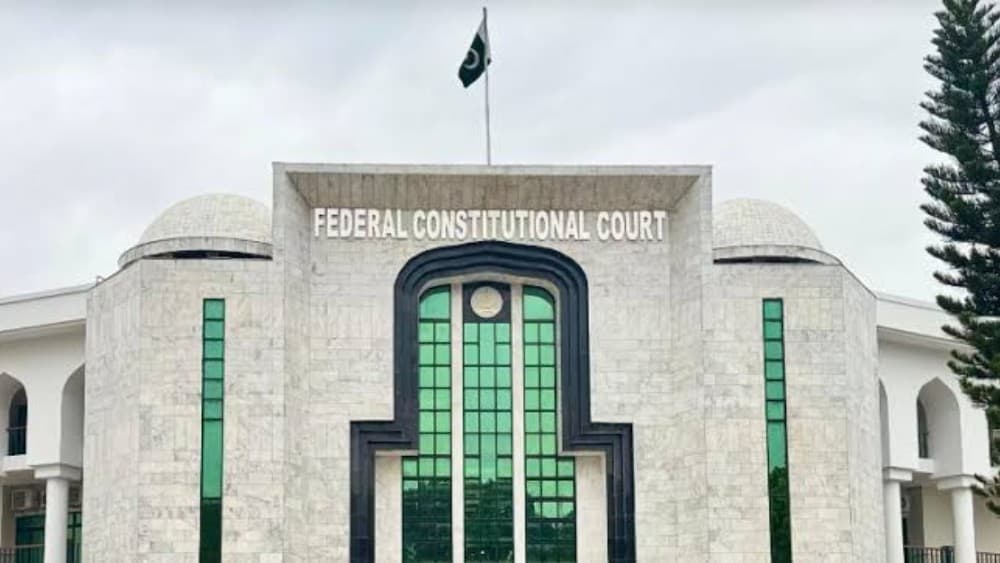
ISLAMABAD: European Parliament has tabled a motion for a resolution on the "abduction, forced conversion and child marriage of Maria Shahbaz," but an earlier judgment by Pakistan's Federal Constitutional Court shows the bench concluded she was of "mature age" and had embraced Islam to marry of "her own free will."
According to the detailed judgment released on March 25, Maria appeared before the court in person and reiterated that she had embraced Islam voluntarily, married Shehryar Ahmad "of her own free will" and had not been abducted.
The appeal was filed by Maria's father, Shahbaz Masih, who sought to overturn decisions of the Additional Sessions Court and the Lahore High Court (LHC), both of which had refused his plea for Maria's recovery after she told the courts she had voluntarily converted to Islam and married Ahmad.
The Federal Constitutional Court (FCC) said her position was consistent with her statement recorded under Section 164 of the Criminal Procedure Code before a judicial magistrate, as well as statements made before the Sessions Court and the LHC.
"The petitioner has failed to establish that the detenue is under any illegal or unlawful custody," the judgment said, adding that Maria had consistently maintained that she wished to reside with her husband.
The court said the evidence on record showed that Maria had "voluntarily embraced Islam and entered into a valid Nikah" and that there was "no material available on record" to conclude that she had been subjected to coercion.
She was of ‘mature age’
The bench rejected reliance on the birth records presented by her family, saying they "do not inspire confidence" and had "diminished probative value," the court said.
The judges cited delayed registration of birth records, inconsistencies in official documents, discrepancies in family records and Maria's own declared date of birth in the marriage documents.
They also referred to a medico-legal examination estimating her age at approximately 18 to 20 years and observed that "her physical appearance before the Court also suggests a more advanced age."
The judgment concluded that "the available documentary evidence cannot safely be relied upon to establish that the detenue was a minor" and held that she was of "mature age."
The bench also discussed the legal validity of Maria's conversion, saying that "no specific rituals are required for a non-Muslim to be regarded as having embraced Islam."
"What is required is a declaration and recitation of the Kalima, with belief in the Oneness of Allah, the Finality of the Prophethood of the Holy Prophet Muhammad (peace be upon him), and the Holy Quran," the judgment said.
It also held that, under Islamic law, a Muslim man may marry a woman from the Ahl al-Kitab, or People of the Book, and that embracing Islam requires no formal ritual beyond a declaration of faith and belief.
The judges also made an important distinction, saying the case before them concerned the legality of Maria's custody, not the criminal allegations arising from the police report, which remain matters for the trial court to decide.
Finding no grounds to interfere with the concurrent findings of the lower courts, the court dismissed the father's petition and allowed the earlier orders to stand.