


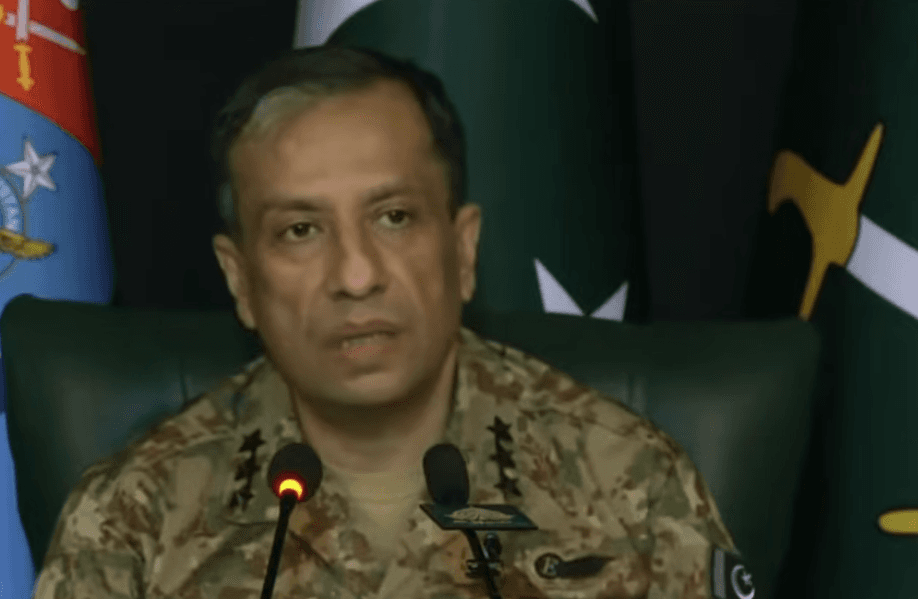
ISLAMABAD: Director General Inter-Services Public Relations (ISPR) Lt. Gen. Ahmed Sharif Chaudhry on Thursday said the conflict witnessed during Marka-e-Haq and Operation Bunyan-un-Marsoos was a "multidimensional phenomenon" fought beyond the Line of Control (LoC) and across every level.
Pakistan’s armed forces were fully prepared for the confrontation during Marka-e-Haq ("Battle of Truth"), the official designation for the military conflict with India, with the support of the public and the "blessings of Allah", the Director General said in a briefing to commemorate Pakistan's victory against India.
The ISPR chief claimed that India is continuously launching proxies against Pakistan, while the Pakistan Army remains engaged in a perpetual process of countering these threats.
Banyan-ul-Marsoos proved Pakistan’s potential and resilience against multi-faceted challenges, posed by both security and non-security threats, he said, adding that "this proves that we believe in ourselves to face all kinds of threats."
Lt. Gen. Chaudhry further described the operation as a "loud and clear re-establishment of deterrence," reaffirming that there is no space for war between two geographically contiguous nuclear powers.
"Even today, this message is reverberating throughout the entire region," he stressed.
Consequences of the war
Lt. Gen. Chaudhry said one of the major consequences of Marka-e-Haq was that attempts to portray Pakistan as a hub of terrorism had failed internationally.
"Attempts had been made to portray Pakistan as a hub of terrorism, and that was done without any evidence," he said, adding that the narrative was no longer being accepted globally.
DG ISPR further added that the conflict reinforced Pakistan’s role as a "net security stabilizer" in the region, saying India escalated tensions "based on a lie."
"Pakistan and its leadership came up as the biggest ambassador of security in the region," he said.
"Why are you trying to make jokers out of your admirals, generals, and marshals?", adding that "we [Pakistan] have placed the facts as they are."
He further said that Indian politicians appeared more like ‘warmongers', going by their statements, asserting that the politicization of the military and militarization of politics was ‘dangerous.’