

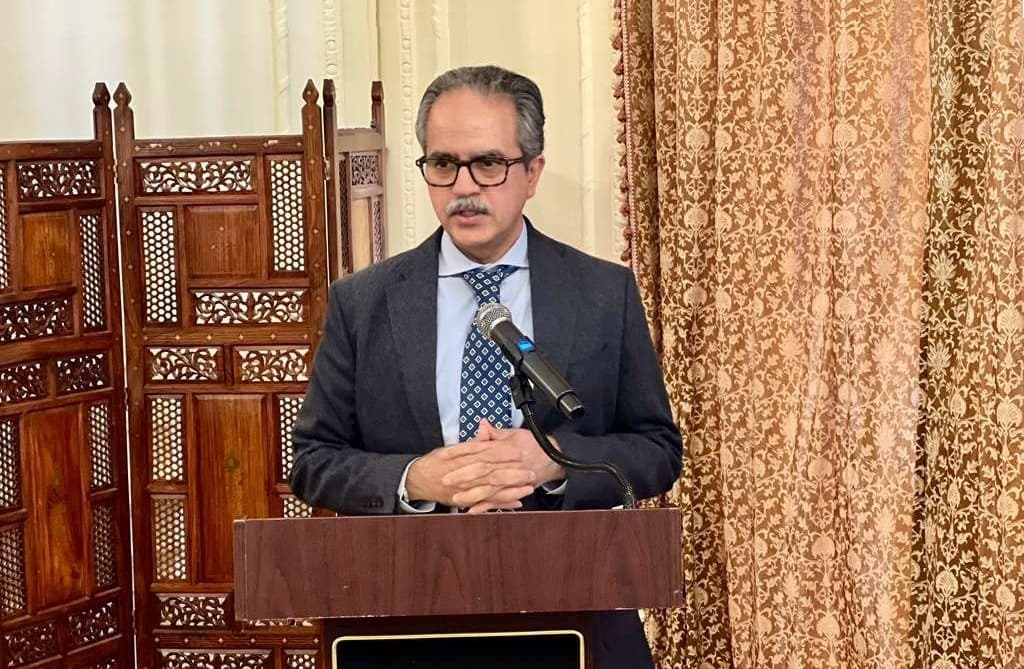
ISLAMABAD: Pakistan’s Permanent Representative to the United Nations Asim Iftikhar Ahmad called for reforms to the UN Security Council and urged stronger multilateral cooperation during a briefing with a visiting US Army War College delegation, according to a statement released Tuesday by Pakistan’s Mission to the UN.
According to the statement posted on X, a 40-member delegation from the United States Army War College, led by Colonel Stephan Walters and including five female officers, visited Pakistan’s mission to the United Nations for a country briefing.
UN reform push
Asim Iftikhar told participants the United Nations remained the central platform for addressing international peace and security, development, human rights, climate change and emerging challenges such as artificial intelligence and information technology.
He said global challenges were too interconnected for any country to address alone and called for stronger multilateral cooperation through the UN framework. The ambassador also discussed ongoing UN reform efforts, including changes to the Security Council and revitalization of the General Assembly.
He said Pakistan supports “democratic, transparent, and accountable” reform of the Security Council while opposing the creation of new permanent seats.
Pakistan’s UNSC role
Asim Iftikhar pointed to Pakistan’s role as a current member of the UN Security Council in peacekeeping, counterterrorism, regional stability and promoting peaceful settlement of disputes.
He also referred to the recent adoption of a Security Council resolution during Pakistan’s council presidency that committed to peaceful dispute resolution under Chapter VI of the UN Charter.
US-Iran tensions
The discussions also focused on tensions involving the United States and Iran, the evolving security situation in the Middle East, demographic change, artificial intelligence and Islamophobia.
The Pakistani ambassador warned that instability linked to US-Iran tensions had affected global energy markets, oil and gas supplies, fertilizer availability, food security, inflation, maritime trade and global economic growth.
Regional diplomacy
Asim Iftikhar said disruption in the Strait of Hormuz carried serious implications for global energy flows and trade routes. He stated that the United Nations had examined several scenarios linked to a prolonged crisis and said Pakistan had also experienced economic effects from the regional instability.
He described Pakistan’s relationship with the United States as broad-based, covering security, defense, counterterrorism, economic cooperation and trade. He also said Pakistan had engaged with the United States, Iran, Gulf countries, Egypt, China and Turkiye to support de-escalation, dialogue and diplomacy.
AI and Islamophobia
On artificial intelligence, Ahmad said growing use of AI in policy-making and institutional decision-making would raise human rights concerns and become a larger issue within the United Nations system.
Addressing Islamophobia, the Pakistani envoy said freedom of religion and belief remained a fundamental human right. He noted Pakistan’s support for efforts at the United Nations to establish a special envoy to combat Islamophobia.
The delegation included 33 American participants, two from Pakistan and one each from Türkiye, Sri Lanka, Moldova, Guatemala and Ecuador.