


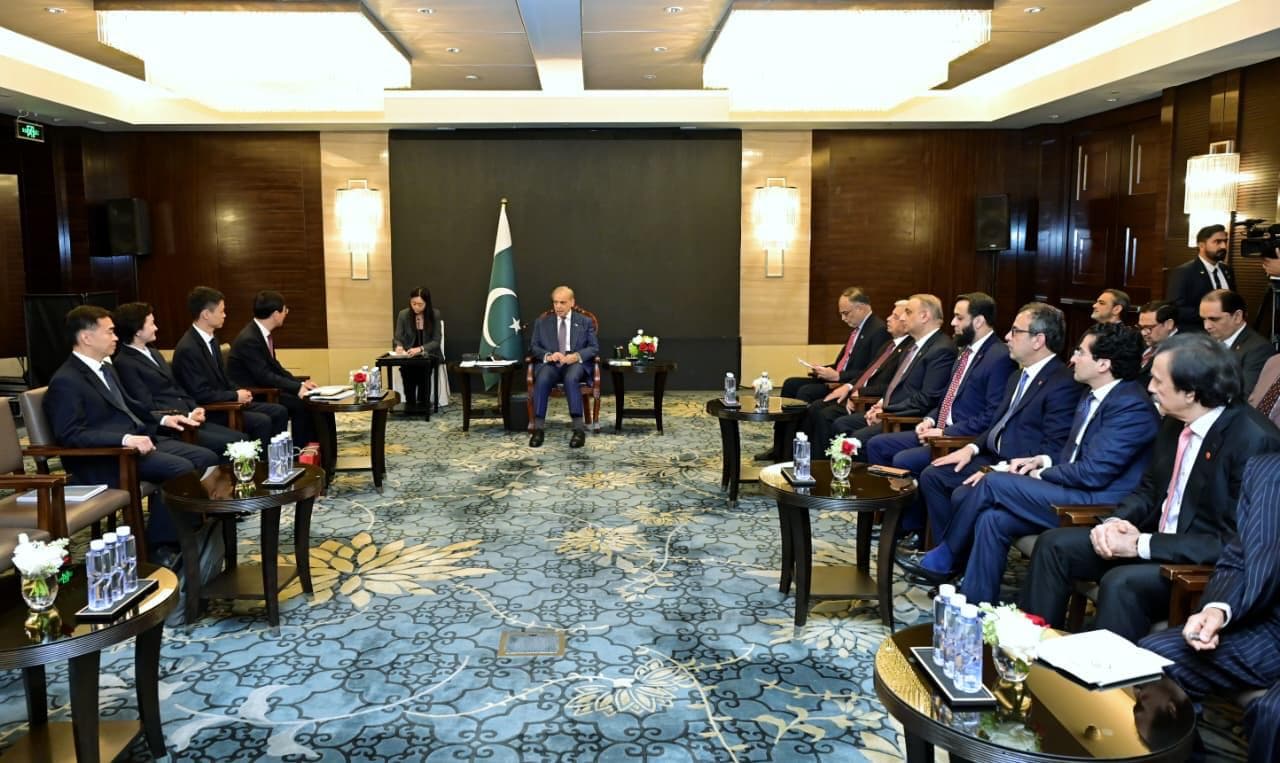
ISLAMABAD: Prime Minister Shehbaz Sharif held high-level meetings with leading Chinese companies in Beijing on Tuesday, as Islamabad intensified efforts to expand industrial cooperation, infrastructure connectivity, and technology investment under the second phase of the China-Pakistan Economic Corridor (CPEC).
The engagements come as Pakistan increasingly seeks to reposition CPEC beyond large-scale infrastructure financing toward manufacturing, industrial relocation, energy transition and export-oriented business partnerships with Chinese firms.
According to a statement issued by the Prime Minister’s Office, PM Sharif and Chinese executives reaffirmed their commitment to “further expand cooperation in the economic, industrial and infrastructure sectors under CPEC Phase-II.”
During a meeting with FAMSUN Chief Executive Officer Zhengjun Chen, the prime minister praised the company’s longstanding role in Pakistan’s agriculture sector, particularly in grain storage, feed production and food security.
The statement said PM Sharif identified the reduction of post-harvest crop losses as a government priority and invited the company to establish manufacturing and technology-transfer facilities in Pakistan by utilizing incentives available under Special Economic Zones and the Green Pakistan Initiative.
PM Sharif also met Chairman Hou Jianxin and representatives of Shandong Xinxu Group Corporation, welcoming the group’s expanding investments in maritime development, battery manufacturing, mineral processing and industrial cooperation.
The prime minister appreciated the company’s role in the Xinxu Special Economic Zone, the C2 Steel project at Port Qasim, and investments in Gwadar and Pakistan’s northern mineral sectors.
Reaffirming Islamabad’s backing for the projects, Sharif stressed the need for their “fast-track implementation under CPEC Phase-II,” according to the statement.
The prime minister separately met Chairman Zhang Bingnan of China Communications Construction Company and senior representatives of China Road and Bridge Corporation.
Sharif praised the companies’ contribution to Pakistan’s infrastructure development over the past six decades, particularly in projects including the Karakoram Highway and Rashakai Special Economic Zone.
He reiterated Pakistan’s commitment to accelerated progress on the ML-1 railway project, the realignment of the Karakoram Highway and other regional connectivity initiatives.
The prime minister emphasized that Pakistan viewed CCCC and CRBC as “long-term strategic partners” in infrastructure modernization and regional connectivity.
The meetings follow Sharif’s investment-focused engagements in Hangzhou earlier this week, where he urged Chinese companies to relocate industries to Pakistan through joint ventures with Pakistani firms.
“This model will be a win-win model for Chinese and Pakistani entrepreneurs,” Sharif said during the Pakistan-China B2B Investment Conference.
Chinese companies participating in Tuesday’s meetings expressed “strong confidence in Pakistan’s economic potential” and signaled “keen interest” in expanding investments across agriculture, industrial production, logistics, infrastructure and technology sectors, according to the statement.
Federal ministers and senior Pakistani officials attended the meetings and were directed to ensure “effective and timely implementation” of decisions reached during the business engagements.