


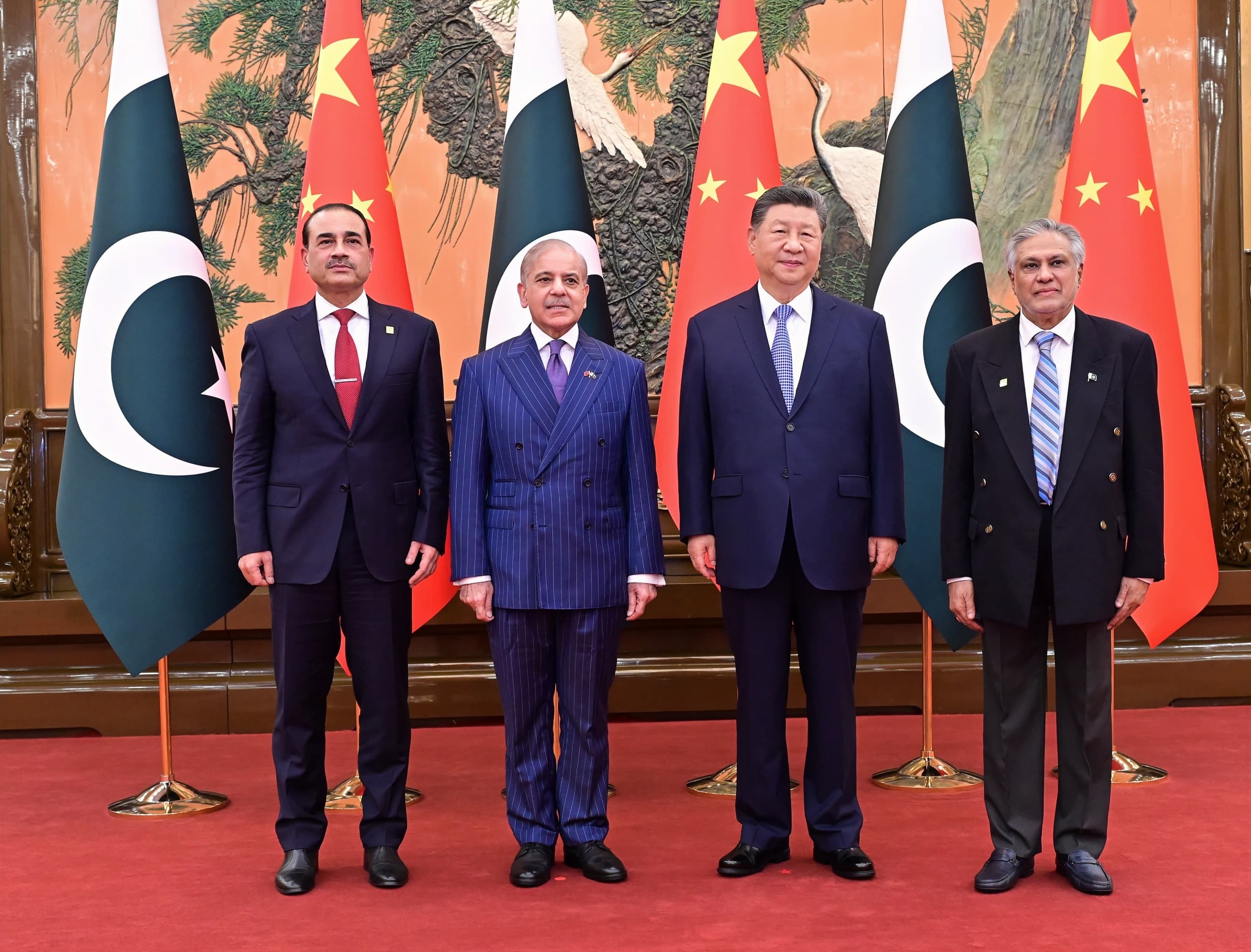
ISLAMABAD: Pakistan’s Prime Minister Muhammad Shehbaz Sharif met with Chinese President Xi Jinping in Beijing on Monday as both countries celebrate 75 years of diplomatic relations.
During the meeting, President Xi Jinping stated that China and Pakistan had built an “unbreakable traditional friendship” based on mutual understanding, trust, and support. He emphasized that China will always prioritize its relations with Pakistan in its neighborhood diplomacy, regardless of international changes, said a statement from the prime minister's office.
President Xi also appreciated Pakistan’s Chief of Defense Forces Asim Munir, for mediating negotiations between Iran and US in the recent conflict.
“Field Marshal Munir, [you] are also welcome in China,” he added, “I know you just came back from Iran for positive efforts to mediate for peace.”
PM Sharif thanked President Xi for the warm reception and reaffirmed Pakistan’s commitment to the all-weather strategic cooperative partnership with China.
He stated that the iron-clad friendship between the two countries had assumed even greater strategic importance in the evolving regional and global environment.
Both leaders agreed to carry forward the historic legacy of Pakistan-China friendship and transform the 75th anniversary into a new phase of strategic, practical, and future-oriented cooperation.
The meeting also included the Foreign Minister Ishaq Dar, Chief of Defence Forces Field Marshal Syed Asim Munir, Minister for Information and Broadcasting Attaullah Tarar, and other senior Ministers and government officials.
PM Sharif pays tribute to China's heroes
Pakistan's Prime Minister Shehbaz Sharif along with senior officials from both countries also laid flowers at the monument of the People's Heroes at Tiananmen Square in Beijing later on Monday, said a statement from the prime minister's office.
During the special ceremony, national anthems of both countries were played upon the arrival of the prime minister.
Tiananmen Square, which is located in the heart of Beijing, is regarded as a significant symbol of China's history, culture, and national identity.
Pakistan, China sign multiple MoUs
Earlier in Beijing, Pakistan and China signed multiple agreements, protocols and MoUs aimed at expanding bilateral cooperation in key sectors between the two countries, said a statement from the Prime Minister's Office in Islamabad.
The signing of agreements took place at a ceremony in the presence of Prime Minister Shehbaz Sharif and his Chinese counterpart Li Qiang.
The documents cover trade, agriculture, science and technology, climate change, education, media, and people-to-people exchanges.
The statement said that the key agreements include protocols on agricultural exports, such as maize and dried fruits, as well as cooperation in environmental protection, economic development, and human resource training.
It added that educational and institutional linkages were also strengthened between policy and foreign service academies of both countries.
According to the statement, "Media collaboration agreements were signed between PTV and Chinese counterparts, alongside science and technology partnerships."
Both sides emphasized that the agreements reflect the growing depth and diversification of Pakistan-China relations and will further enhance practical cooperation for mutual development and shared prosperity.
PM Sharif meeting with Chinese counterpart
Pakistan PM Shehbaz Sharif met Chinese Premier Li Qiang in Beijing during his official visit marking the 75th anniversary of diplomatic relations between Pakistan and China, said a statement from the Prime Minister’s Office in Islamabad.
The two leaders reaffirmed the Pakistan-China All-Weather Strategic Cooperative Partnership and reiterated support on issues of core interest to both countries.
According to the statement, the meeting reviewed bilateral cooperation in political, economic, strategic, security, and people-to-people domains, while expressing satisfaction over the steady progress of China-Pakistan Economic Corridor (CPEC) projects.
“Prime Minister Shehbaz Sharif emphasized Pakistan’s commitment to the high-quality development of CPEC’s next phase, focusing on industrialization, connectivity, agriculture, clean energy, science and technology, and digital transformation,” the statement read.
The prime minister also appreciated China’s continued support for Pakistan’s economic stability and reaffirmed Pakistan’s commitment to ensuring the security of Chinese nationals and projects.
Both sides agreed to enhance coordination and accelerate the implementation of key bilateral initiatives.
According to the statement, Deputy Prime Minister and Foreign Minister Mohammad Ishaq Dar, Chief of Defense Forces Field Marshal Syed Asim Munir, and other senior government officials also attended.
PM Shehbaz Sharif welcomed at the Great Hall
Prime Minister Shehbaz Sharif was received at Beijing’s Great Hall of the People on Monday, where he met Chinese Premier Li Qiang.
Sharif arrived in China on Saturday for a four-day official visit and reached Beijing on Sunday after a stop in Hangzhou.
Upon arrival at the Great Hall of the People, he was given a guard of honor, according to footage released by the government.
Chief of Army Staff and Chief of Defense Forces Field Marshal Syed Asim Munir, who wrapped up his visit to Iran on Saturday, was also present on the occasion.
PM to meet Chinese leadership in Beijing
The prime minister is scheduled to hold a series of high-level engagements in Beijing on Monday as part of his official visit to China, according to the Prime Minister’s Office.
During the visit, the prime minister will meet President Xi Jinping and other senior Chinese leaders to discuss bilateral cooperation and matters of mutual interest.
Pakistan and China are expected to exchange several memoranda of understanding and agreements during an official ceremony attended by both prime ministers.
Prime Minister Sharif, accompanied by his delegation, will also visit Tiananmen Square to lay a floral wreath at the Monument to the People’s Heroes.
As part of his engagements, the prime minister will meet leading Chinese investors and chief executive officers of major Chinese companies to promote economic cooperation and investment opportunities.
He will also attend a ceremony marking the 75th anniversary of diplomatic relations between Pakistan and China alongside the Chinese leadership.
Pakistan PM in Beijing
Earlier, PM Sharif arrived in Beijing on Sunday after concluding a series of investment and industrial engagements in Hangzhou, where he urged Chinese companies to relocate industries to Pakistan under what he described as a “win-win model” for both countries.
The prime minister’s visit comes as Islamabad seeks to deepen economic cooperation with China beyond traditional infrastructure financing under the China-Pakistan Economic Corridor (CPEC) project, focusing instead on industrial relocation, technology partnerships, renewable energy, agriculture and business-to-business investment.
According to a statement issued by the Prime Minister’s Office, PM Sharif is expected to hold high-level meetings with Chinese President Xi Jinping and Premier Li Qiang during his stay in Beijing to advance cooperation under CPEC Phase-II in trade, investment, industry, agriculture, science and technology, and people-to-people exchanges.
The visit coincides with the 75th anniversary of diplomatic relations between Pakistan and China.
In Hangzhou, PM Sharif chaired the opening session of the third Pakistan-China B2B Investment Conference, attended by more than 500 companies from both countries and focused on information technology, battery energy storage systems, agriculture, solar technologies and pharmaceuticals.
Addressing Chinese investors and business leaders, the prime minister said Pakistan was offering long-term industrial and investment opportunities rather than seeking external assistance.
“Pakistan is looking for expertise, experience, investments and not loans, not aid, not handouts, because handouts, aid never made a nation vibrant, never made a nation to stand on its own feet,” Sharif said.
He invited Chinese manufacturers facing rising labor costs at home to relocate industries to Pakistan through joint ventures with Pakistani firms.
“This model will be a win-win model for Chinese and Pakistani entrepreneurs, and this will be something of a roaring success in times to come,” the prime minister said.
Sharif said Pakistan was offering investor-friendly policies, long-term industrial land leases and one-window business facilitation through special economic zones, including a 6,000-acre export zone near Karachi.
“We are going to offer land to you on a long-term basis in terms of lease,” he told investors. “This special economic zone would have modern infrastructure, a seamless business environment and would offer a red-carpet treatment and one-window operation.”
Agriculture, minerals, IT in focus
The prime minister also emphasized opportunities in agriculture, minerals, artificial intelligence and information technology, saying Pakistan aimed to significantly expand agricultural exports to China over the next five to seven years.
“In the next five to seven years, we expect an increase in our agri product trade to China by about $10 billion,” he said.
PM Sharif held separate engagements with Chinese provincial authorities and leading companies, including Alibaba Group, CATL and StarCharge, to explore industrial cooperation and investment opportunities.
At Alibaba headquarters, the prime minister met Executive Chairman Joe Tsai as Pakistan seeks greater cooperation in digitalization, e-commerce and technology development.
Pakistani and Chinese officials, on the other hand, agreed to establish a joint working group to explore cooperation in battery cell manufacturing and advanced energy technologies during meetings with CALB Group in Jiangsu province.
Pakistan’s delegation was briefed on lithium battery systems, electric mobility and energy storage technologies as both sides discussed localization, technical collaboration and industrial modernization initiatives.
Deputy Prime Minister and Foreign Minister Ishaq Dar, who also arrived in Beijing, said the Pakistan-China “iron brotherhood” was growing stronger as the two countries marked 75 years of diplomatic relations.
“Our friendship has stood the test of time, changing global realities and regional challenges,” Dar said during the B2B conference.
“Pakistan is open for business. Pakistan is reforming. Pakistan is rising,” he added.
Dar said more than 300 memorandums of understanding and nearly three dozen joint ventures worth over $13 billion had emerged from recent Pakistan-China business engagements.
He is also scheduled to attend the second Pakistan-China Political Parties Forum and the fourth CPEC Political Parties Joint Consultation Mechanism alongside senior Chinese Communist Party officials.
PM Sharif said the latest agreements signed during the China visit now needed to be translated into operational projects and investments.
“We have signed MoUs worth billions of dollars,” he said. “These MoUs now need to be converted into agreements.”