

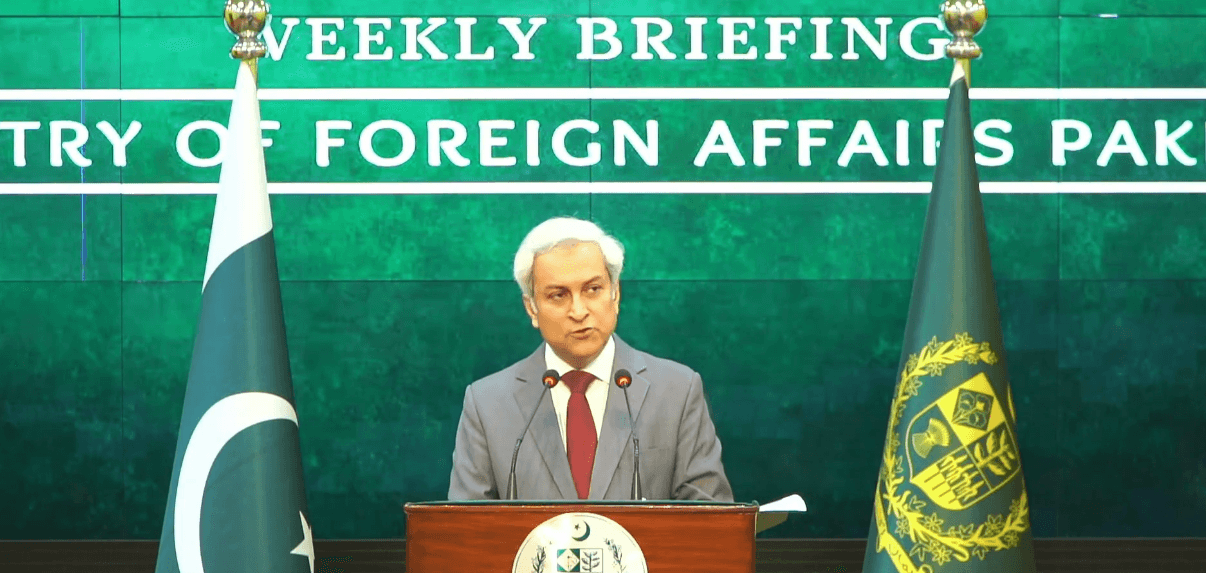
ISLAMABAD: Pakistan on Thursday said the responsibility for ending hostilities with Afghanistan rests with Kabul, as both sides engage in ongoing talks aimed at easing tensions following weeks of cross-border conflict.
Foreign Office spokesperson Tahir Hussain Andrabi said Pakistan is participating in the dialogue process but expects concrete action from Afghan authorities.
“The burden of real process… lies with Afghanistan, which must demonstrate visible and verifiable actions against terrorist groups using its soil against Pakistan,” Andrabi told reporters at a weekly briefing.
Talks began in Urumqi, China, after Deputy Prime Minister and Foreign Minister Ishaq Dar traveled to Beijing for discussions with Chinese officials, including Wang Yi.
Andrabi described the engagement as preliminary.
“These are working-level talks… our delegation has not returned yet,” he said, adding that Pakistan is seeking a “durable solution.”
Conflict, pause and renewed diplomacy
The talks come after weeks of heightened tensions along the Pakistan-Afghanistan border, where Islamabad launched Operation Ghazab lil Haq following sustained cross-border terrorist attacks.
The operation was briefly paused during Eid-ul-Fitr at the request of regional partners before resuming after the truce period ended.
Pakistani officials say the campaign targets terrorist infrastructure, including camps, logistics networks and support systems used to carry out attacks inside Pakistan.
Pakistan highlights diplomatic outreach
Andrabi said Pakistan has simultaneously intensified diplomatic efforts to reduce tensions both regionally and beyond.
He noted that Islamabad hosted a second round of four-party consultations with foreign ministers from Saudi Arabia, Türkiye, and Egypt, following an earlier meeting in Riyadh.
The discussions focused on de-escalation, humanitarian concerns and promoting dialogue amid ongoing conflicts in the Middle East and the Gulf region.
“The ministers agreed on dialogue as the primary path to prevent conflict and strengthen cooperation,” Andrabi said.
He added that Pakistan has also engaged in extensive diplomatic outreach through high-level calls and consultations with regional and global leaders.
China engagement and regional coordination
Andrabi highlighted Dar’s recent visit to China as a key development, where both sides discussed Afghanistan and broader regional stability.
He said a five-point peace initiative jointly emphasized cessation of hostilities, humanitarian assistance, civilian protection, dialogue and adherence to international law.
Pakistan also welcomed steps aimed at maintaining stability in critical global trade routes, including safe passage through the Strait of Hormuz, he added.
Push for verifiable action
Despite ongoing talks, Pakistan maintains that progress depends on concrete steps by Afghan authorities.
“We did explore all avenues… but violence and attacks from Afghanistan did not stop,” Andrabi said, referring to past diplomatic engagement efforts.
Officials say Islamabad remains committed to dialogue but insists that any sustainable resolution requires guarantees that Afghan territory will not be used for terrorism against Pakistan.
The talks in China are ongoing, with Pakistani officials framing them as part of a broader effort to balance military action with diplomacy amid a complex and evolving regional security landscape.