


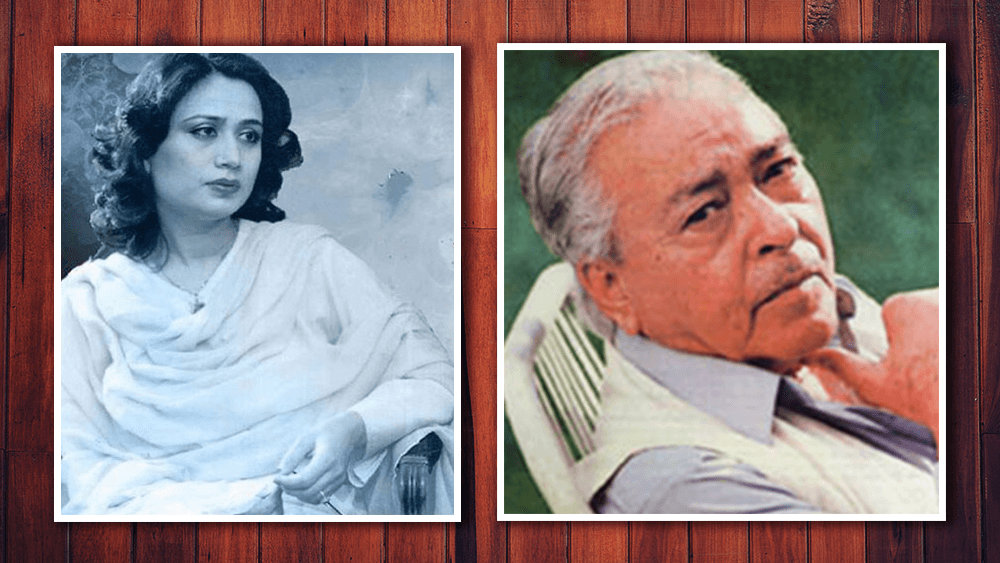
ISLAMABAD: Pakistan marks a significant literary milestone on Friday with the 19th death anniversary of poets Munir Niazi and the 31st of Parveen Shakir.
Though separated by generation and gender, these two poets fundamentally reshaped Pakistani literature, each giving voice to experiences that defined the nation's soul.
Munir Niazi: Poetry of displacement and longing
Born in Hoshiarpur, Eastern Punjab, in 1923, Munir Niazi's journey reflected that of millions who crossed borders during partition. This upheaval became the invisible thread running through his entire body of work, creating a sense of being perpetually late, perpetually elsewhere, perpetually longing for what was lost.
What set Niazi apart was his rare mastery of both Urdu and Punjabi poetry, bringing philosophical depth to both traditions. While many poets specialized in one language, Niazi moved fluidly between them, proving that profound existential questions transcended linguistic boundaries.
His collections "Taiz Hawa Aur Tanha Phool" and "Jungle Mein Dhanak" in Urdu, and "Safar Di Raat" in Punjabi, established a new aesthetic where ordinary moments concealed deeper metaphysical truths.
Consider his most celebrated couplet:
"Duniya jise kehte hain jaadu kaa khilona hai
Mil jaaye to mitti hai, kho jaaye to sona hai"
(What we call the world is a magic toy
If you get it, it's just dirt; if you lose it, it's gold)
This verse captures the cruel irony at the heart of human desire: that we only truly value what we've lost. For a nation built on partition's losses, this resonated deeply. Niazi articulated what an entire generation felt but couldn't express: that displacement had taught them the difference between possession and longing.
His autobiographical masterpiece "Hamesha Der Kar Deta Hoon Main" (I Am Always Too Late) became even more culturally significant:
"Hamesha der kar deta hun main
Zaroori baat kehni ho, koi vaada nibhaana ho"
(I am always too late
When I have to say something important, or keep a promise)
This poem articulated a distinctly Pakistani middle-class experience: the paralysis between intention and action, the weight of words left unspoken in a culture governed by honor and restraint.
Niazi transformed personal regret into collective confession, giving millions permission to acknowledge their own procrastination, their own failures to speak when it mattered most.
Beyond pure literature, Niazi composed memorable film songs for Radio Pakistan, bringing his existential sensibility to mass audiences. The government honored him with the Pride of Performance in 1992 and Sitara-e-Imtiaz in 1998.
He passed away on December 26, 2006, in Lahore.
Parveen Shakir: The female voice
If Niazi gave Pakistan the poetry of displacement, Parveen Shakir, born in Karachi in 1952, gave it the poetry of female assertion.
Her revolutionary act was deceptively simple: she consistently used the female first-person pronoun in romantic poetry. In the male-dominated tradition of Urdu ghazal, this grammatical shift represented a seismic cultural change.
Her debut collection "Khushbu" (1976) brought immediate recognition, but it was the depth of her social critique that secured her lasting legacy. Shakir embedded feminist consciousness within traditional forms, making her work both accessible and subversive.
Her most famous couplet demonstrates this perfectly:
"Woh tou khushbu hai, hawaon main bikhar jaye ga
Masla phool ka hai, phool kidhar jaye ga?"
(He is just a fragrance, he will scatter in the winds
The problem lies with the flower; where will the flower go?)
On the surface, this addresses male infidelity: the man as fleeting fragrance, free to dissipate, while the woman bears the social consequences. But the metaphor cuts deeper, interrogating why reputation is gendered, why the visible must answer for what the invisible escapes. This is social commentary disguised as a romantic lament.
Shakir constantly challenged prescribed roles. In her poem "Obstinate," she wrote:
"Main kyun usko phone karun!
Us ke bhi to ilm mein hoga
Kal shab mausam ki pehli baarish thi!"
(Why should I be the first to phone him!
He also knows, surely,
That last night came the first rain of the monsoon!)
The first rain is traditionally a romantic, sensual moment in South Asian poetry. By refusing to wait passively, Shakir claimed equal agency in desire, a radical act in society.
Her later collections, "Sad-barg," "Khud-Kalami," and "Inkaar," grew even bolder. She maintained this literary output while serving in the Pakistan Administrative Service from 1982, embodying the professional woman her poetry championed.
She received the Pride of Performance before her death in a traffic accident on December 26, 1994, aged just 42. The Islamabad road where she died now bears her name.
A shared legacy
That both poets share a death anniversary seems fitting. Together, they represent complementary dimensions of Pakistani identity: Niazi articulating the trauma of displacement and the philosophy of loss, Shakir asserting women's right to speak, desire, and occupy public space.
They proved that Pakistani poetry could honor classical forms while speaking contemporary truths. Their verses continue to define what it means to write honestly in Pakistan, to carry history's weight while insisting on personal voice, to use inherited traditions while bending them toward new realities. In their different ways, both permitted Pakistan to feel what it had been feeling all along.