


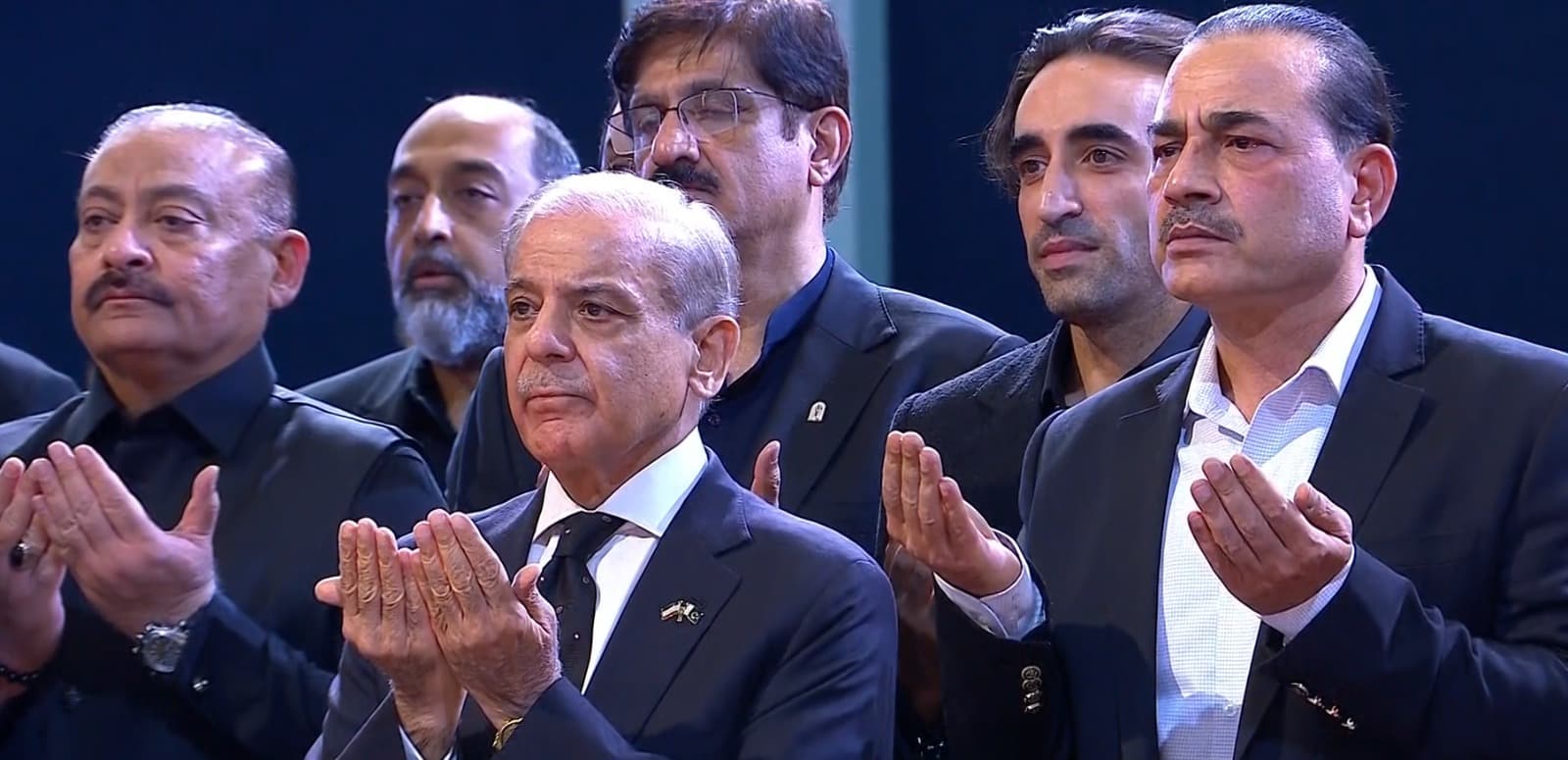
ISLAMABAD: The participation of Pakistan's top leadership in the funeral of assassinated former Supreme Leader of Iran Ayatollah Ali Ali Khamenei reflects a new era of diplomacy in the region and beyond—as well as endless opportunities for the people of both the countries.
Pakistan Prime Minister Shehbaz Sharif landed in Iran on Friday to attend the funeral of assassinated former Supreme Leader Ayatollah Ali Khamenei along with Chief of Defense Forces Field Marshal Asim Munir and Foreign Minister Ishaq Dar.
Pakistan’s Foreign Office confirmed that PM Sharif’s single-day visit will include paying condolences and participating in the funeral rites of the late Khamenei.
Khamenei's casket was placed at Tehran's Imam Khomeini Grand Mosalla for people to pay their respects on Friday. It will move to Qom on Monday, then to Najaf and Karbala in Iraq, before burial at Mashhad's Imam Reza Shrine on July 9, according to Iranian local media.
Iran's Foreign Ministry said that roughly 100 countries sent their delegations, including Russia's Dmitry Medvedev and senior Chinese lawmaker He Wei. Officials project turnout as high as 20 million.
Islamabad-Tehran ties
The time-tested, brotherly relations between Pakistan and Iran have been cemented after the former left no stone unturned in making sure the US-Israel war against the latter came to an end.
Following the joint US-Israeli operation that killed the Supreme Leader, Iran launched retaliatory strikes against Israel and American military bases in the Middle East, sparking fears of a full-scale regional escalation.
It was Islamabad that brokered the April 8 ceasefire between Washington and Tehran, bringing the war to a halt.
The ceasefire then resulted in the Islamabad Talks, where high-level delegations from both sides traveled to Pakistan on the 10th and 11th of April and tried to diplomatically settle the dispute.
Although the talks concluded, a ceasefire was maintained, which was finally followed by the Islamabad Memorandum of Understanding signed by Washington and Tehran on June 17, that completely put an end to the hostilities and allowed both parties to create a new deal.
Iranian Foreign Minister Abbas Araghchi thanked PM Sharif and CDF Munir in a statement on April 8, crediting and appreciating them "for their tireless efforts to end the war in the region." He said Iran accepted the truce at Sharif's request, and the relationship has only grown closer since then.
Bilateral trade
Iranian President Masoud Pezeshkian went a step ahead in expressing Tehran's gratitude as he made his first foreign trip to Islamabad since the war began. After landing in Pakistan on June 23, he minced no words in thanking Pakistan in meetings with Pakistani leadership.
"Pakistan and Iran are one soul, not just neighbors but brothers," he said while speaking alongside Sharif in Islamabad. He thanked Pakistan and its people for promoting peace and stability in the region.
Pakistan's Foreign Office said the next day that progress on economic projects, including a long-delayed gas pipeline, would progress with relief on sanctions against Tehran.
Islamabad also pushed to lift bilateral trade to $10 billion annually, up from roughly $3 billion. Foreign Office Spokesperson Tahir Andrabi said Iran had "reaffirmed their trust in us, for which we are grateful."
While the visit did not produce any deals, the 60-day window under the Islamabad MoU, includes phased sanctions relief and a partial reopening of Iran's oil exports.
Regime change
The war began with strikes on February 28, killing Khamenei and senior commanders within hours. Washington initially framed the campaign around regime change, with Trump urging Iranians to rise up against their government.
That intended outcome was not achieved. Secretary of State Marco Rubio, speaking in Bahrain last month, said "the Iranian system is led by clerics, radical clerics," rejecting the idea that Tehran's leadership had fundamentally shifted.
Mojtaba Khamenei, the late leader's son, was confirmed as his successor on March 8. He has not appeared publicly since being wounded in the February strike and will skip his father's funeral over security concerns.
For Tehran, the ceremony doubles as a show of resilience to adversaries and domestic critics alike. For Islamabad, it is another marker of a mediator role it has spent five months building, and one it shows no sign of stepping back from.