


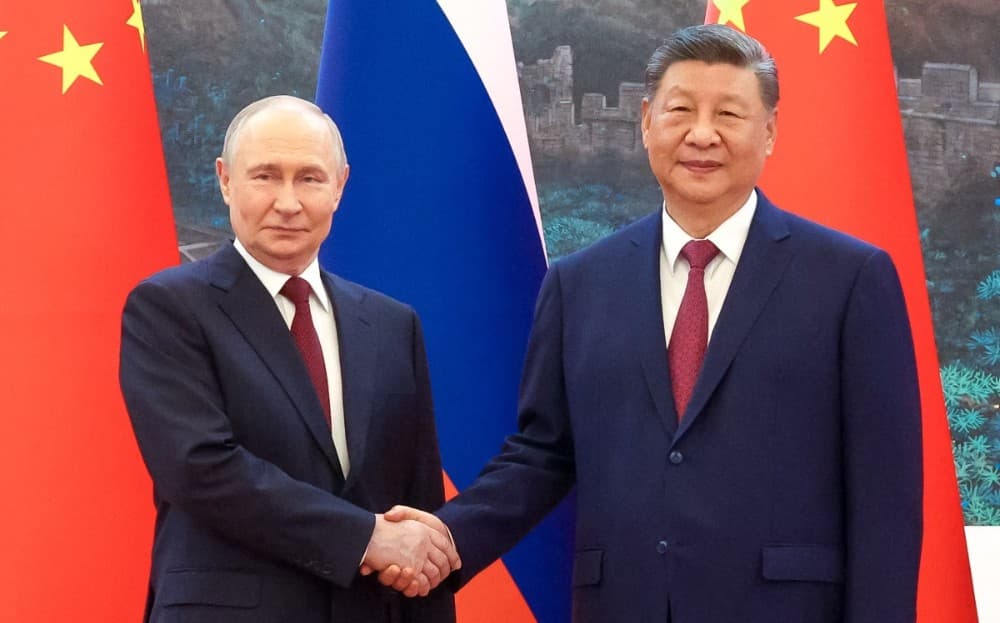
BEIJING: Chinese President Xi Jinping and Russian President Vladimir Putin signed in Beijing on Wednesday a joint statement on further enhancing the comprehensive strategic coordination and deepening good-neighbourliness and friendly cooperation between the two countries, said the Chinese state news agency Xinhua.
The news agency quoted President Xi as saying that the China-Russia relationship has entered a new stage of greater achievements and faster development.
Xi made the remarks when holding talks with Russian President Vladimir Putin, who is on a state visit to China, at the Great Hall of the People in Beijing.
The Chinese President pointed out that in recent years, faced with a fluid and turbulent international situation, China and Russia have developed a comprehensive strategic partnership of coordination for a new era based on equality, mutual respect, good faith, and win-win cooperation.
Earlier, Russian President Vladimir Putin held talks with Chinese leader Xi Jinping on Wednesday in Beijing's Great Hall of the People, Russian media reported.
Putin is in Beijing seeking to underscore their unshakeable alliance, days after US President Donald Trump visited the Chinese capital.
Russian President Vladimir Putin had arrived in Beijing late on Tuesday for talks with his Chinese counterpart and "long-time good friend" Xi Jinping, intending to show their ties are unshakeable days after a visit by Donald Trump.
The confirmation of Putin's trip came just hours after Trump wrapped up his visit on Friday, the first by a US president to China in nearly a decade and one aimed at stabilizing their turbulent relations.
Putin arrived at Beijing Capital International Airport around 11:15 p.m. (1515 GMT) on Tuesday, where he was greeted by Chinese Foreign Minister Wang Yi and a military band.
It was a near-mirror image of Trump's arrival days earlier, with both leaders stepping out of their planes onto a red carpet as Chinese youths chanted "welcome, welcome" - this time, waving Russian flags instead of American.
Putin and Xi are set to discuss how to strengthen Russia and China's strategic partnership and "exchange views on key international and regional issues", according to a Kremlin statement.
Their ties have deepened since Russia invaded Ukraine in 2022, with Putin visiting Beijing every year since as his country is cut off diplomatically on the world stage.
However, their relationship is far from equal, with Moscow heavily dependent economically on Beijing, the main buyer of sanctioned Russian oil.
Among topics Xi and Putin could discuss is the construction of the major "Power of Siberia 2" natural gas pipeline from Russia to China through Mongolia - a land alternative to crude imported by sea from the Middle East - which Moscow is keen to get underway.
Setting a warm tone for the visit, Xi and Putin exchanged "congratulatory letters" on Sunday to mark 30 years of their countries' strategic partnership.
Chinese foreign ministry spokesperson Guo Jiakun lauded "the enduring friendship between China and Russia" on Tuesday.
And in a video message to the Chinese people released on Tuesday, Putin said relations have reached "a truly unprecedented level", and that "trade between Russia and China continues to grow".
"The close strategic relationship between Russia and China plays a major, stabilizing role globally. Without allying against anyone, we seek peace and universal prosperity," Putin said, without mentioning any third country.
The two leaders are also expected to sign a joint declaration after their talks.
'Dear, old friends'
Xi welcomed Putin with open arms as an "old friend" when he last visited Beijing in September 2025 - language the Chinese leader did not extend to Trump last week.
Putin, who in turn called Xi his "dear friend", will be keen to show the world that their relations are unaffected by Trump's visit.
While Putin's visit is not expected to receive the same pomp as Trump's, "the Xi-Putin relationship does not require that kind of performative reassurance", said Patricia Kim from the Brookings Institution in Washington.
Both sides view ties as "structurally stronger and more stable" than those between China and the United States, she said.
Beijing has regularly called for talks to end the war in Ukraine but has never condemned Russia for sending in troops, presenting itself instead as a neutral party.
Trump and Xi discussed Ukraine last week, but the US president left China without a breakthrough.
"Xi will almost certainly brief Putin on his summit with Trump," Kim said.
The lack of clear outcomes from the Xi-Trump meeting, though, "likely reassures Moscow that Xi did not strike any understanding with Trump that would materially undercut Russian interests".
Appetite for oil
Putin will be hoping that China deepens its commitment to Moscow, after Trump told Fox News during his visit that Beijing had agreed to buy US oil to feed its "insatiable" appetite for energy.
With Russia reliant on sales to China to sustain its war effort, "Putin does not want to lose that support", Asia Society's Lyle Morris told AFP.
"Putin will likely be keen to hear from Xi about China's next step in the Middle East," Morris said, after "Trump signaled clearly that he hopes Beijing will play a leading role".
When it comes to the US-Israeli war on Iran, though, China and Russia may have different priorities.
"(China) relies on the freedom of the world's major waterways to sustain its economic activities, and would prefer that the standoff in the Strait of Hormuz end sooner rather than later," James Char of Singapore's Nanyang Technological University told AFP.
On the other hand, Moscow has "been benefitting economically from the fighting in Iran due to the relaxation of sanctions against Russian energy supplies, so may have a different view", he said.
Russia's top diplomat, Sergei Lavrov, said after meeting Xi in April that Russia could "compensate" for China's energy shortages as the Middle East war hits global supplies.
"Expanded energy ties may feature prominently at the meeting (as) Beijing seeks more Russian energy," said Joseph Webster from the Atlantic Council.
"From Moscow's perspective, shipping more oil east may be more attractive in the wake of Ukraine's relentless campaign targeting Russian energy infrastructure."