


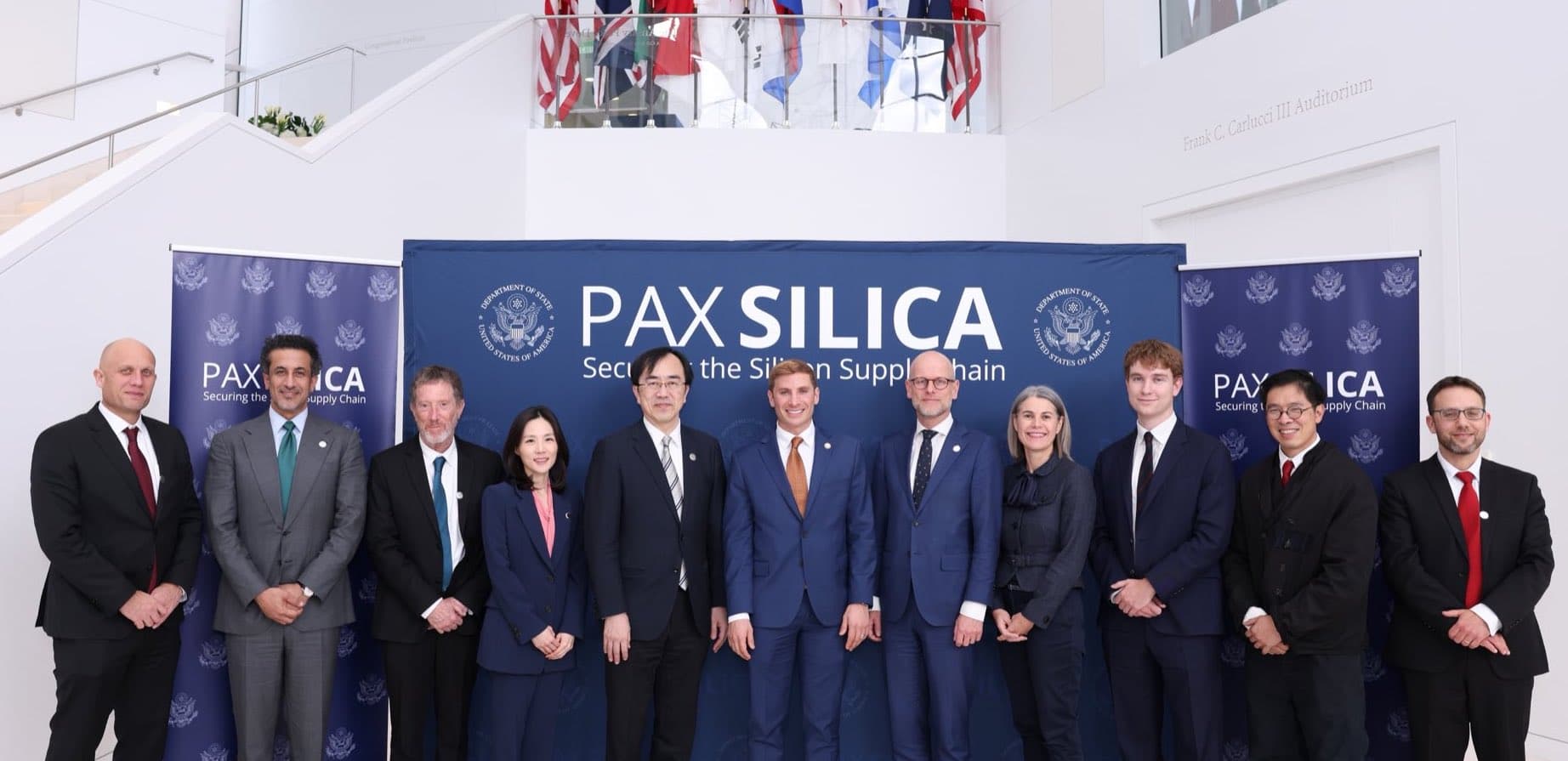
ISLAMABAD: The United States expanded its push to secure global technology supply chains as Qatar and the United Arab Emirates formally joined the Pax Silica framework, a US-led initiative focused on semiconductors, artificial intelligence infrastructure, and critical minerals.
Qatar signed the Pax Silica Declaration on Jan. 12, followed by the UAE on Jan. 14, bringing the total number of signatories to nine countries.
Other than the US, the alliance includes Australia, Israel, Japan, Singapore, South Korea, and the United Kingdom, with India expected to join next month.
The declaration, launched at a Washington summit in December 2025, represents a non-binding statement of shared principles focused on securing artificial intelligence supply chains, semiconductor manufacturing, critical minerals, and digital infrastructure. The pact emphasizes that resilient supply chains are essential to the mutual economic security of signatories.
In a press release issued by the US State Department, US Under Secretary of State for Economic Affairs Jacob Helberg characterized the Qatar signing as “marking a fundamental shift in the region's security architecture, transitioning from one based on oil to one anchored in silicon statecraft.”
Gulf meets Silicon Valley
The Gulf states' entry into Pax Silica comes amid massive investments in AI infrastructure.
Qatar Investment Authority, which manages approximately $524 billion in assets, stated in late 2025 that its AI unit, Qai, had formed a $20 billion joint venture with Brookfield Asset Management to develop AI infrastructure, including data centers, in Qatar and overseas.
In the UAE, Abu Dhabi-backed technology investor MGX was established with a target of $100 billion in AI and advanced technology investments and is part of an AI Infrastructure Partnership with BlackRock, Global Infrastructure Partners, and Microsoft to mobilize up to $100 billion for data center and power projects.
During the official signing ceremony of the declaration in Abu Dhabi, Saeed bin Mubarak Al Hajeri, the UAE minister of state, noted that the move is a core component of a national plan to diversify the economy, stating that the UAE is moving "beyond the traditional dynamics of buyer and seller" to become a co-developer of future technologies.
In a post on X, Qatar’s Ministry of Commerce and Industry wrote, “This step reinforces the partnership between the two countries and contributes to building a more resilient and sustainable economic ecosystem.”
As the alliance grows, countries outside Pax Silica are seeking to position themselves within its supply chains.
The Netherlands holds a particularly strategic position, despite being among the smaller signatories, due to its control of the lithography machinery bottleneck through ASML, the largest supplier to the semiconductor industry and the most advanced producer of extreme ultraviolet (EUV) machines.
US Under Secretary Helberg has identified the Netherlands as part of the alliance’s "industrial core."
In a digital press briefing on Jan. 5, he confirmed that the European Union participates as a guest contributor rather than a formal signatory to Pax Silica.
He noted that while the US desires a "strong Europe," there are significant "philosophical differences" regarding regulation, stating that the EU's approach is often "far too regulated," which has contributed to an economic divergence between the US and the EU.
The EU’s limited role comes despite its push to strengthen its own semiconductor base under the European Chips Act, adopted in 2023, which sets a target of increasing Europe’s share of global semiconductor production from about 10% to 20% by 2030.
Global competition
The expansion comes amid rising competition with China, which has invested heavily in overseas digital infrastructure under Digital Silk Road (DSR), Beijing's framework for cross-border digital connectivity launched in 2015 as part of the Belt and Road Initiative.
The DSR encompasses fiber optic networks, data centers, 5G infrastructure, cloud services, and e-commerce platforms, with China having established cooperation mechanisms with 16 countries and e-commerce partnerships with 26 nations, including Pakistan.
Pakistan has identified the Digital Silk Road as the next key phase of the China-Pakistan Economic Corridor (CPEC). In September 2025, Federal Minister for Planning, Ahsan Iqbal referred to the Pakistan-China Digital Silk Road as a central pillar of CPEC's second phase.
Initiatives would focus on investments in 5G, fiber optics, data centers, and the creation of joint laboratories in artificial intelligence and quantum computing.
In November 2025, Federal Minister for IT and Telecom Shaza Fatima Khawaja presented a set of recommendations at the World Telecommunication Development Conference in Baku, Azerbaijan, aligned with Pakistan’s digital strategy.
Pakistan and China have signed numerous agreements covering areas such as digital and IT infrastructure, emerging technologies, and talent exchanges.
Pakistan’s mineral push
Although not a signatory of the Pax Silica Declaration, Pakistan is positioning itself within the emerging supply chain architecture through its mineral reserves.
According to Associated Press of Pakistan (APP), Pakistan holds billions in untapped mineral wealth, including copper, gold, lithium, cobalt, rare earth elements, and gemstones.
The Prime Minister’s Office said on Jan. 9 that Pakistan’s gemstone reserves are estimated at around $450 billion even as exports remain limited.
Prime Minister Shehbaz Sharif has approved a National Policy Framework for Gemstones, targeting $1 billion in exports within five years through measures to curb smuggling and establish internationally accredited testing laboratories.
The Second Pakistan Minerals Investment Forum (PMIF26), scheduled for April 8-9 in Islamabad, aims to present Pakistan as an investment-ready mining economy to international investors, APP reported.