


ISLAMABAD: Pakistan is home to two of the world's most imperiled big cats. On International Leopard Day, the country's conservationists have reason to mark genuine progress.
The snow leopard (Panthera uncia) and the common leopard (Panthera pardus) share Pakistan's mountains and forests. They also share a precarious future.
But a convergence of scientific rigor, community engagement, and institutional commitment is shifting the odds in their favor.
The clearest marker of that progress is a number between 155 and 167. That is Pakistan's first scientifically verified snow leopard population count, produced by a 13-year nationwide study conducted by the Snow Leopard Foundation in collaboration with the Ministry of Climate Change and international academic partners.
Where estimates had previously ranged from 200 to 420 (based on expert consensus rather than data), Pakistan now has a baseline it can build from.
The study deployed over 828 cameras across 65 locations between 2010 and 2019, generating more than 4,700 images and identifying 53 unique individuals, according to the Snow Leopard Foundation.
A parallel genetic study, run between 2017 and 2023, analyzed over 1,000 scat samples and confirmed 56 unique individuals. The two methods produced estimates of 155 and 167 respectively. This is a convergence that gives conservationists high confidence in the results.
The snow leopard's habitat spans approximately 80,000 square kilometers across the Hindu Kush, Karakoram, Pamir, and Himalayan ranges, according to WWF-Pakistan. The country is now actively working to protect this region.
Central to that work is winning over the communities that share it.
Livestock depredation had long made coexistence costly. In high-altitude regions, livestock accounts for more than 40% of household farm income, with an estimated 4.56 million animals on alpine pastures, according to Pakistan's National Snow Leopard and Ecosystem Priorities document. A single predator attack could mean devastating loss for a family and a death sentence for the leopard responsible.
The response has been innovative. Community-based livestock insurance schemes, pioneered in Baltistan and the Chitral National Park buffer zones, now allow herders to recover losses without resorting to retaliatory killing, according to WWF-Pakistan.
Village Insurance Committees collect monthly premiums of 30 Pakistani rupee per adult yak and 50 Pakistani rupee per calf. In some programs, trekking and conservation tourism revenue also supplements the fund, according to a Baltistan pilot study. WWF-Pakistan says these schemes have helped shift perceptions in some communities, where leopards are increasingly seen as an asset rather than a threat.
Prevention has also gone high-tech. WWF-Pakistan, in partnership with the Lahore University of Management Sciences, has deployed AI-powered camera traps at known depredation sites in Gilgit-Baltistan.
The cameras detect leopards in real-time and send automated alerts to herders, according to WWF-Pakistan. This allows livestock to reach predator-proof corrals before an attack occurs.
Initial results have shown a measurable reduction in losses.
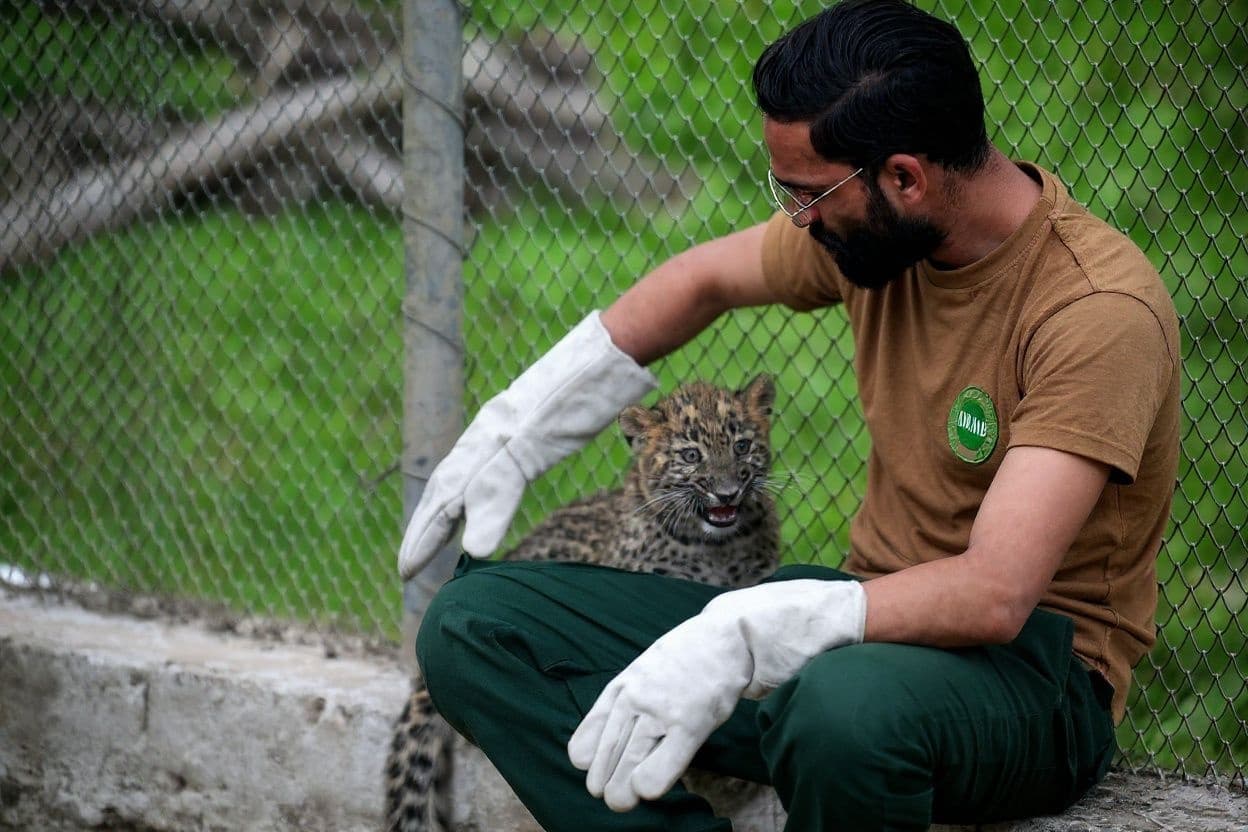
Closer to the capital, Margalla Hills National Park provides an urban refuge for common leopards on the northern edge of Islamabad. The Islamabad Wildlife Management Board operates a dedicated rescue and rehabilitation center for injured and confiscated leopards, including animals recovered from illegal private ownership.
At the international level, Pakistan's commitments extend across borders. The country is a signatory to the Global Snow Leopard and Ecosystem Protection Program and the 2013 Bishkek Declaration. The latter unites all 12 snow leopard-range countries around cooperative habitat management and joint research.
Pakistan has thus anchored its domestic efforts within a coordinated global framework.
While the spots have not changed, the strategies protecting these leopards have.