


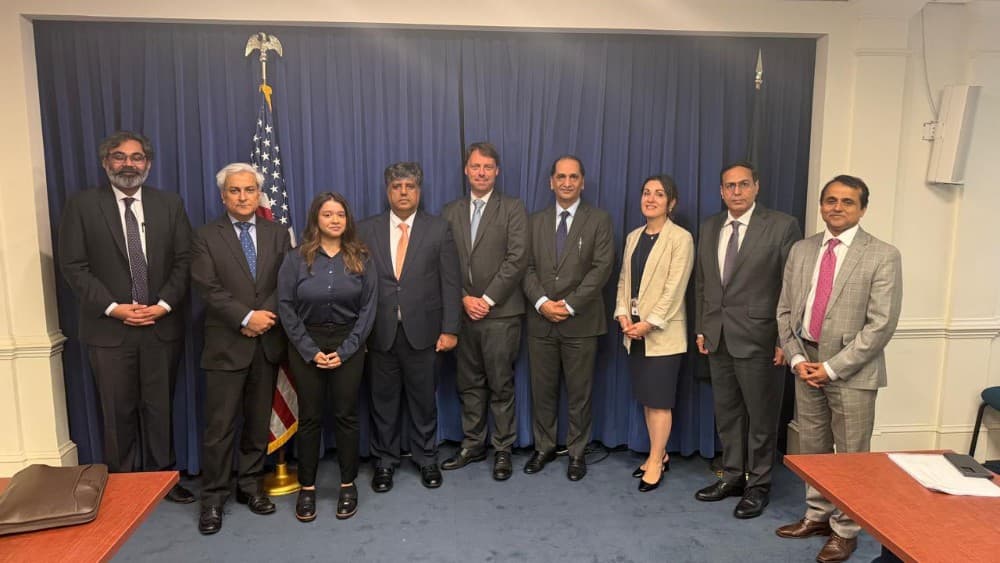
LAHORE: Pakistan and the United States have made significant progress toward a Reciprocal Trade Agreement after two days of negotiations in Washington, with both sides "ironing out differences and building convergence" toward the pact's early conclusion, Pakistan Foreign Office Spokesperson Tahir Andrabi said early Saturday.
The latest round of negotiations marks another step in the growing economic engagement between Islamabad and Washington, where both governments have increasingly prioritized trade, investment and commercial partnerships. The talks follow recent cooperation through the SelectUSA Investment Summit, expanding interest in Pakistan's critical minerals sector and broader efforts to diversify bilateral trade, reflecting a growing emphasis on economic diplomacy alongside longstanding strategic cooperation.
The negotiations also align with Pakistan's wider economic strategy of diversifying its economy by boosting exports, attracting foreign direct investment and developing high-potential sectors, including mining, manufacturing and information technology.
The United States remains Pakistan's largest single-country export market, underscoring the importance of the negotiations. According to the Office of the United States Trade Representative, total US goods and services trade with Pakistan reached an estimated $10.1 billion in 2024. US goods trade totaled $8.7 billion in 2025, with US exports to Pakistan rising 56.6% year-on-year to $3.3 billion, while imports from Pakistan increased 5.9% to $5.4 billion.
In a post on X after the conclusion of the talks, Andrabi said negotiations on the Pakistan-United States Agreement on Reciprocal Trade were held in Washington on July 9 and 10.
"The talks were conducted in a cordial atmosphere, with both sides ironing out differences and building convergence, with a view to the early conclusion of the Agreement," Andrabi said.
He added that Commerce Secretary Jawad Paul, who led Pakistan's delegation, described the negotiations as "positive" and appreciated the "significant progress made during the negotiations."
According to Andrabi, the Pakistani delegation included Secretary Overseas Pakistanis and Human Resource Development Nadeem Chaudhary, Joint Secretary Tariff Policy Mohammad Ashfaq and officials from the Ministry of Foreign Affairs, while representatives of other government ministries participated virtually.
The talks were aimed at strengthening Pakistan-US trade relations, facilitating bilateral trade as a driver of economic cooperation and paving the way for the diversification and expansion of existing trade.
Photographs shared by Andrabi on X showed Pakistani and US officials posing for a group photograph following the negotiations. In another image, Commerce Secretary Jawad Paul presented a Pakistan-made football to a US official, symbolizing one of Pakistan's globally recognized export industries and highlighting the country's manufacturing capabilities.
According to Lahore Chamber of Commerce and Industry President Faheem Ur Rehman Saigol, a successful outcome from the negotiations would provide Pakistani exporters with greater market access through tariff reductions, particularly for textiles, apparel, surgical instruments, sports goods and information technology services.
Talking to Pakistan TV Digital, Saigol said Pakistan should capitalize on its constructive diplomatic engagement and regional importance to secure stronger economic outcomes.
"Pakistan should leverage its constructive diplomatic engagement and regional importance to secure economic benefits. We expect negotiations to focus on enhancing bilateral trade, attracting US investment, and removing non-tariff barriers that hinder Pakistani exports," Saigol said.
"A mutually beneficial agreement should improve Pakistan's export competitiveness, create employment opportunities, and strengthen long-term economic cooperation between the two countries while ensuring a more balanced and sustainable trade relationship," he added.
The latest negotiations come against the backdrop of evolving US tariff measures affecting Pakistani exports. In April 2025, President Donald Trump invoked the International Emergency Economic Powers Act (IEEPA) to impose a proposed 29% tariff on Pakistani exports as part of broader global trade measures. Following negotiations between Pakistani officials and the Office of the United States Trade Representative, the proposed tariff on Pakistani goods was reduced to 19%.
The tariff framework changed earlier this year after the US Supreme Court ruled that the IEEPA did not authorize the President to impose broad tariffs under the emergency law, effectively invalidating the measure. The Trump administration subsequently invoked Section 122 of the Trade Act of 1974 to impose a temporary 10% global tariff for up to 150 days, a measure scheduled to expire later this month.
Pakistan is also among nearly 60 countries subject to Section 301 investigations by the Office of the United States Trade Representative over alleged forced labor-related trade practices. Islamabad has submitted detailed responses to the USTR, including an additional submission ahead of the latest round of negotiations. Under the Section 301 process, Pakistan faces a proposed additional 10% tariff, while India and 53 other countries are subject to proposed tariffs of 12.5%.