


ISLAMABAD: New results from the Large Hadron Collider suggest even small particle collisions can briefly recreate matter similar to that found just after the Big Bang, the "Quark-Gluon plasma," offering scientists a clearer glimpse into the early universe, Space reported Wednesday.
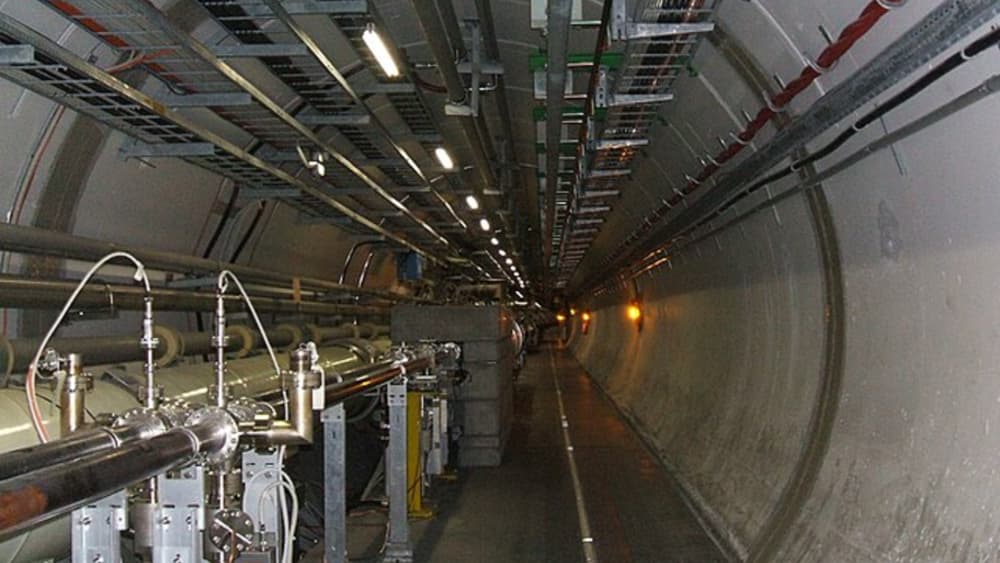
The Large Hadron Collider (LHC) is the world’s largest (17km long) and most advanced particle accelerator, located on the border between Switzerland and France.
The research was carried out by ALICE (A Large Ion Collider Experiment), one of the main experiments at CERN, the European laboratory that operates the collider.
Scientists studied collisions involving protons, which are particles found inside atoms, and lead nuclei, the dense central cores of lead atoms. In those collisions, they found signs of "quark-gluon plasma," a state of matter so hot and energetic that quarks and gluons, the basic components that normally remain bound inside larger particles, can move freely for a brief moment.
Scientists believe this kind of matter existed in the earliest moments of the universe.
What makes the result especially important is that the researchers observed a common flow pattern, meaning the particles produced in the collisions appeared to move in a coordinated way rather than scattering randomly.
In simple terms, the debris from these collisions did not behave like unrelated fragments, but more like matter responding together under extreme conditions.
The work also connects with another striking discovery at the LHC: scientists working on ALICE recently confirmed that collisions involving lead can also incidentally produce tiny amounts of gold.
This happens when extremely powerful electromagnetic fields in near-miss lead collisions knock exactly three protons out of a lead nucleus, briefly turning it into gold.
For years, scientists generally expected this kind of collective behavior to appear only in the largest and most violent heavy-ion collisions.
This new result suggests similar conditions may also emerge in smaller systems, which could reshape how researchers understand the earliest stages of matter under extreme conditions.
The study was also published in Nature Communications, a peer-reviewed scientific journal.