


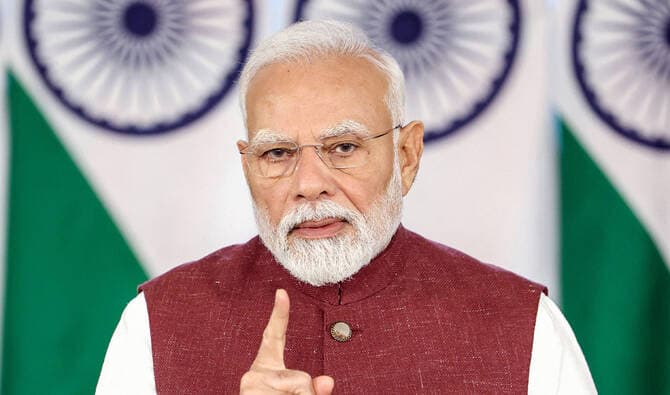
ISLAMABAD: Indian Prime Minister Narendra Modi’s long-standing effort to diplomatically isolate Pakistan has yielded the opposite result, with Islamabad emerging as an increasingly influential geopolitical and diplomatic actor, according to a report by Al Jazeera.
The report recalled that in September 2016, following the Uri attack in Indian-occupied Kashmir, Modi publicly vowed to isolate Pakistan internationally.
Addressing a rally in the southwestern state of Kerala, he said India would intensify efforts to ensure Pakistan remained isolated on the world stage.
Nearly a decade later, however, Al Jazeera noted that Pakistan has strengthened ties with major global powers, including China and the United States, while expanding its diplomatic role in regional and international affairs.
The report highlighted Pakistan’s growing engagement with the administration of US President Donald Trump, noting that Prime Minister Shehbaz Sharif and Field Marshal Asim Munir both visited the White House over the past year.
According to Al Jazeera, Pakistan has also emerged as an important diplomatic interlocutor between Washington and Tehran amid continuing regional tensions, further enhancing Islamabad’s international relevance.
The report pointed to the May 2025 military confrontation between Pakistan and India as another moment that elevated Pakistan’s diplomatic profile.
During the conflict, US President Donald Trump publicly announced a ceasefire between the two nuclear-armed neighbors.
Pakistan promptly acknowledged Washington’s role in securing the truce, with Prime Minister Shehbaz Sharif thanking Trump for his “leadership and proactive role.”
Islamabad later nominated Trump for the Nobel Peace Prize, a move that, according to the report, further strengthened ties between Pakistan and the United States.
In contrast, Al Jazeera noted that New Delhi resisted acknowledging third-party mediation and maintained that the ceasefire resulted solely from bilateral military communication.
Trump, however, repeatedly asserted that the United States had brokered the truce and claimed his administration had helped avert a potentially wider conflict in South Asia.
The report said Pakistan also gained an advantage in shaping international perceptions during the crisis.
Analysts cited by Al Jazeera argued that India failed to present convincing evidence linking Pakistan to the Pahalgam attack that triggered the escalation.
Michael Kugelman of the Atlantic Council told Al Jazeera that Pakistan appeared to have won “the global battle of narratives.”
The report further noted that Pakistan’s military performance during the confrontation attracted significant international attention, particularly Islamabad’s claims regarding the downing of multiple Indian fighter aircraft, including Rafale jets.
According to Al Jazeera, India’s delayed acknowledgment of aircraft losses reinforced perceptions that Pakistan had effectively held its ground militarily against a much larger adversary.
On the diplomatic front, the report highlighted Pakistan’s deepening strategic partnership with China.
During PM Sharif’s recent visit to Beijing, Chinese President Xi Jinping described relations between the two countries as “unbreakable,” underscoring what the report characterized as the enduring strength of bilateral ties.
Al Jazeera also pointed to Pakistan’s expanding engagement with regional countries, including Bangladesh following political changes in Dhaka, while noting that India’s regional diplomacy has faced challenges amid the continued paralysis of the South Asian Association for Regional Cooperation (SAARC).
Analysts cited in the report argued that New Delhi’s approach toward Pakistan had undermined prospects for broader regional integration in South Asia.
Former Pakistani envoy Masood Khan told Al Jazeera that Pakistan’s recent diplomatic gains in Washington were the result of “astute diplomacy,” particularly in the aftermath of the May 2025 conflict.
The report concluded that despite years of Indian efforts to isolate Pakistan through international forums and counterterrorism narratives, shifting geopolitical realities have repositioned Islamabad as an increasingly important regional actor with growing influence in Washington, Beijing, and wider international diplomacy.