


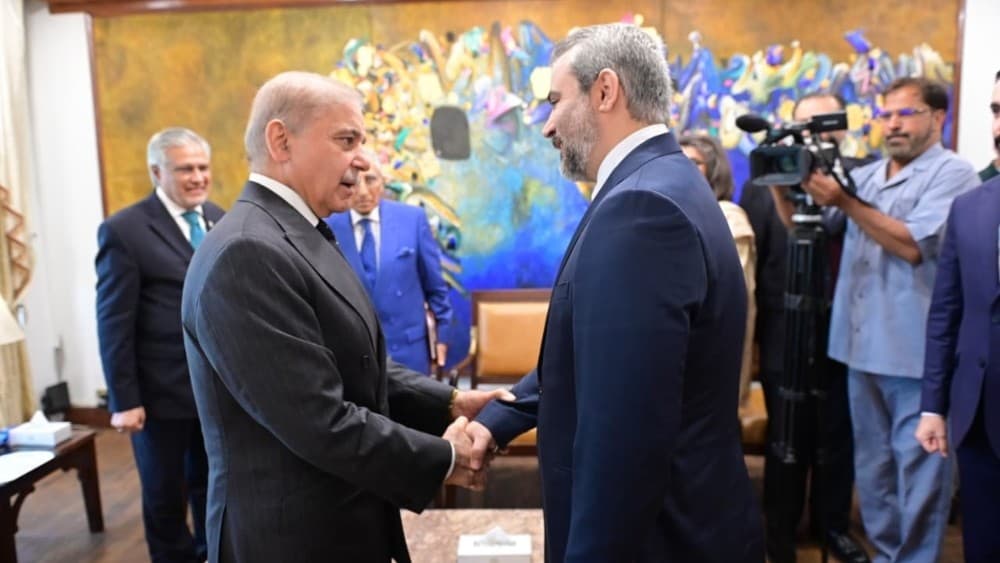
ISLAMABAD: Pakistan and Syria are deepening ties after a 19-year gap in foreign ministerial visits, with Damascus planning ambassador-level representation, expanding trade and defense cooperation, and weighing whether to join the Makkah Joint Defense Agreement.
Foreign Minister Asaad Hassan Al-Shaibani also rejected Israeli objections to Syria’s regional partnerships.
Speaking to Pakistani media in Islamabad on Thursday, Al-Shaibani said Syria would raise its diplomatic representation in Pakistan to ambassadorial level “in the coming days,” with Pakistan expected to reciprocate.
He said the two sides had also agreed to revive their joint ministerial committee, restore direct flights between Islamabad and Damascus, establish a Pakistan-Syria business council and organize an investment forum in Damascus.
“We already have representation between Pakistan and Syria that didn't stop,” Al-Shaibani said through an interpreter. “But in the coming days we are going to improve the level of representation to the level of ambassadors, and Pakistan is going to do the same with us. This is a very important step.”
Al-Shaibani, who met Prime Minister Shehbaz Sharif, Deputy Prime Minister and Foreign Minister Ishaq Dar and Field Marshal Asim Munir during his two-day visit, described the trip as “successful” and said specialized institutions on both sides would now work to translate the understandings into a practical work plan.
Syria weighs Makkah defense pact
On the Makkah Joint Defense Agreement signed by Pakistan, Saudi Arabia and Türkiye earlier this month, Al-Shaibani said Damascus had not yet decided whether to join the arrangement, while acknowledging the importance of the three countries in the region.
“We understand Pakistan and Saudi Arabia and Turkiye are very important countries in the region and it is important to get into alliance,” he said. “We don't have a decision right now to join or not to join.”
Al-Shaibani strongly defended Syria’s strategic ties with Türkiye, describing Ankara as “a partner and an ally, very important to Syria.”
He said Türkiye had supported the Syrian people during the past 14 years and highlighted the countries’ more than 1,000-kilometer border.
Responding to Israeli objections to Syria’s growing ties with Ankara, Al-Shaibani said Israel cannot determine Syria’s foreign partnerships.
“Israel should have no say in imposing on us or telling us who are our allies and who are our partners,” he said. “Syria is a sovereign country and we decide our options in terms of making alignments or partnerships based on our national interests.”
Syria condemns Israeli strikes
Addressing Israeli military aggression in Syria, Al-Shaibani said relations with Israel had remained tense since the fall of the Assad government on December 8.
He slammed Israel of seeking to prevent Syria from achieving stability and rebuilding, and said Israeli forces had violated the 1974 disengagement agreement by advancing into the buffer zone.
“Israel is seeking not to give space to Syria to have stability in the country or to rebuild the country,” he said, adding that the United States was currently mediating between the two sides.
“There is an ongoing mediation by the United States in order to keep the de-escalation between Syria and Israel and to reach a security agreement to stop the aggressions of Israel against Syria,” he said.
The remarks followed Israeli strikes on Syria’s Abu Al Duhur airbase in Idlib on August 18 and 19, which Damascus described as a violation of international law. Pakistan has also condemned the strikes, warning that such actions could contribute to further regional instability.
Syria backs Lebanon sovereignty
On Lebanon, Al-Shaibani supported Beirut’s efforts to establish what he called a “monopoly of control over weapons and to disarm any other groups,” while condemning Israeli attacks and calling on Iran to stop interfering in Lebanon’s internal affairs.
“We want Lebanon to be a safe, secure, stable country with sovereignty, and to be free of any outlaw militia,” he said, adding that Damascus “will not hesitate” to assist Lebanon if requested.
On Pakistan’s security concerns along its western border, Al-Shaibani expressed support for Islamabad and condemned attacks originating from Afghan territory.
“We support Pakistan in securing the stability of the country and we condemn any terrorist attacks coming from Afghanistan,” he said. “We call on Afghanistan not to allow any terrorist attacks from its territory against its neighbors, especially Pakistan, and we call on both countries to find a solution to this problem.”
Reconstruction drives economic outreach
Al-Shaibani said Syria’s economic outreach was closely linked to the country’s reconstruction needs following years of conflict.
“The war that was waged by the defunct regime against the Syrian people destroyed the infrastructure of Syria,” he said. “That is why, as we are working on the reconstruction of the country, we are keen to have economic cooperation and to have friends and allies.”