


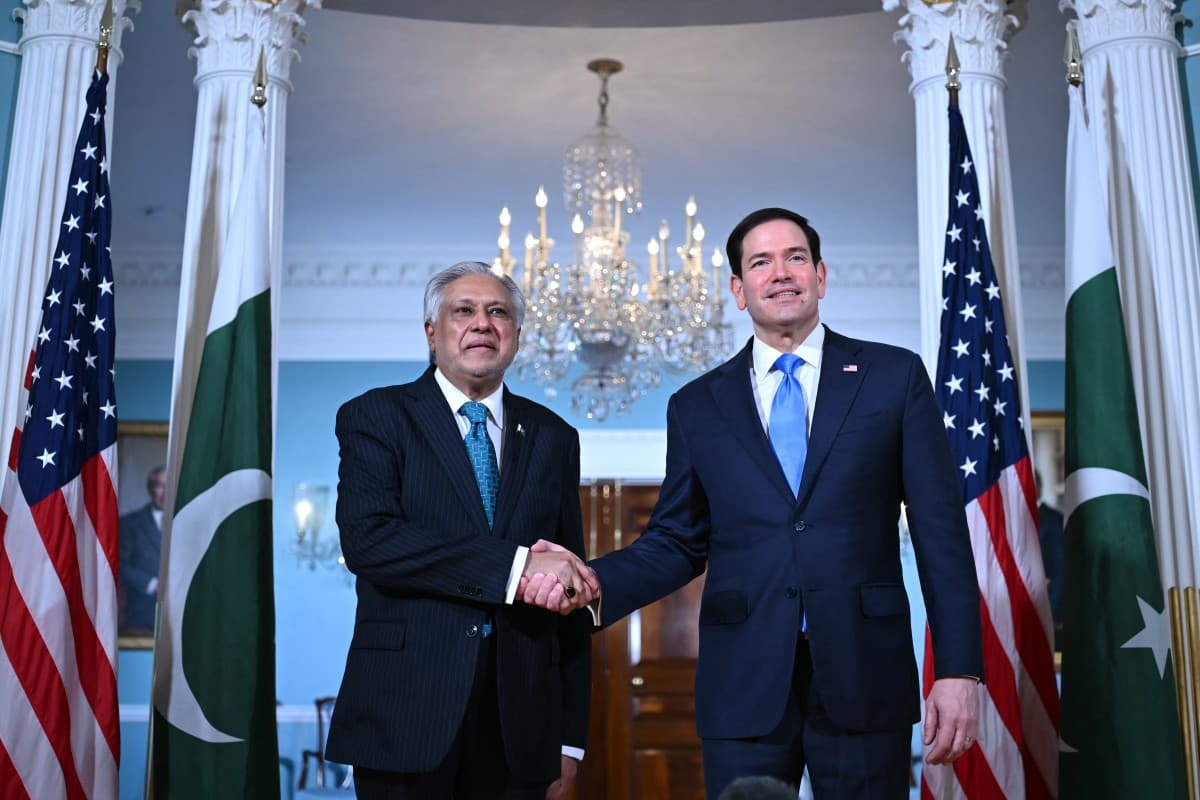
ISLAMABAD: US Secretary of State and National Security Advisor Marco Rubio acknowledged Pakistan’s diplomatic and mediation efforts in the Middle East during talks with Deputy Prime Minister and Foreign Minister Ishaq Dar on Friday, as the two sides agreed to deepen cooperation in trade, security, and counter-terrorism.
The meeting marked one of the highest-level engagements between Islamabad and Washington since Pakistan helped facilitate negotiations between the United States and Iran and came amid ongoing efforts to preserve the US-Iran ceasefire framework and advance a broader regional peace agreement.
According to Pakistan’s Foreign Office, Dar and Rubio welcomed the positive trajectory of Pakistan-US relations over the past year and discussed a wide range of bilateral, regional and global issues.
They agreed to upscale economic and trade relations, strengthen cultural cooperation and expand partnership in security and counter-terrorism domains.
During the meeting, Dar expressed admiration for President Donald Trump’s “vision and commitment to peace,” including his support for the US-Iran ceasefire and the dispatch of a high-level American delegation led by Vice President JD Vance to Pakistan for the Islamabad peace talks.
The Foreign Office said Rubio acknowledged Pakistan’s “diplomatic and mediatory efforts” and commended the close engagement and continued coordination between Pakistan’s leadership and the US administration.
Dar said Pakistan’s continued efforts for peace and stability, backed by friendly countries, would yield positive results.
In a statement released after the meeting, the US State Department said Rubio thanked Pakistan for the “constructive role” it continues to play in advancing President Trump’s vision for peace in the Middle East and for its mediation efforts with Iran.
The State Department also said Rubio expressed condolences for the victims of the recent Balochistan Liberation Army terrorist attack in Quetta.
Rubio later wrote on X that he had thanked Dar “for the role Pakistan continues to play in advancing peace in the Middle East” and that both sides agreed on the importance of strengthening “a meaningful partnership for better security and more prosperity for our two nations.”
The discussions also focused on regional security challenges.
According to the Foreign Office, Dar conveyed Pakistan’s concerns regarding the use of Afghan territory by terrorist groups carrying out attacks inside Pakistan and stressed the need for enhanced counter-terrorism cooperation.
The foreign minister also appreciated the role played by Trump and Rubio in helping de-escalate tensions between Pakistan and India last year and preventing a broader conflict between the two nuclear-armed neighbors.
Speaking to reporters after the meeting, Dar described his talks with Rubio as “a very comprehensive meeting,” covering bilateral relations, trade, investment, energy cooperation and regional developments.
He revealed that Pakistan had proposed reviving the Pakistan-US High-Level Strategic Dialogue, a framework that has remained dormant for nearly a decade, and said the proposal received a positive response.
Dar said Pakistan’s diplomatic engagement throughout the Middle East crisis had been driven by a desire to prevent further escalation, restore regional stability and minimize the humanitarian and economic consequences of the conflict.
He noted that disruptions to global energy supplies and maritime trade had affected economies worldwide and said Islamabad had maintained active contacts with Washington, Tehran, Beijing, Riyadh, Ankara and other capitals throughout the crisis.
The two sides agreed to continue working together to strengthen a Pakistan-US partnership anchored in high-level engagement and shared interests in regional peace, security and economic prosperity.