


ISLAMABAD: Australia has imposed its toughest visa restrictions on Indian applicants, citing what officials describe as systemic marriage fraud and industrial-scale forgery of academic qualifications originating in India.
The measures have slowed processing times, triggered manual financial checks and prompted universities to curb recruitment from several Indian states.
Australia’s Department of Home Affairs reclassified India to Evidence Level 3 on Jan. 8, the highest risk category for visa integrity. The change mandates manual verification of all financial documents and bank statements. Internal department material cited “emerging integrity issues” linked to fraudulent applications.
The crackdown follows years of documented abuse of Australia’s migration system by Indian-based syndicates, particularly through sham marriages and fake degrees used to secure student and partner visas.
Marriage fraud networks
Australian authorities say organized marriage fraud has been a persistent problem tied to Indian applicants. A 2018 Counter Fraud Centre report found the Australian Border Force refused 164 partner visa applications linked to marriage fraud syndicates. None of the applicants obtained permanent residency.
One case laid bare the mechanics of the scheme. Indian national Pradeep Singh testified in Brisbane Magistrates Court in 2014 that he paid migration agent Chetan Mohanlal Mashru $5,000 to arrange a marriage with Australian citizen Josie Haig. Singh said he met Haig for the first time at Mashru’s residence and paid her $1,000 a month for two years after securing a partner visa in mid-2011.
In a Nov. 15, 2018 warning, the Australian High Commission in New Delhi said it had identified “organized contrived marriage scams targeting South Asians” after the arrest of a 32-year-old Indian national described as the main facilitator of a Sydney-based syndicate. Four Australian citizens were charged in the case.
“Many of the women involved in these scams have suffered a history of substance abuse, family violence and financial hardship, and are lured in with promises of substantial payments,” Acting Investigations Commander Clinton Sims said in a government release.
Under Australia’s Migration Act, organizing or participating in such schemes carries penalties of up to $210,000 and 10 years’ imprisonment, authorities said.
Forged degrees and credential mills
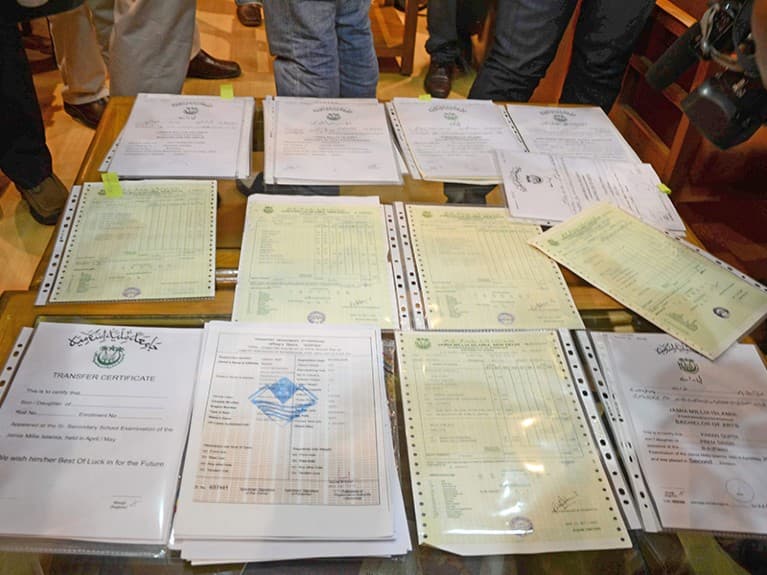
Australian lawmakers have also pointed to widespread academic fraud emanating from India. Senator Malcolm Roberts told Parliament that Indian police seized 100,000 forged educational certificates in January, calling the scale of fraud “industrial.”
In Senate questioning, Roberts said 23,000 foreign students were caught purchasing qualifications in 2024. Australia’s Skills Quality Authority later canceled credentials for more than 4,200 foreign students after deregistering SPS Education Pty Ltd for running what officials described as a “cash-for-diplomas” operation.
“In some cases, people were being awarded qualifications without doing any training or any study whatsoever. It was basically pay for a qualification and you got it,” Minister Murray Watt said during the hearing.
Indian law enforcement actions have reinforced Australian concerns. The Enforcement Directorate raided 16 locations across multiple Indian states linked to Monad University in January under anti-money-laundering laws. Investigators said only 5,000 of 41,000 degrees issued over 11 years were genuine, findings later cited in court proceedings that led to a fugitive economic offender declaration.
Indian police have made multiple arrests tied to fake credentials, including a former university lecturer accused of identity theft and fraud, and several operators running printing facilities used to manufacture forged certificates. Fees for counterfeit documents reportedly ranged from $600 to $2,400.
India’s own regulators have acknowledged the problem. The University Grants Commission has identified 21 fake universities operating without approval, noting that the Delhi region and Uttar Pradesh accounted for the highest numbers.
Impact on students and universities
As a result of the heightened scrutiny, visa processing times for Indian applicants are expected to stretch from about 14 days to four to eight weeks under the new verification regime.
Australian universities have moved to protect their compliance ratings. Internal directives at several institutions instructed recruitment agents to halt or limit applications from Indian states including Punjab, Haryana, Uttar Pradesh, Rajasthan and Gujarat, citing elevated fraud risk.
Australian officials say the restrictions are not aimed at legitimate applicants but reflect repeated failures by Indian authorities to curb fraud networks operating within their borders. For India, Australia’s actions amount to a public rebuke: a signal that systemic corruption in education and migration has begun to carry tangible international consequences.