


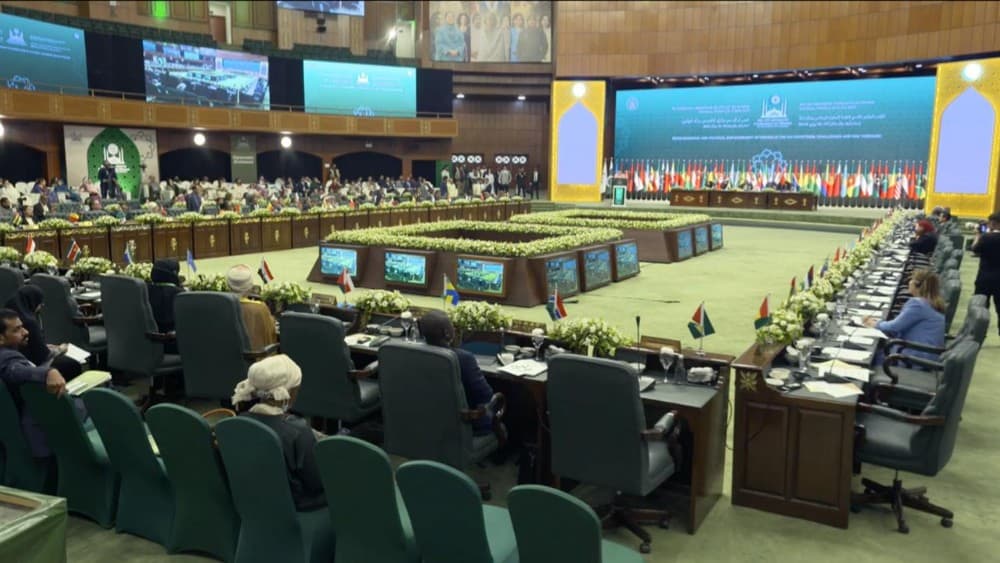
ISLAMABAD: Pakistan assumed the chairmanship of the Organization of Islamic Cooperation (OIC) Ministerial Conference on Women on Monday as ministers from across the Muslim world adopted the Islamabad Declaration and launched a new digital inclusion initiative, placing technology, economic participation and implementation at the center of the organization's women's empowerment agenda for the next two years.
The declaration, adopted at the conclusion of the ninth ministerial conference in Islamabad, reaffirmed member states' commitment to advancing the socio-economic and political empowerment of women and girls while introducing the Islamabad Initiative on Women's Digital Inclusion, a voluntary platform designed to expand digital literacy, entrepreneurship, artificial intelligence skills and equitable access to technology across OIC countries.
The two-day gathering brought together ministers, senior officials and representatives from the OIC's 57 member states, international organizations and development institutions to chart a common course for strengthening women's participation in public life, expanding economic opportunities and deepening cooperation across the Muslim world.
For Pakistan, a founding member of the OIC, the conference also marked the beginning of its two-year stewardship of the organization's ministerial platform on women, succeeding Egypt as chair.
The meeting reflected an emerging consensus among member states that empowering women through education, economic opportunity and digital inclusion would be essential to sustainable development across OIC countries. Throughout the conference, speakers repeatedly stressed that success would ultimately depend not on declarations alone but on translating commitments into practical action.
Islamabad Declaration
The Islamabad Declaration called on member states to strengthen policies and institutions to ensure women's meaningful participation in political, economic and public life while removing barriers to education, employment and leadership.
Delegates pledged to expand access to quality education, vocational training and leadership development programs, strengthen women's economic empowerment through employment, finance, entrepreneurship and social protection, and promote inclusive financial systems, including Islamic finance, microfinance and digital financial services.
Recognizing technology as a key driver of development, the declaration urged member states to increase women's participation in science, technology, engineering and mathematics (STEM), artificial intelligence and emerging technologies while narrowing the digital gender gap through affordable connectivity, digital literacy and improved access to digital devices, particularly in underserved communities.
The declaration also called for stronger action against violence targeting women and girls, including cyber harassment, online abuse and technology-facilitated exploitation, while urging greater cooperation to combat Islamophobia, xenophobia and discrimination affecting Muslim women.
Member states further expressed solidarity with the women and girls of Palestine and Indian Illegally Occupied Jammu and Kashmir (IIOJK), calling on the international community to provide legal, humanitarian, educational and psychosocial support.
Alongside the declaration, ministers adopted an omnibus resolution outlining a broader framework for cooperation on women's empowerment across OIC member states.
Digital inclusion emerges as defining theme
While education, health, entrepreneurship and political participation remained central to the conference, digital inclusion emerged as its defining policy priority.
The newly launched Islamabad Initiative on Women's Digital Inclusion seeks to promote digital literacy, digital entrepreneurship, STEM education, artificial intelligence skills, cybersecurity awareness and equitable access to digital technologies for women and girls throughout the OIC.
The initiative also encourages interested member states, OIC institutions and development partners to support training programs, scholarships, mentorship opportunities and the exchange of expertise to accelerate women's participation in the digital economy.
The emphasis on technology echoed throughout the conference.
Pakistan’s Information Technology Minister Shaza Fatima Khawaja argued that digital public infrastructure could transform legal rights into practical opportunities by expanding women's access to financial services, education, entrepreneurship and government services.
"Digital public infrastructure gives them direct financial control," she said, explaining that digital identity systems, interoperable payments and online public services could help women move "from invisible workers to documented economic actors."
At the same time, she cautioned that technology could also deepen inequality if access remained uneven.
"The question is not simply that technology is available; the question is: available to whom, controlled by whom, and designed by whom?" she said.
Calling for greater female participation in emerging technologies, Khawaja said, "Women cannot just be at the receiving end of technology."
"Women need to be at the building ground," she added, urging OIC countries to ensure women had "a seat on the table" as artificial intelligence, cybersecurity and digital governance evolve.
Highlighting Pakistan's own efforts, she said the country had developed a Digital Gender Inclusion Strategy with UNESCO, incubated more than 700 women-led startups through National Incubation Centers and expanded technology access through initiatives including the ICT for Girls program and the Prime Minister's Laptop Scheme.
Khawaja also cited government efforts to expand digital financial inclusion, saying more than 800,000 women opened digital wallets during Ramadan under a government-supported payments initiative, followed by another 900,000 women this year.
Pakistan pledges implementation-focused leadership
As Pakistan assumed the chairmanship, conference leaders repeatedly emphasized implementation rather than rhetoric.
Deputy Prime Minister and Foreign Minister Muhammad Ishaq Dar described women's empowerment as "among the smartest investments any nation could make."
"Empowering women is not about simply advancing one segment of society but it is about strengthening the very foundation upon which every nation is built. When we invest in a woman, we invest in generations," he said during a cultural reception on the eve of the ministerial session.
Dar urged OIC member states to move beyond commitments.
"OIC has already laid a strong foundation for the advancement of women," he said. "Our responsibility now is to transform commitments into measurable progress."
Presiding over the ministerial session, Pakistan’s Law Minister Azam Nazeer Tarar echoed that message, saying Pakistan would lead the conference "with respect, fairness and openness."
"The true success of this conference will not be measured solely by the declarations we adopt but by the progress we achieve together after we return home," Tarar said.
He also highlighted the importance of ensuring that Muslim women not only participate in the digital economy but help shape its future.
"Our challenge is not whether technology will shape the future; it is whether that future will be inclusive," he said.
"The next generation of Muslim women must not merely participate in the digital economy; they must help lead it."
From policy commitments to lives transformed
Punjab Chief Minister Maryam Nawaz Sharif used her keynote address to argue that women's empowerment should ultimately be judged by its impact on people's lives rather than by policy announcements alone.
Standing before delegates as "a proud daughter of Pakistan," she described the history of women in the Muslim world as "a story of strength, resilience, courage, perseverance and leadership."
Reflecting on her own political journey, Maryam said adversity had reinforced her belief that leadership often emerged through perseverance.
"Empowerment is often created by circumstances," she said.
She paid tribute to Fatima Jinnah, Begum Kulsoom Nawaz and Benazir Bhutto, saying each generation of women carries the responsibility of making the path easier for those who follow.
Highlighting Pakistan's milestones in women's leadership, she noted that the country elected the Muslim world's first woman prime minister and pointed to the growing presence of women in politics, the judiciary and public institutions.
For Maryam, however, empowerment extended beyond representation.
"Women empowerment is not a ceremonial expression; it is the distance between a right written on paper and a life changed on ground."
She said women should not simply benefit from development but help shape it "as professionals and leaders alongside men as equal partners."
Using examples from Punjab's development agenda, she highlighted initiatives aimed at expanding women's access to education, entrepreneurship, housing, technology, digital skills, financial inclusion, public safety and social protection.
Among them were the Honhaar Scholarship Program, under which women account for 60% of beneficiaries, the Prime Minister's Laptop Scheme, Apni Chat Apna Ghar, Apna Khet Apna Rozgar, Asaan Karobar Finance, IT and freelancing programs for rural women, livestock support initiatives, and technology-enabled public safety measures, including virtual women police stations and the Women Safety App.
"If circumstances can empower one woman," she told delegates, "opportunity can empower millions."
Pakistan showcases women's achievements
Beyond the ministerial sessions, Pakistan used the conference to showcase the contributions of its women through presentations highlighting achievements across politics, public service, science, technology, education, aviation, sports and the arts.
Organizers traced the country's journey from the leadership of Fatima Jinnah during Pakistan's independence movement to Benazir Bhutto, the first woman elected prime minister of a Muslim-majority country, while also highlighting the accomplishments of Malala Yousafzai and Pakistani women serving as judges, entrepreneurs, scientists, engineers, fighter pilots, mountaineers and technology innovators.
The presentations framed those achievements as evidence of expanding opportunities while acknowledging that barriers to education, leadership and economic participation continue to confront women across parts of the Muslim world.
Diplomacy on the conference sidelines
Alongside the ministerial proceedings, Pakistan used the conference to deepen bilateral engagement with OIC member states and affiliated institutions.
Tarar held meetings with ministers and senior officials from Türkiye, Iran, Saudi Arabia, Egypt, Bosnia and Herzegovina, Syria, Somalia and Yemen, as well as representatives of the Women Development Organization (WDO) and the OIC Labour Centre.
According to Pakistan's Ministry of Human Rights, the discussions focused on women's rights, family welfare, social protection, economic empowerment, institutional cooperation and expanding collaboration under the OIC framework.
Pakistan and Türkiye signed a memorandum of understanding to strengthen cooperation in family affairs, social services and social protection while agreeing to expand collaboration on protecting women and children, strengthening family institutions and developing joint policy initiatives.
During talks with Iran's Vice President for Women and Family Affairs Dr Zahra Behrouz Azar, the two sides discussed women's rights and regional cooperation. According to Pakistani officials, Dr Azar thanked Pakistan for its diplomatic efforts supporting the regional ceasefire and welcomed Islamabad's assumption of the OIC chairmanship.
In separate meetings, Saudi Arabia's Family Affairs Council Secretary General Dr. Maimouna Al Khalil, WDO Executive Director Sarah Ali Al-Shura, and Azerbaijan's Jalila Allahverdiyeva discussed expanding institutional cooperation, capacity-building and the exchange of expertise to advance women's development.
International delegates call for stronger cooperation
Speaking to Pakistan TV Digital on the sidelines of the conference in Islamabad, participating delegates broadly welcomed the meeting's focus on translating commitments into action through stronger cooperation and digital inclusion.
Dr Maimouna Al Khalil, Secretary General of Saudi Arabia's Family Affairs Council, described the conference as a reflection of the OIC's continued commitment to women's empowerment.
While highlighting Saudi Arabia's own progress, she said member states had made significant advances but more work remained to strengthen women's economic and social participation.
Imaan Sulaiman-Ibrahim, Nigeria's Minister of Women Affairs and Social Development, said the gathering came at an important time as Nigeria expanded legal reforms and national programs to advance women's socio-economic empowerment. She also praised Pakistan's hospitality and reaffirmed Nigeria's commitment to strengthening cooperation across the OIC.
Hind Kabawat, Syria's Minister for Social Affairs and Labour, said Syria's participation marked the return of Syrian women to an international conference after many years. She described digital transformation and women's affairs as priorities for her ministry and expressed hope that the conference would generate new ideas and practical cooperation.
Dr Hanna Nakhleh, adviser to the Palestinian Minister of Women's Affairs, welcomed Pakistan's assumption of the OIC chairmanship and called for translating the conference's commitments into tangible improvements.
"We want to translate the speeches and the ministerial declaration into actions on the ground," he said.
Jacqueline Babazi, Uganda's Minister of State for Gender, Labour and Social Affairs, said she hoped the conference would expand women's participation in the workforce and decision-making while expressing admiration for the progress made by Pakistani women.
"I see vibrancy in the women here. I see a lot of hope in the women in Pakistan," she said.
Oguzhan Hasipoğlu, Minister for Labour and Social Security of the Turkish Republic of Northern Cyprus, described women as "a priority" and stressed that their participation in social, economic and political life was essential.
He also highlighted the close ties between Pakistan and Northern Cyprus, noting the contribution of thousands of Pakistanis living and working there.
Isatou Jobe, Secretary at The Gambia's Ministry of Gender, Children and Social Welfare, said the conference reflected Pakistan's leadership within the Muslim world and praised its efforts to advance women's empowerment.
Mariyam Raya Ahmed, representing the Maldives delegation, said the conference underscored the importance of cooperation among Islamic countries to advance women's development and gender equality, expressing confidence that it would strengthen regional collaboration.
Dr. Alhagi Manta Drammeh, Director of Planning and International Cooperation at the International Islamic Fiqh Academy, described the gathering as a timely platform to promote women's empowerment while addressing misconceptions about women's role in Islam.
Tunisia's Chargé d'Affaires Dorsaf Maaroufi said Pakistan's history offered inspiring examples of women's leadership, citing Fatima Jinnah and Malala Yousafzai among those who had contributed not only to Pakistan's development but also to broader humanitarian progress.
From declarations to delivery
Closing the conference, OIC Assistant Secretary-General Ambassador Dr Tarig Ali Bakheet described the adoption of the Islamabad Declaration and the omnibus resolution as important milestones for advancing women's empowerment across OIC member states.
He congratulated Pakistan on assuming the conference chairmanship and expressed confidence that Islamabad would effectively guide implementation of the conference's decisions over the next two years.
Bakheet also reaffirmed the OIC General Secretariat's commitment to working closely with Pakistan, the Women Development Organization and member states to translate the conference's commitments into practical outcomes.