


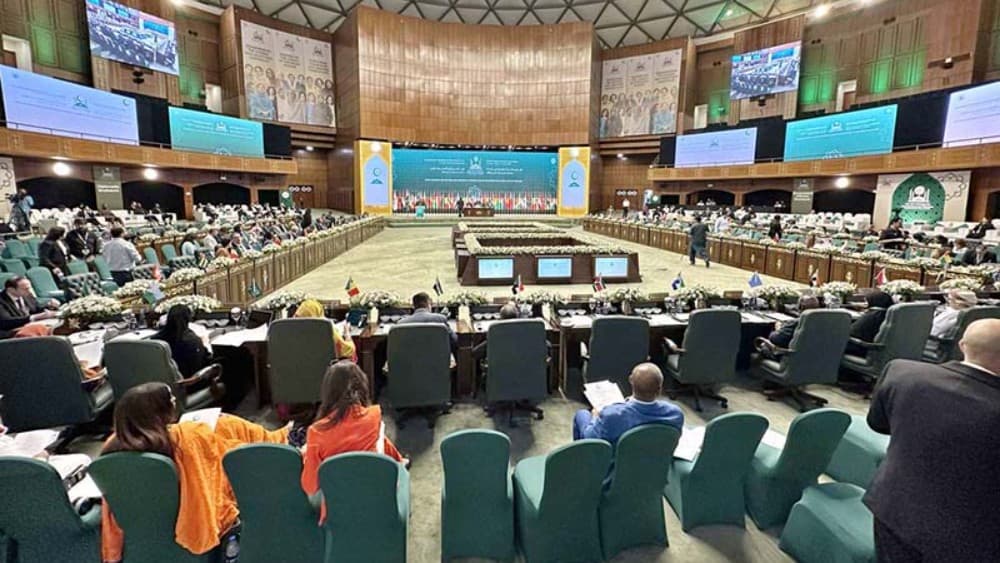
ISLAMABAD: Pakistan assumed the two-year chairmanship of the Organization of Islamic Cooperation (OIC) Ministerial Conference on Women on Monday as ministers from across the Muslim world gather in Islamabad to adopt the Islamabad Declaration and chart a common agenda for advancing women's development and empowerment.
Assuming the chairmanship, Federal Minister for Law, Justice and Human Rights Senator Azam Nazeer Tarar said Pakistan regarded the chairmanship as a responsibility to help transform shared aspirations into practical action that improves the lives of women across the Islamic world.
The minister said that Islamabad would promote "exchange of experiences, encourage practical cooperation and advance the shared commitment to the empowerment of women."
He said that empowerment of women for Pakistan was a national priority, inspired by faith and essential to the country's future, adding that Pakistan continued to strengthen its legal, policy and institutional framework to advance the rights, opportunities and leadership of women.
Minister Tarar said Islamabad was expanding women's leadership, financial inclusion and entrepreneurship, bridging the digital divide, strengthening access to justice and creating safer and more inclusive work places, adding that the collective effort was to ensure that no women or girl was left behind because of conflict, poverty and inequality.
Technical sessions lay groundwork
The conference, organized by the human rights ministry, began with technical sessions on Sunday during which delegates approved the agenda and reviewed implementation of the OIC Plan of Action for the Advancement of Women (OPAAW).
Participants discussed a wide range of issues affecting women across OIC member states, including education, healthcare, economic opportunities, financial inclusion, women's participation in decision-making, and greater representation in science, technology and digital sectors.
The technical meetings also reviewed progress made since the previous ministerial conference, with member states examining initiatives undertaken under the OIC framework to advance women's development.
Pakistan calls for translating commitments into action
Speaking at a cultural evening hosted for delegates ahead of the ministerial session on Sunday, Deputy Prime Minister and Foreign Minister Muhammad Ishaq Dar said the conference reflected the collective determination of OIC member states to build societies where women could contribute fully to national development.
"Empowering women is not about simply advancing one segment of society but it is about strengthening the very foundation upon which every nation is built. When we invest in a woman, we invest in generations," Dar said.
He said Pakistan was investing in girls' education, entrepreneurship, digital literacy and inclusion because it believed empowering women was "among the smartest investments any nation could make."
Highlighting the role of Islamic teachings, Dar said, "Our Prophet Muhammad (PBUH) upheld the dignity of women through both his teachings and examples. He affirmed the women's rights to education, property, inheritance, enterprise and participation in society."
Calling for greater implementation of existing commitments, he said, "OIC has already laid a strong foundation for the advancement of women. Our responsibility now is to transform commitments into measurable progress."
Dar also reiterated Pakistan's support for Palestinian women, particularly those in Gaza, called attention to the situation of women in Indian Illegally Occupied Jammu and Kashmir, and urged Afghanistan's interim authorities to restore the rights of Afghan women and girls to education, employment and meaningful participation in national life.
Bilateral diplomacy
Separately, on the sidelines of the conference yesterday, Federal Minister Tarar held a series of bilateral meetings with ministers and senior officials from Iran, Türkiye, Saudi Arabia, Egypt, Bosnia and Herzegovina, Syria, Somalia and Yemen, as well as representatives of the Women Development Organization (WDO), the OIC Labour Centre and Azerbaijan.
According to official statements, the meetings focused on women's rights, strengthening family institutions, social protection, women's economic and political empowerment, institutional cooperation and expanding collaboration through the OIC framework.
Pakistan and Türkiye signed a memorandum of understanding to strengthen cooperation in family affairs, social services and social protection. The two sides also agreed to enhance collaboration on protecting family values in the digital space, promoting the rights of women and children, and advancing joint policy initiatives.
During his meeting with Iran's Vice President for Women and Family Affairs Dr. Zahra Behrouz Azar, both sides agreed to strengthen cooperation on women's rights and raise the issues facing women in Palestine and Afghanistan through the OIC platform. Dr. Behrouz Azar also thanked Pakistan for its diplomatic efforts in support of the regional ceasefire and welcomed Pakistan's upcoming OIC chairmanship.
In talks with Saudi Arabia's Family Affairs Council Secretary General Dr. Maimoonah Al Khalil, the two sides discussed women's rights, family welfare and social development. Tarar said Islam granted women rights to education, inheritance, entrepreneurship and participation in society, adding that Pakistan was the first country in the Muslim world to elect a woman prime minister.
The law minister also met WDO Executive Director Counsellor Sarah Ali Al-Shura and Azerbaijan's Head of Administrative Division Jalila Allahverdiyeva, with both meetings focusing on strengthening institutional cooperation, capacity-building and the exchange of expertise to advance women's empowerment across OIC member states.