


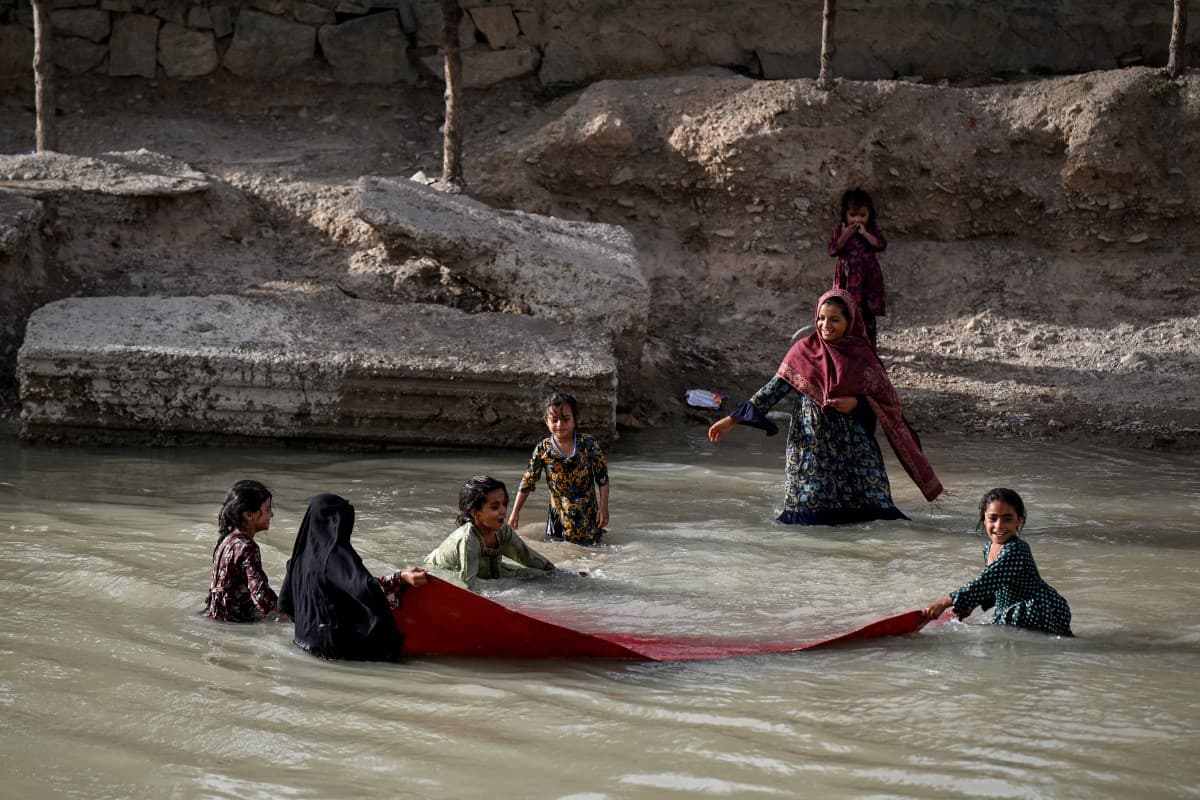
ISLAMABAD: More than three of four children in Afghanistan are exposed to drought, with more than half confronting longer and more frequent heatwaves, according to UNICEF's Children’s Climate Risk Report 2026.
The report, released on Tuesday, found that drought is among the most widespread climate hazards affecting children globally, with around 1.8 billion children, more than three-quarters of the world’s child population, exposed to agricultural or meteorological droughts.
"Almost all children are now exposed to at least one" climate hazard, including droughts, floods, heatwaves, and tropical storms, the report said.
According to UNICEF, 8.8 million out of 21 million children living in Afghanistan (41%) and over 1 billion children worldwide are exposed to at least three overlapping climate hazards. These include floods, droughts, heatwaves, extreme heat, sand and dust storms.
Almost all children, some 2.3 billion, are exposed to at least one risk; 2 billion are exposed to at least two, while 364 million face at least four.
Lasting effects
UNICEF warned that droughts can devastate harvests, disrupt livelihoods, and worsen malnutrition, with children bearing a disproportionate share of the burden because "their developing bodies make it harder for them to cope with the physical and psychological stresses."
"Droughts cause food and nutritional insecurity," the report said, with Dr Tajudeen Oyewale, UNICEF Representative in Afghanistan, adding that “children in Afghanistan are already living on the frontlines of the climate crisis.”
“What makes this especially dangerous is that climate hazards are overlapping with high child vulnerability. Strengthening climate-resilient health, nutrition, WASH, education, child protection, as well as social protection systems and services is critical to protect children today and safeguard their future," Oyewale said.
Unprepared public services
The report analyzes children's exposure to risks and the quality of six public services that determine a child's ability to adapt to or recover from a climate shock. These include health, nutrition, water and sanitation, education, child protection, and social protection.
UNICEF said climate hazards are increasingly straining health, education, water, and sanitation systems, particularly in low-income and fragile countries.
For millions of children, the climate crisis is not experienced as a single event but as "a complex and dangerous cascade of multiple, overlapping hazards," UNICEF said.
"This compounding of threats overwhelms the capacity of unprepared social services and undermines the resilience of families and communities."
UNICEF estimates that without urgent intervention, climate change could cause an additional 28 million children to suffer acute wasting and 40 million to be stunted globally by 2050. Between 2016 and 2023, climate hazards caused 62.1 million internal displacements of children worldwide, the equivalent of more than 21,000 per day.
In 2024, 634 million children globally lacked access to drinking water, 1 billion lacked safely managed sanitation, and 489 million lacked basic hygiene.
"The impact on children's physical and mental health and wellbeing and their access to education and protection is huge, yet barely quantified," the report said.
Call to action
UNICEF called on governments and international partners to strengthen climate adaptation measures, invest in resilient social services and place children at the center of climate policies and disaster preparedness efforts.
"Upholding every child's right to a clean, healthy and sustainable environment requires urgent, coordinated and child-responsive climate policies, action and investment," the report concluded.
It urged governments to prioritize the "urgent phasing-out of fossil fuels and a just transition towards renewable energy and energy efficiency in line with 1.5°C pathways, ensuring the best interests of the child are a primary consideration."