
Pakistan proposes $66.6 billion budget with tax relief and growth measures

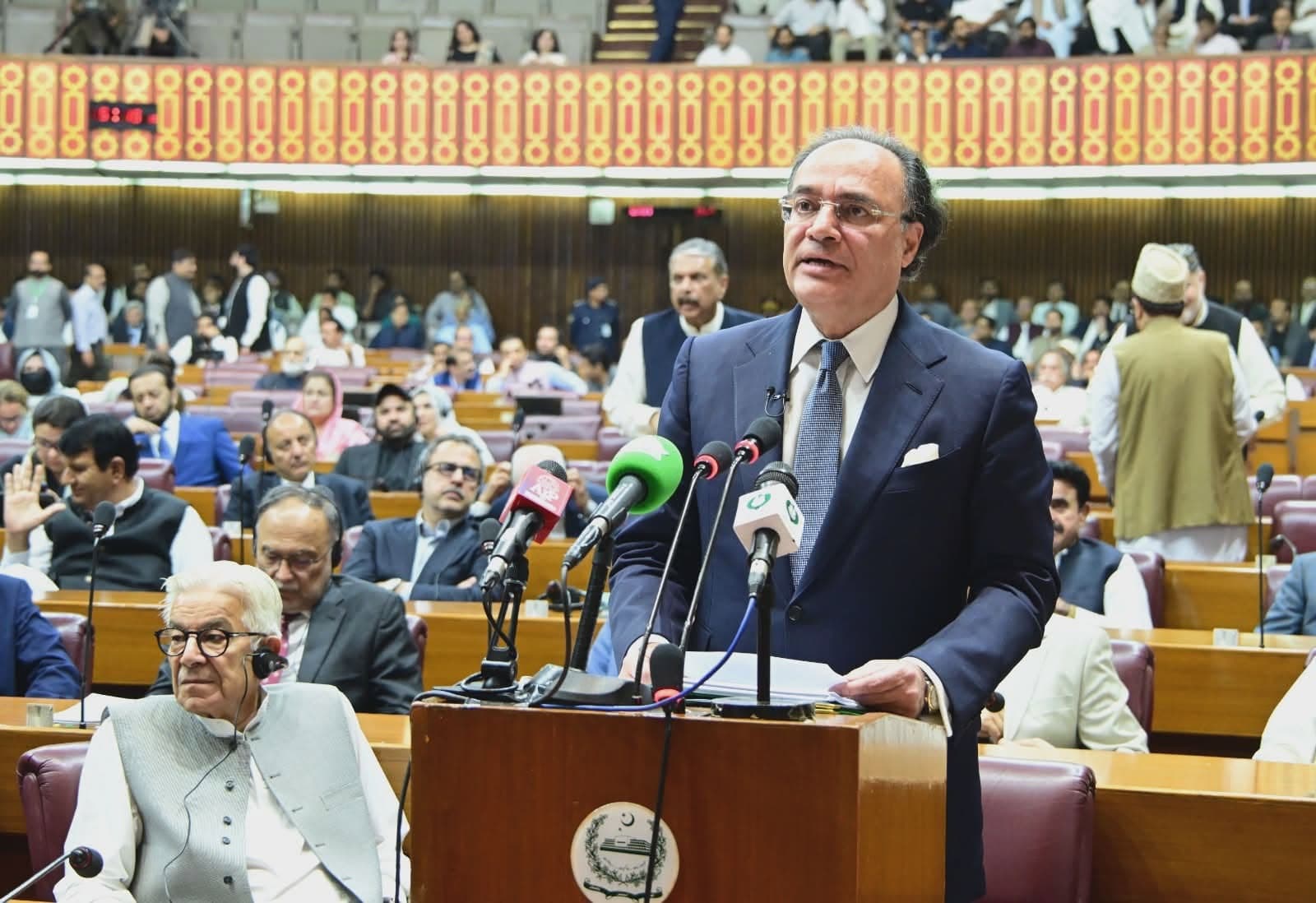
Pakistan Finance Minister Muhammad Aurangzeb delivering the Budget Speech during the Budget Session 2026–27 of the National Assembly. (Source: Pakistan National Assembly/Facebook)
ISLAMABAD: Pakistan on Friday presented a proposed Rs18.7 trillion ($66.6 billion) federal budget for fiscal year 2026-27, combining tax relief measures, higher public-sector salaries and pensions, development spending and investment incentives as the government seeks to sustain economic recovery and accelerate growth.
The budget was approved by the federal cabinet during a meeting at Parliament House in Islamabad before being presented in the National Assembly by Finance Minister Muhammad Aurangzeb. The fiscal plan marks Aurangzeb's third federal budget since taking office.
Budget at a glance
* Total budget outlay: Rs18.7 trillion ($66.6 billion)
* FBR tax collection target: Rs15.264 trillion
* Defense allocation: Rs3 trillion
* Debt servicing and mark-up payments: Rs8.054 trillion
* Federal Public Sector Development Program (PSDP): Rs1 trillion
* Federal employees' salary increase: 7%
* Pension increase: 7%
* Minimum wage increase: 10%
* Tax relief for salaried taxpayers
* Super tax abolished for exporters
* Advance and minimum tax on exporters reduced from 2% to 1.25%
* IT and freelancing tax rate maintained at 0.25%
* Withholding tax on international online card payments reduced from 5% to 0.5%
* Capital Value Tax on overseas Pakistanis' property transactions abolished
* Sales tax removed on shipping sector
* Sales tax removed on sanitary products and contraceptives
Prime Minister Shehbaz Sharif signed the budget documents following cabinet approval and said the financial plan had been prepared with the welfare of the Pakistani people as its foremost objective.
"By the grace of Allah, this budget has been prepared with great hard work and sincerity, with the welfare of Pakistan's people as its top priority," Sharif said in a post on X.
The budget comes a day after the release of the Pakistan Economic Survey 2025-26, which reported economic growth of 3.7% during the outgoing fiscal year, with the economy reaching a record size of $452.1 billion.
The survey highlighted improvements in manufacturing, remittances, foreign exchange reserves and public finances as the government seeks to transition from economic stabilization to sustained growth.
The government says the proposed budget is designed to provide relief to households, support businesses, encourage investment and maintain macroeconomic stability while advancing reforms aimed at strengthening long-term growth.
Presenting the budget, Aurangzeb said Pakistan had remained resilient despite global trade uncertainty, floods and regional tensions.
"Pakistan entered the crisis of the US-Iran war with a stable economy and strong economic buffers," he told parliament.
The finance minister said Pakistan avoided fuel shortages, rationing and major currency volatility during the conflict due to timely government decisions and economic management.
"There were no queues at petrol stations, no law and order issues, and the exchange rate remained stable," he said.
Relief for salaried taxpayers, workers and pensioners
Among the most significant measures announced were tax cuts for salaried individuals across several income brackets and the abolition of a 10% surcharge previously imposed on higher-income earners.
The government reduced tax rates for individuals earning between Rs2.2 million and Rs7 million annually and introduced new tax slabs aimed at easing the burden on middle- and upper-middle-income taxpayers.
Federal government employees will receive a proposed 7% increase in salaries, while pensions for retired government personnel will also increase by 7%.
The government further announced a proposed 10% increase in the minimum wage in a move aimed at providing relief to lower-income workers amid cost-of-living pressures.
Incentives for exports, investment and the digital economy
The budget introduces a series of measures designed to encourage investment and support key sectors of the economy.
For exporters, the government reduced the combined advance and minimum tax rate from 2% to 1.25%.
While the budget initially proposed partial relief on super tax, the government later announced that, on the instructions of Prime Minister Shehbaz Sharif, super tax would be abolished for all exporters.
Officials described the move as one of the most significant relief measures in the budget and said it was intended to support industrial activity, improve competitiveness and encourage export growth.
The government also retained the concessional 0.25% income tax rate for the IT and freelancing sector and reduced withholding tax on international online payments made through credit and debit cards from 5% to 0.5%, a move aimed at lowering transaction costs and supporting the digital economy.
In the property sector, taxes on property purchases and sales have been reduced across multiple categories, while the government abolished the 1% Capital Value Tax on property transactions by overseas Pakistanis.
Support for industry and public welfare
The government announced the removal of the 18% sales tax on the shipping sector as well as on the upgradation of brownfield refineries and related imports.
In measures aimed at supporting public health and reducing consumer costs, taxes on tampons, sanitary pads, condoms and contraceptive products have also been proposed for removal.
Officials say the measures are intended to lower business costs, encourage investment, strengthen logistics and support broader economic activity.
Defense, development and revenue targets
The proposed budget sets a Federal Board of Revenue (FBR) tax collection target of Rs15.264 trillion for the upcoming fiscal year.
The government has earmarked Rs8.054 trillion for debt servicing and mark-up payments, Rs3 trillion for defense and Rs1 trillion for the Federal Public Sector Development Program (PSDP).
Aurangzeb said Pakistan's recent economic and security achievements had strengthened international confidence in the country.
Referring to Operation Bunyan Um Marsoos, he said several countries were in contact with Pakistan regarding fighter aircraft used by the Pakistan Air Force and described the defense industry as an emerging source of foreign exchange earnings.
"Our defense industry has also become a source of valuable foreign exchange earnings," he said.
"This demonstrates that a strong defense is not only essential for our security but can also contribute significantly to the country's economic development."
'Budget of relief'
In a statement issued after the budget presentation, Prime Minister Shehbaz Sharif said the government had fulfilled its commitment to extending the benefits of economic stability to ordinary citizens.
"I promised the people that once economic stability was achieved, its benefits would directly reach the common man. By the grace of Allah, the time of prosperity has now begun," he said.
Sharif described the fiscal plan as a "budget of relief" and a "budget of public welfare," saying it was designed to reduce the burden on salaried taxpayers, support exports, promote industrial and agricultural growth, encourage investment and accelerate economic development.
"The fundamental objective of this budget is to ensure that the benefits of a stronger economy directly reach the people and that every segment of society shares in the country's progress," he said.
The prime minister said measures ranging from tax relief and support for the housing sector to job creation initiatives for young people and incentives for businesses reflected the government's broader effort to strengthen economic opportunity and improve living standards.
Sharif also thanked Deputy Prime Minister Ishaq Dar, Finance Minister Muhammad Aurangzeb, Field Marshal Syed Asim Munir, the chief ministers of all four provinces and members of the government's economic team for their contributions to the budget process.
What happens next?
The proposed budget will now be debated in the National Assembly, where lawmakers will discuss spending priorities, taxation measures and allocations before voting on the Finance Bill and related budgetary proposals.
Any amendments approved by parliament will be incorporated before the budget takes effect at the start of the new fiscal year on July 1.
Government officials say the budget seeks to maintain fiscal discipline while supporting investment, exports, industrial growth and social protection as Pakistan pursues its next phase of economic development.
Additional reporting and editing by Muhammad Ibrahim; writing by Muhammad Imad Abbas, Maryam Shah and Aleena Zara Malik.
Latest News
West Indies beat Pakistan by 90 runs in first Test
AN HOUR AGO

Kuwaiti FM lands in Islamabad on official visit FM at Dar’s invitation
3 HOURS AGO
.jpg&w=3840&q=75)
‘Political dividend for Modi govt’: Prof. Jake Lynch on Indian media’s Pakistan obsession
3 HOURS AGO
.jpg&w=3840&q=75)
Zelensky hails 'good' Trump talks on Patriot air defenses
5 HOURS AGO
.jpg&w=3840&q=75)
No official source spoke to foreign media on Gulf situation: Intelligence sources to Pakistan TV Digital
4 HOURS AGO
.jpg&w=3840&q=75)