


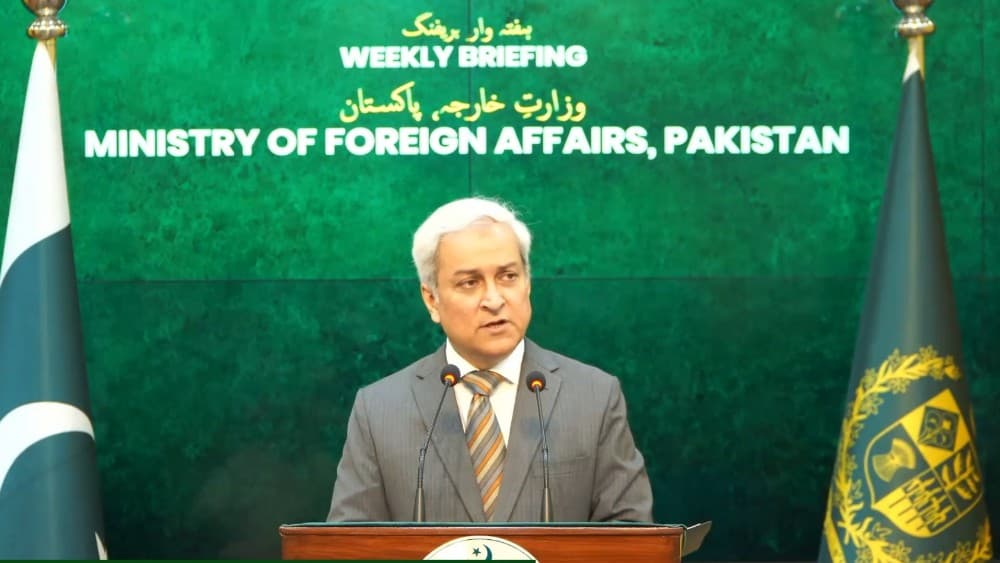
ISLAMABAD: The Ministry of Foreign Affairs on Thursday said Pakistan will continue its diplomatic push to end the US-Iran conflict, with Chief of Army Staff and Chief of Defense Forces Field Marshal Asim Munir’s recent visit to Tehran aimed at breaking the military stalemate, advancing a negotiated settlement and helping reopen the strategic Strait of Hormuz.
At the weekly press briefing in Islamabad, Foreign Office spokesperson Tahir Andrabi said Pakistan had remained engaged with "brotherly countries" in efforts to resolve the crisis in the Middle East and the Gulf, including the US-Iran standoff.
Andrabi said CDF Munir visited Tehran on Aug 24 as part of Pakistan’s ongoing diplomatic efforts to end the conflict and reopen the Strait of Hormuz.
He said that discussions during the visit focused on "regional de-escalation, breaking the military stalemate, and exploring a negotiated settlement" to restore regional peace and stability.
The visit, he added, underscored Islamabad’s "sincere and constructive role" in bridging differences between Washington and Tehran. The statement said that the Iranian leadership appreciated Pakistan’s efforts toward de-escalation and a peaceful resolution of the conflict.
The spokesperson also rejected reports suggesting that Munir had travelled to Iran as an envoy of US President Donald Trump or Washington.
"Claims by certain quarters that the Chief of Army Staff and the Chief of Defense Forces visited Iran as envoy of President Trump or the US are misleading and factually incorrect," Andrabi said, adding that the visit was undertaken "purely in the context and backdrop of Pakistan’s ongoing role as a mediator".
Regional outreach
Andrabi said Deputy Prime Minister and Foreign Minister Ishaq Dar had also remained engaged with his counterparts in the region as part of Pakistan’s diplomatic efforts.
According to the weekly briefing, Dar spoke three times with Turkish foreign minister Hakan Fidan on Aug 17, 19 and 25, with discussions focused on the importance of dialogue and diplomacy for regional peace and stability.
He also spoke with Egyptian foreign minister Badr Abdelatty on Aug 14 and Kuwaiti Foreign Minister Sheikh Jarrah Jaber Al-Sabah on Aug 24, with the latter discussion covering regional developments, dialogue and diplomacy and the implementation of the Islamabad Memorandum of Understanding.
"Pakistan will continue to actively pursue diplomatic engagement and support all sincere efforts aimed at reviving the peace talks," Andrabi said, calling for a "comprehensive, just, and lasting resolution" of the conflict.
SCO chairmanship
Separately, the Foreign Office said Pakistan was set to assume the chairmanship of the Shanghai Cooperation Organization for a one-year term following the SCO Council of Heads of State summit in Bishkek from Aug 31 to Sept 1.
Prime Minister Shehbaz Sharif will visit Bishkek to participate in the summit and hold bilateral meetings with the Kyrgyz leadership, Andrabi said.
The hallmark of Pakistan’s SCO chairmanship will be the SCO summit to be hosted by Islamabad in 2027, he added.
Maritime security
During his London visit, Dar also met International Maritime Organization Secretary-General Arsenio Dominguez and sought "urgent and effective institutional intervention" for the safe release of 10 Pakistani seafarers aboard MTV Honour.
The seafarers are being held captive by Somali pirates, with Dar calling for an early return of all 10 Pakistanis.
Discussions also covered Pakistan-IMO cooperation on maritime security, regulatory reforms and the blue economy.
Statements on Gaza, Syria
Andrabi said Pakistan had joined other Arab and Islamic countries in statements concerning Gaza, Syria and Israeli settlement activity.
Pakistan was among eight Islamic countries that condemned Israel’s rejection of a US-backed comprehensive peace plan for Gaza and Palestinian statehood, calling for an end to the war and progress towards a two-state solution based on the 1967 borders.
Pakistan also joined 10 other Islamic countries in condemning Israeli strikes in Syria, describing them as violations of Syrian sovereignty and territorial integrity.
The Foreign Office said Pakistan had joined eight other countries in rejecting Israel’s E1 settlement plan, warning that settlement expansion threatened Palestinian territorial contiguity and statehood.