


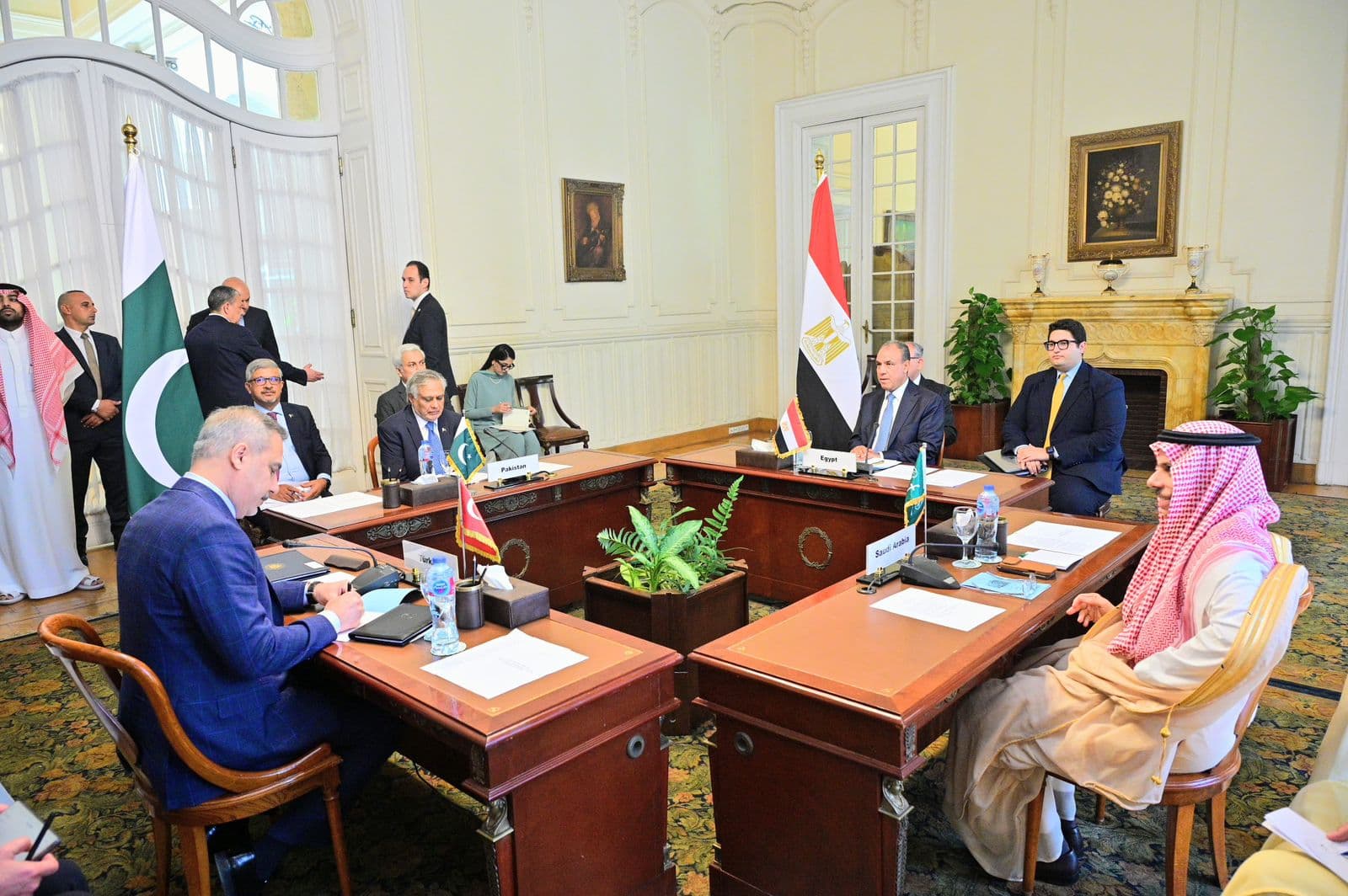
ISLAMABAD: Foreign ministers from Pakistan, Saudi Arabia, Türkiye and Egypt on Sunday welcomed progress under the Islamabad Memorandum of Understanding and called for continued diplomacy to advance the next phase of negotiations between the United States and Iran.
Pakistan's Deputy Prime Minister and Foreign Minister Ishaq Dar participated in the fourth meeting of the Regional Four (R-4) grouping in Cairo, where ministers reviewed progress on the Islamabad MoU, exchanged views on regional and international developments, and reaffirmed their commitment to dialogue, diplomacy and collective efforts aimed at promoting peace, security, stability and prosperity across the Middle East and beyond.
The meeting came as high-level talks on implementing the Islamabad Memorandum of Understanding got underway in Bürgenstock, Switzerland, bringing together delegations from the United States, Iran, Pakistan and Qatar.
The discussions mark the first formal engagement since the signing of the agreement and are aimed at advancing understandings reached under its implementation framework.
The R-4 mechanism emerged as a key platform for regional coordination during the crisis.
The grouping first convened in Riyadh before holding subsequent ministerial meetings in Islamabad and Antalya, where member states coordinated diplomatic efforts aimed at reducing tensions and encouraging dialogue.
Sunday's gathering in Cairo marked the fourth consultative meeting of the forum.
According to a joint statement issued at the conclusion of the meeting, the ministers viewed the Islamabad Memorandum of Understanding as "a constructive step towards de-escalation" and toward ending a conflict that posed significant risks to regional security and stability, as well as to energy markets, international maritime routes, global supply chains and international trade.
"The Ministers lauded the instrumental efforts of the Islamic Republic of Pakistan in reaching this historic outcome, along with the support extended by the State of Qatar to bring about a successful conclusion to the negotiations on the MoU," the joint statement said.
Building on what they described as positive momentum, the ministers emphasized the importance of achieving "a swift and successful conclusion to the subsequent phase of negotiations" aimed at reaching a lasting, verifiable and mutually acceptable solution to the remaining issues.
The statement added that future efforts should take into account the concerns of countries across the region, particularly with regard to the security and stability of the Gulf Arab states and the Levant.
Egyptian president accepts PM Sharif’s invitation
During his visit, Dar joined his counterparts from Egypt, Saudi Arabia and Türkiye in a joint call on Egyptian President Abdel Fattah El-Sisi.
According to Pakistan's Foreign Office, Dar conveyed the greetings and best wishes of Pakistan's president, prime minister and chief of defense forces, while reaffirming Islamabad's commitment to strengthening its longstanding relations with Egypt.
The foreign minister also welcomed President El-Sisi's acceptance of Prime Minister Shehbaz Sharif's invitation to visit Pakistan at the earliest convenient date, the statement said.
Pakistan, Egypt review bilateral relations
On the sidelines of the meeting, Dar held bilateral talks with Egyptian Foreign Minister Badr Abdelatty.
The two sides reviewed Pakistan-Egypt relations and discussed ways to expand cooperation in trade, investment, education, culture and people-to-people exchanges.
According to the Foreign Office, both ministers expressed satisfaction with the positive trajectory of bilateral ties and agreed to reactivate existing bilateral mechanisms to deepen cooperation across multiple sectors.
The ministers also exchanged views on regional and international developments, reaffirming their commitment to close coordination and consultations at bilateral and multilateral levels while emphasizing the importance of promoting peace, stability and sustainable development.
Support for Palestine
The R-4 ministers additionally reiterated support for the Palestinian cause and backed the establishment of an independent Palestinian state based on the June 4, 1967 lines, with East Jerusalem as its capital, in accordance with relevant United Nations Security Council resolutions.